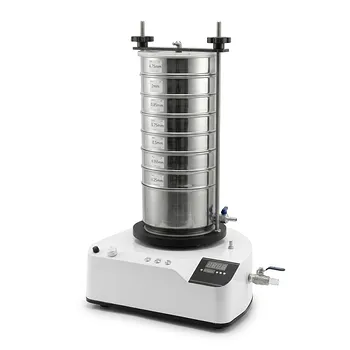
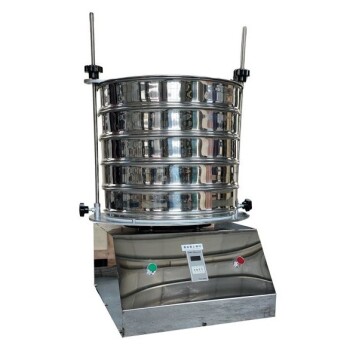
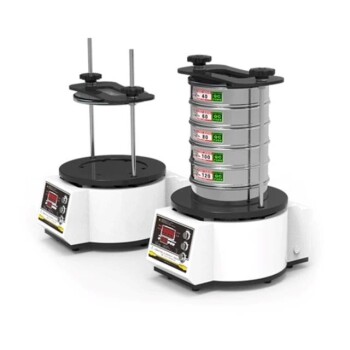
The primary function of a sieving system during Hyper-cross-linked Polystyrene (HPS) pretreatment is to standardize the particle size distribution of the catalyst support. By utilizing precision mesh screens, often targeting specific sizes such as 60 micrometers, the system physically separates the bulk powder. This process strictly removes both oversized particles and excessively fine dust to create a batch with uniform external dimensions.
Core Takeaway: Sieving is not merely a cleaning step; it is a critical calibration of your catalyst’s physical properties. By ensuring a uniform particle size, you stabilize stirring kinetics within high-pressure reactors and eliminate diffusion limitations, guaranteeing that your experimental results are both accurate and repeatable.
The Mechanics of Size Control
Eliminating Physical Outliers
The raw synthesis of HPS powders rarely yields a perfect, uniform batch. The sieving system acts as a physical gatekeeper.
It filters out oversized particles that may hinder proper mixing or settling. Simultaneously, it removes fine powders that can cause clogging or inconsistent reaction rates.
Establishing Uniform Dimensions
The goal is to achieve a consistent "external dimension" for every particle entering the reactor.
When using HPS as a catalyst support, this geometric uniformity is essential. It ensures that every unit of catalyst behaves predictably under similar physical conditions.
Why Uniformity Drives Performance
Stabilizing Stirring Kinetics
In high-pressure reactors, the physical movement of the catalyst is just as important as its chemical properties.
Uniform particles respond consistently to agitation. This allows for stable stirring kinetics, ensuring the catalyst remains evenly suspended and distributed throughout the reaction medium.
Preventing Diffusion Limitations
Variations in particle size create variations in how reactants access the catalyst.
Large particles may suffer from mass transfer issues, where reactants cannot reach the active sites deep inside the support. Sieving mitigates these diffusion limitations, allowing for a homogeneous reaction rate across the entire batch.
Risks of Neglecting Particle Sizing
Compromised Repeatability
Without sieving, two experiments using the same "recipe" can yield vastly different results simply because the particle distribution shifted.
The sieving process locks in variables. It ensures that changes in your results are due to chemical parameters, not random fluctuations in particle size.
Kinetic Instability
An uneven mix of fines and large chunks creates chaotic hydrodynamics inside the reactor.
This instability makes it difficult to model the reaction accurately or scale the process up, as the physical behavior of the powder becomes unpredictable.
Ensuring Experimental Success
To maximize the reliability of your HPS-based catalysis, align your sieving strategy with your specific experimental goals.
- If your primary focus is Experimental Repeatability: strictly adhere to a specific mesh size (e.g., 60 micrometers) to remove physical variables between batches.
- If your primary focus is Reaction Efficiency: prioritize the removal of oversized particles to eliminate diffusion barriers and ensure maximum active site accessibility.
Consistently sieving HPS powders transforms a variable raw material into a reliable, engineering-grade catalyst support.
Summary Table:
| Feature | Impact on HPS Pretreatment | Benefit to Research |
|---|---|---|
| Particle Uniformity | Removes oversized outliers and fine dust | Ensures predictable behavior in reactors |
| Stirring Kinetics | Stabilizes physical movement of catalyst | Maintains even suspension and distribution |
| Mass Transfer | Mitigates diffusion limitations | Homogeneous reaction rates across the batch |
| Data Integrity | Locks in physical variables | Guarantees experimental repeatability |
Elevate Your Catalyst Performance with KINTEK
Precision in particle sizing is the foundation of repeatable research. KINTEK specializes in high-performance laboratory equipment designed to transform your raw materials into engineering-grade catalyst supports.
Whether you are refining Hyper-cross-linked Polystyrene (HPS) or conducting complex syntheses, our comprehensive range of sieving equipment, crushing and milling systems, and high-pressure reactors provides the control you need. From ensuring kinetic stability in our high-temperature high-pressure autoclaves to achieving perfect material preparation with our hydraulic presses, we empower scientists to eliminate variables and focus on results.
Ready to optimize your lab’s workflow? Contact our technical experts today to discover how KINTEK’s precision tools can enhance your experimental accuracy.
References
- Oleg V. Manaenkov, Lioubov Kiwi‐Minsker. An Overview of Heterogeneous Catalysts Based on Hypercrosslinked Polystyrene for the Synthesis and Transformation of Platform Chemicals Derived from Biomass. DOI: 10.3390/molecules28248126
This article is also based on technical information from Kintek Solution Knowledge Base .
Related Products
- Three-dimensional electromagnetic sieving instrument
- Laboratory Vibratory Sieve Shaker Machine for Dry and Wet Three-Dimensional Sieving
- Laboratory Test Sieves and Sieving Machines
- Laboratory Wet Three-Dimensional Vibratory Sieve Shaker Machine
- Vibratory Sieve Shaker Machine Dry Three-Dimensional Vibrating Sieve
People Also Ask
- Why is sieving equipment essential for the classification of processed bio-activated carbon? Optimize Performance
- What are the limitations of sieving? Understanding the Constraints of Particle Size Analysis
- What are advantages and disadvantages of sieving method? A Guide to Reliable & Cost-Effective Particle Sizing
- How is sieving important? The Critical Role of Particle Size Analysis in Quality Control
- What is sieving and how does it work? A Guide to Accurate Particle Size Analysis