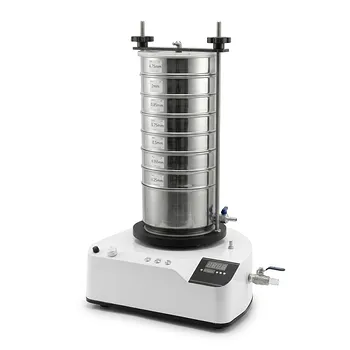
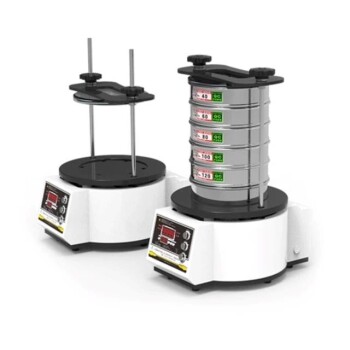
Precision vibratory sieving is the critical control step for ensuring data integrity in alloy analysis. It functions to isolate Platinum-Palladium (Pt/Pd) alloy powder particles into an extremely narrow size distribution. This mechanical separation is a prerequisite for creating uniform pressed samples and achieving the high resolution necessary for advanced characterization techniques.
Core Takeaway Reliable structural analysis requires the elimination of variables that distort measurement data. By removing oversized and undersized particles, precision sieving ensures that subsequent X-ray diffraction (XRD) readings reflect the true lattice constants and phase composition of the alloy, rather than artifacts caused by inconsistent particle geometry.
The Role of Particle Consistency in Analysis
Optimization for X-Ray Diffraction (XRD)
The primary driver for using precision sieving is to refine the accuracy of X-ray diffraction (XRD).
Inconsistent particle sizes can introduce noise and broaden diffraction peaks. By restricting the powder to a specific size fraction, researchers can obtain sharper data regarding the lattice constants and phase composition.
Ensuring Uniformity in Pressed Samples
Structural analysis often requires the powder to be compressed into pellets using a laboratory hydraulic press.
A narrow particle size distribution ensures uniform internal density and reduces porosity within these samples. This physical homogeneity provides a standardized basis for measurements, ensuring that variations in data result from chemical changes, not packing defects.
Correlating Size with Microstructure
Isolating Cooling Rate Effects
In gas-atomized powders, the particle diameter is often directly linked to its cooling rate during formation.
Smaller particles cool significantly faster than larger ones. By separating fractions (e.g., <20 µm vs. 106 µm), researchers can quantitatively analyze how varying cooling rates influence phase selection and microstructural morphology in the Pt/Pd alloy.
Validating Mechanical Processing
Sieving serves as a quality control checkpoint for upstream processes like ball milling.
It provides quantitative data on the particle size distribution, confirming whether the powder has reached the target average size. This step prevents the waste of expensive Pt/Pd materials on defective samples that do not meet the criteria for optimal pressing quality.
Understanding the Trade-offs
Process Time vs. Yield
Achieving a "narrow" distribution inevitably means discarding a percentage of the bulk material.
For high-value materials like Platinum and Palladium, rejecting the "tails" of the distribution (the very coarse and very fine particles) represents a cost-yield trade-off that must be balanced against the need for analytical precision.
Screen Blinding and Maintenance
As the target particle size decreases (into the micron range), the risk of mesh blockage increases.
Precision sieving requires rigorous maintenance and cleaning protocols to prevent cross-contamination or "blinding" (clogging) of the aperture, which would skew the size distribution data and compromise the structural analysis.
Making the Right Choice for Your Goal
To maximize the value of your structural analysis, apply the sieving process based on your specific experimental objectives:
- If your primary focus is Crystallographic Accuracy: Prioritize the removal of all fines and agglomerates to ensure the sharpest possible peaks during XRD analysis.
- If your primary focus is Process Optimization: Use sieving to isolate specific size fractions to map the correlation between cooling rates and the resulting phase composition.
- If your primary focus is Sample Reproducibility: Target a median particle size that maximizes packing density to ensure uniform electrical or thermal conductivity measurements.
Consistency in the physical sample is the only path to certainty in chemical analysis.
Summary Table:
| Analytical Benefit | Impact on Pt/Pd Alloy Characterization |
|---|---|
| XRD Resolution | Sharper peaks; accurate lattice constants and phase composition. |
| Sample Homogeneity | Uniform pellet density; reduced porosity and packing defects. |
| Microstructure Study | Isolates cooling rate effects; enables size-to-phase correlation. |
| Process Validation | Verifies milling efficiency; prevents waste of high-value powders. |
Maximize Your Analytical Precision with KINTEK
High-value Platinum-Palladium research demands the highest level of consistency. At KINTEK, we specialize in the high-performance laboratory equipment required to achieve these results. From precision vibratory sieving systems that ensure narrow particle distribution to hydraulic presses for uniform pellet preparation, our tools are engineered for accuracy.
Whether you are refining powder metallurgy or conducting advanced XRD analysis, our comprehensive range—including high-temperature furnaces, ball milling systems, and ceramic consumables—provides the reliability your lab needs. Contact us today to discuss how our solutions can enhance your material characterization and process yield.
References
- L Botha, Elizaveta Ivanovna Plastinina. Ab Initio Study of Structural, Electronic, and Thermal Properties of Pt/Pd-Based Alloys. DOI: 10.3390/condmat8030076
This article is also based on technical information from Kintek Solution Knowledge Base .
Related Products
- Laboratory Vibratory Sieve Shaker Machine for Dry and Wet Three-Dimensional Sieving
- Vibratory Sieve Shaker Machine Dry Three-Dimensional Vibrating Sieve
- Laboratory Test Sieves and Vibratory Sieve Shaker Machine
- Laboratory Wet Three-Dimensional Vibratory Sieve Shaker Machine
- Laboratory Vibratory Sieve Shaker Machine Slap Vibrating Sieve
People Also Ask
- How does a laboratory vibratory sieve shaker facilitate the microstructural study of gas-atomized alloy powders?
- What role does a laboratory vibrating sieve shaker play in the LiFePO4 powder processing workflow? Ensure Batch Quality
- Why use a vibratory sieve shaker for PET powder? Achieve Precise Particle Size Control for Chemical Research
- What is the principle of vibratory sieve shaker? Achieve Accurate Particle Size Analysis
- What is the function of a vibratory sieve shaker? Achieve Precise Particle Size Analysis