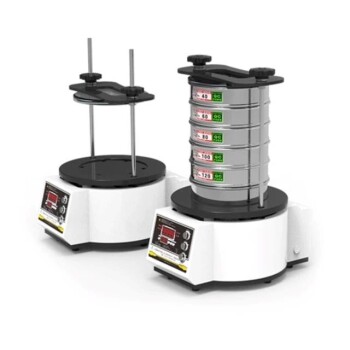
Precision in particle size determines coating performance. A laboratory sieving system with standard apertures is required to strictly regulate the particle size distribution of bentonite before it is introduced into a coating formulation. By filtering out non-uniform or oversized particles, this process ensures the material is fully compatible with the polyurethane matrix, directly preventing surface defects and structural weaknesses in the dried coating.
Core Insight: Without strict particle size control, bentonite cannot integrate smoothly into a polyurethane matrix. Standardized sieving is the critical step that eliminates oversized particles to guarantee a smooth surface finish and maintain the physical integrity of the cured coating.
The Critical Role of Particle Size Control
Achieving Uniform Distribution
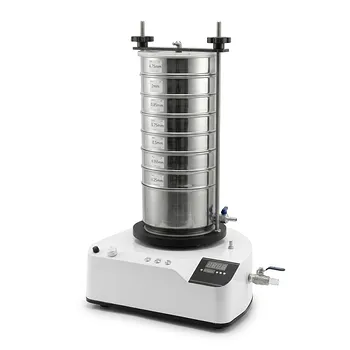
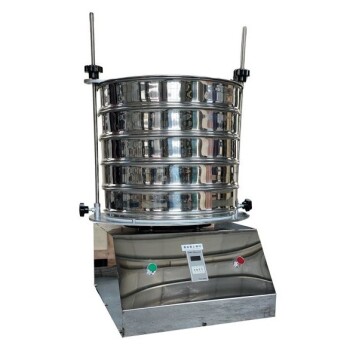
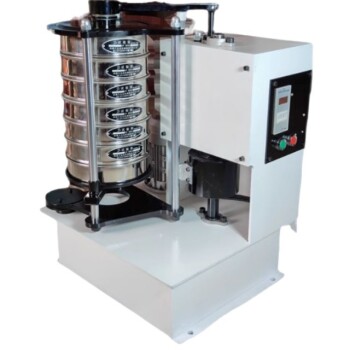
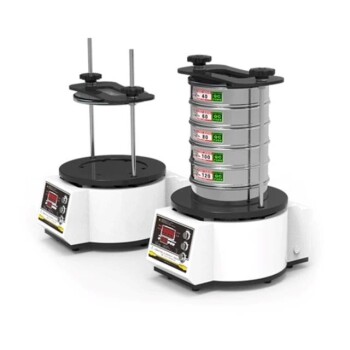
In coating applications, consistency is paramount. A laboratory sieving system uses standard apertures to create a defined threshold for particle size.
This ensures that every batch of bentonite used meets specific geometric criteria. By strictly controlling this distribution, manufacturers can predict how the material will behave during the mixing process.
Eliminating Oversized Particles
Raw bentonite often contains aggregates or particles that exceed the desired size range.
The primary function of the sieving system is to mechanically separate and remove these oversized or non-uniform particles. If left in the mixture, these larger particles disrupt the homogeneity of the formulation.
Integration with Polyurethane Matrices
Ensuring Optimal Compatibility
Bentonite is frequently used as a filler or additive within a polyurethane matrix.
For the coating to function correctly, the bentonite must disperse evenly throughout this matrix. Sieving ensures that the particles are small enough to be fully wetted and encapsulated by the polyurethane, ensuring optimal chemical and physical compatibility.
Maintaining Physical Performance
The presence of non-uniform particles can act as stress concentrators within the dried coating.
By removing these irregularities, the sieving process preserves the physical performance of the final product. This ensures the coating retains its expected durability, flexibility, and adhesion properties after drying.
The Risks of Inadequate Screening
Surface Irregularities
If the sieving process is bypassed or performed with non-standard apertures, oversized particles will remain in the suspension.
Upon drying, these particles often protrude from the film or cause uneven drying rates. This leads to visible surface irregularities, ruining the aesthetic finish and potential protective qualities of the coating.
Structural Weakness
Beyond aesthetics, poor screening compromises the structural integrity of the coating.
Large particles can interrupt the continuous film formation of the polyurethane. This discontinuity can lead to a significant decrease in physical performance, making the coating more susceptible to cracking or peeling under stress.
Ensuring Quality in Coating Formulation
To maximize the effectiveness of bentonite in your polyurethane coatings, apply these principles:
- If your primary focus is Surface Aesthetics: Prioritize standard aperture sieving to eliminate the oversized particles that cause visible bumps and texture defects.
- If your primary focus is Durability: rigorous screening to ensure the filler integrates fully with the matrix, preventing weak points in the cured film.
Precision at the sieving stage is the invisible foundation of a flawless coating application.
Summary Table:
| Feature | Impact on Coating Quality | Importance Level |
|---|---|---|
| Standard Apertures | Ensures precise particle size distribution and batch consistency | Critical |
| Oversized Removal | Eliminates surface protrusions and visible texture defects | High |
| Matrix Compatibility | Facilitates even dispersion within the polyurethane matrix | Essential |
| Structural Integrity | Prevents stress concentrators to ensure durability and adhesion | High |
Elevate Your Coating Precision with KINTEK
Don't let oversized particles compromise your product's integrity. KINTEK specializes in high-performance laboratory sieving equipment and crushing and milling systems designed to ensure your bentonite and fillers meet the strictest standards. Our comprehensive range of laboratory solutions—from sieving equipment to high-temperature furnaces and hydraulic presses—empowers researchers to achieve superior material consistency and flawless results.
Ready to optimize your lab's performance? Contact KINTEK today to discover how our precision tools can enhance your formulation process.
References
- Teuku Rihayat, Tezara Cionita. Investigation of Polyurethane Primer Coating Paint Based on Local Palm Oil with Antimicrobial and Anticorrotion Agent Formula Bentonite-Chitosan. DOI: 10.61972/cetics.v1i2.15
This article is also based on technical information from Kintek Solution Knowledge Base .
Related Products
- Laboratory Vibratory Sieve Shaker Machine for Dry and Wet Three-Dimensional Sieving
- Laboratory Test Sieves and Sieving Machines
- Laboratory Vibratory Sieve Shaker Machine Slap Vibrating Sieve
- Laboratory Wet Three-Dimensional Vibratory Sieve Shaker Machine
- Laboratory Test Sieves and Vibratory Sieve Shaker Machine
People Also Ask
- How does a laboratory vibratory sieve shaker facilitate the microstructural study of gas-atomized alloy powders?
- What role does a laboratory vibrating sieve shaker play in the LiFePO4 powder processing workflow? Ensure Batch Quality
- Why use a vibratory sieve shaker for PET powder? Achieve Precise Particle Size Control for Chemical Research
- What is the principle of vibratory sieve shaker? Achieve Accurate Particle Size Analysis
- What is the function of a vibratory sieve shaker? Achieve Precise Particle Size Analysis