The primary function of a magnetic stirrer during the co-precipitation of Ni-Ag catalyst precursors is to ensure the rigorous, homogeneous mixing of nickel and silver salt solutions at the moment the precipitating agent (sodium hydroxide) is introduced. This mechanical agitation prevents localized concentration gradients, ensuring that the reaction environment remains uniform throughout the vessel.
Core Takeaway By maintaining strict uniformity within the reaction system, the magnetic stirrer facilitates molecular-level contact between metal ions. This agitation is the prerequisite for establishing optimal interfacial contact between the resulting NiO and Ag phases in the final catalyst structure.
The Mechanics of Homogeneity
Achieving Molecular Contact
The stirrer does more than simply blend fluids; it forces interaction at the molecular scale.
By keeping the solution in constant motion, the device ensures that nickel and silver ions are brought into close physical proximity. This prevents the isolation of specific ions and ensures the co-precipitation occurs simultaneously across the entire volume of the solution.
Managing the Precipitating Agent
When sodium hydroxide (NaOH) is added, the local pH changes instantly.
Without a high-precision stirrer, the NaOH would create localized zones of high alkalinity, causing uneven precipitation. The stirrer disperses the precipitating agent immediately, maintaining a consistent chemical environment for all precursors involved.
Impact on Catalyst Structure
Defining the NiO-Ag Interface
The ultimate goal of this specific co-precipitation process is the formation of distinct Nickel Oxide (NiO) and Silver (Ag) structures.
The mixing provided by the stirrer dictates the quality of the interface between these two phases. Uniform agitation ensures that the phases grow in close contact with one another, rather than separating into large, distinct clumps that lack interaction.
Establishing the Synthesis Foundation
The stirring phase is the foundational step for the entire catalyst synthesis.
Just as in other complex composite syntheses, a consistent concentration foundation is required for uniform nucleation. The magnetic stirrer ensures that the physical arrangement of ions in the liquid phase translates correctly into the solid structure of the final catalyst.
Understanding the Trade-offs
The Risk of Inconsistency
While agitation is critical, the "high-precision" aspect mentioned in the reference is vital.
Inconsistent stirring speeds or stalling can lead to batch variability. If the stirring is not constant, the precipitating agent will react unevenly, resulting in a catalyst with unpredictable performance characteristics.
Mechanical Limitations
It is important to note that magnetic stirring relies on the free movement of the stir bar.
As the precipitate creates a slurry, viscosity may change. If the stirrer lacks the torque to maintain speed during the formation of solids, the homogeneity of the mixture may be compromised exactly when it is needed most.
Optimizing Your Co-Precipitation Setup
To ensure high-quality Ni-Ag catalyst precursors, align your stirring strategy with your specific synthesis goals:
- If your primary focus is Batch Reproducibility: Utilize a high-precision stirrer that maintains a constant RPM regardless of viscosity changes to ensure every batch precipitates under identical conditions.
- If your primary focus is Maximal Interfacial Contact: Ensure the stirrer is active at a high speed before adding the sodium hydroxide to guarantee immediate dispersion and intimate molecular mixing.
The magnetic stirrer is not merely a mixing tool; it is the architect of the catalyst's final microstructural integrity.
Summary Table:
| Feature | Function in Co-precipitation | Impact on Catalyst |
|---|---|---|
| Homogeneous Mixing | Prevents localized concentration gradients | Ensures uniform nucleation and phase growth |
| NaOH Dispersion | Maintains consistent pH across the vessel | Prevents uneven precipitation and batch variability |
| Molecular Contact | Forces Ni and Ag ions into close proximity | Establishes the critical NiO-Ag interfacial contact |
| Agitation Control | Maintains constant RPM during viscosity changes | Guarantees microstructural integrity and reproducibility |
Elevate Your Catalyst Synthesis with KINTEK
Precision is the foundation of high-performance materials. Whether you are performing co-precipitation for Ni-Ag catalysts or complex battery research, KINTEK provides the high-precision tools necessary for repeatable success. From advanced magnetic stirrers and homogenizers to specialized high-temperature reactors and electrolytic cells, our equipment is designed to meet the rigorous demands of modern laboratory environments.
Our value to you:
- Unmatched Uniformity: High-torque solutions that maintain speed even as slurry viscosity changes.
- Comprehensive Range: A full portfolio including muffle furnaces, crushing systems, and hydraulic presses for every stage of your research.
- Technical Expertise: Supporting labs with durable PTFE consumables, ceramics, and crucibles.
Don't let mechanical inconsistencies compromise your results. Contact KINTEK today to optimize your lab setup!
References
- Hayat Henni, Axel Löfberg. Ni-Ag Catalysts for Hydrogen Production through Dry Reforming of Methane: Characterization and Performance Evaluation. DOI: 10.3390/catal14070400
This article is also based on technical information from Kintek Solution Knowledge Base .
Related Products
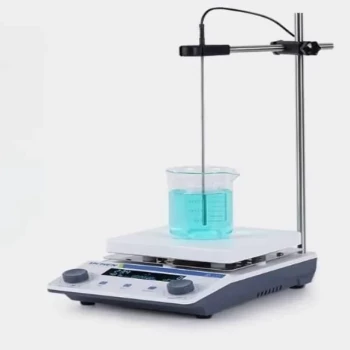
- Laboratory Small Constant Temperature Heated Magnetic Stirrer Heater and Stirrer
- Custom PTFE Teflon Parts Manufacturer for Magnetic Stirring Bar
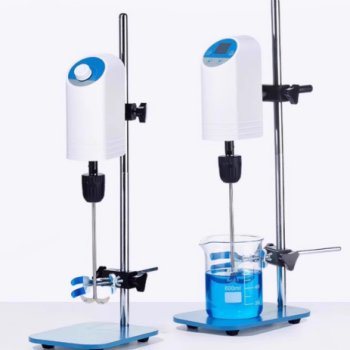
- High Performance Laboratory Stirrers for Diverse Applications
- Three-dimensional electromagnetic sieving instrument
- Custom PTFE Teflon Parts Manufacturer for PTFE Stirring Bar Recovery Rod
People Also Ask
- What role does a magnetic stirrer with heating play in ZnO nanoparticle synthesis? Precision Control for Quality Results
- What role does a constant temperature heating magnetic stirrer play in MFC-HAp synthesis? Achieve Material Homogeneity
- What is the function of a laboratory magnetic stirrer in Ni–Cr–P electrodeposition? Optimize Ion Transport & Coating
- Why is a laboratory magnetic stirrer required for benzoic acid esters? Boost Reaction Speed & Yield with High RPM
- What role does a laboratory magnetic stirrer play in TiO2 and TiO2-Ag sol preparation? Master Chemical Kinetics