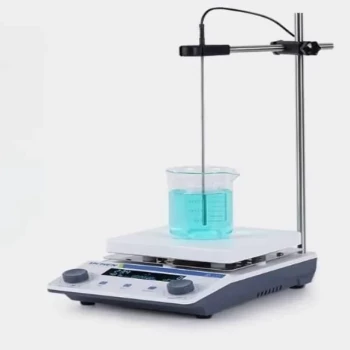
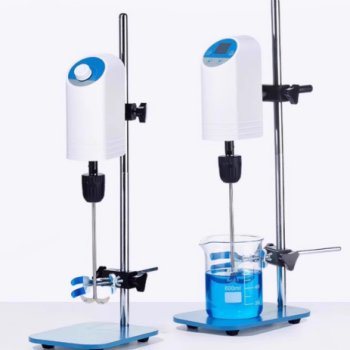
Magnetic stirrers and oscillation devices serve as the kinetic drivers in the Supported Liquid Membrane (SLM) silver separation process. Their primary function is to maintain a constant rotation speed that induces active convection within both the feed and receiving phases of the liquid. This mechanical agitation is essential for moving silver ions from the bulk solution to the membrane interface where separation occurs.
By inducing convection, these devices significantly reduce the thickness of the liquid-side diffusion layer. This minimizes mass transfer resistance and directly accelerates the migration rate of silver ions through the membrane system.
The Mechanics of Mass Transfer Enhancement
Inducing Active Convection
The fundamental role of these devices is to prevent the liquid phases from remaining stagnant.
By maintaining a constant rotation speed, the devices force the fluid to circulate continuously. This circulation, known as convection, ensures that fresh solution containing silver ions is constantly brought into contact with the membrane.
Reducing the Diffusion Layer
At the microscopic level, a stagnant layer of liquid naturally forms along the surface of the membrane.
This boundary, called the liquid-side diffusion layer, acts as a barrier to transport. The convection generated by the stirrers physically "scrubs" this layer, significantly reducing its thickness.
Lowering Resistance
A thinner diffusion layer creates a shorter path for ions to travel.
This reduction in thickness lowers the mass transfer resistance at the membrane interface. With less resistance impeding the process, the chemical potential gradient drives the separation more efficiently.
Critical Process Dynamics
The Link to Migration Rates
The speed of the physical device is directly linked to the chemical efficiency of the process.
The reference establishes a clear causality: increased convection leads to a higher migration rate of silver ions. Without this mechanical input, the separation process would be limited by slow, passive diffusion.
Maintaining Consistency
The devices do not just mix; they provide control.
By setting a constant rotation speed, operators ensure that the hydrodynamic conditions remain stable. This stability is crucial for maintaining predictable extraction rates throughout the entire separation cycle.
Optimizing Your Separation Process
To achieve the best results in silver recovery, you must view the stirring mechanism as a critical variable rather than a passive accessory.
- If your primary focus is maximizing speed: Prioritize sufficient rotation to induce strong convection, as this directly thins the diffusion layer and boosts the silver migration rate.
- If your primary focus is process consistency: Ensure your equipment maintains a strictly constant rotation speed to stabilize mass transfer resistance and prevent fluctuations in recovery.
Effective SLM separation relies as much on proper fluid dynamics as it does on chemical chemistry.
Summary Table:
| Feature | Function in SLM Silver Separation | Impact on Process Efficiency |
|---|---|---|
| Mechanical Agitation | Induces active convection in feed/receiving phases | Prevents stagnant liquid phases |
| Hydrodynamics | Scrubs the liquid-side diffusion layer | Minimizes boundary layer thickness |
| Kinetic Control | Maintains constant rotation speed | Ensures stable and predictable extraction |
| Mass Transfer | Reduces interfacial resistance | Accelerates silver ion migration rates |
Maximize Your Recovery Efficiency with KINTEK Precision
Are you looking to optimize your Supported Liquid Membrane (SLM) processes or silver recovery rates? KINTEK specializes in providing high-performance laboratory equipment designed for the most demanding research and separation workflows.
Our extensive portfolio includes precision magnetic stirrers and oscillation devices, alongside essential tools for advanced materials research such as high-temperature furnaces (CVD, PECVD, vacuum), crushing and milling systems, and high-pressure reactors. From electrolytic cells and electrodes to homogenizers and shakers, we provide the durability and control needed to eliminate mass transfer resistance and stabilize your kinetic variables.
Take control of your fluid dynamics today. Contact our specialists at KINTEK to discover how our high-quality consumables and equipment can enhance your lab's productivity and research accuracy.
References
- Yeti Kurniasih, Baiq Asma Nufida. The Effect of Type and Concentration of Receiving Phase on Silver Separation Efficiency by Supported Liquid Membrane Technique. DOI: 10.58258/jime.v10i1.6504
This article is also based on technical information from Kintek Solution Knowledge Base .
Related Products
- Laboratory Small Constant Temperature Heated Magnetic Stirrer Heater and Stirrer
- Custom PTFE Teflon Parts Manufacturer for Magnetic Stirring Bar
- High Performance Laboratory Stirrers for Diverse Applications
- Three-dimensional electromagnetic sieving instrument
- Custom PTFE Teflon Parts Manufacturer for PTFE Stirring Bar Recovery Rod
People Also Ask
- What role does a magnetic stirrer with heating play in ZnO nanoparticle synthesis? Precision Control for Quality Results
- What role does a constant temperature heating magnetic stirrer play in MFC-HAp synthesis? Achieve Material Homogeneity
- What is the function of a laboratory magnetic stirrer in Ni–Cr–P electrodeposition? Optimize Ion Transport & Coating
- Why is a laboratory magnetic stirrer required for benzoic acid esters? Boost Reaction Speed & Yield with High RPM
- What role does a laboratory magnetic stirrer play in TiO2 and TiO2-Ag sol preparation? Master Chemical Kinetics