The primary function of a magnetic stirrer in silica/iron oxide (SiO2FexOy) synthesis is to facilitate molecular-level homogenization of the chemical precursors. It generates controlled fluid dynamics to ensure that tetraethoxysilane (TEOS), ethanol solvents, and iron compounds mix intimately, preventing the components from separating or clumping during the critical reaction phases.
Core Insight The magnetic stirrer acts as the physical regulator of the chemical reaction, ensuring a smooth and uniform transition from a liquid sol to a solid gel. By maintaining constant motion, it prevents localized agglomeration, which is the single most important factor in guaranteeing the structural integrity and performance of the final adsorbent material.
The Mechanics of Molecular Homogeneity
Achieving Molecular-Level Mixing
The synthesis of SiO2FexOy composites relies on the precise interaction of distinct chemical precursors. The magnetic stirrer ensures that the silica source (TEOS) and the iron precursors are distributed evenly throughout the ethanol solvent.
This is not merely macroscopic blending; it is molecular-level mixing. By maintaining a controlled rotational speed, the stirrer maximizes the contact probability between the reagents, initiating a uniform chemical reaction throughout the vessel.
Facilitating the Sol-to-Gel Transition
The conversion from a sol (a colloidal suspension) to a gel (a semi-solid network) is a kinetic process sensitive to local conditions. The mechanical assistance provided by the stirrer ensures that this phase change occurs consistently across the entire volume of the mixture.
Without this continuous agitation, concentration gradients could form. This would lead to some areas gelling faster than others, creating structural inconsistencies in the final composite.
Prevention of Structural Defects
Eliminating Localized Agglomeration
One of the primary risks in synthesizing iron oxide composites is the tendency for particles to cluster together. The magnetic stirrer creates constant fluid shear that counteracts this natural attraction.
By preventing localized agglomeration, the stirrer ensures that the iron oxide components remain dispersed. This dispersion is vital for integrating the iron evenly into the silica matrix rather than forming isolated clumps.
Ensuring Final Material Performance
The ultimate goal of this synthesis is to create an effective adsorbent material. The physical properties of this material—specifically its surface area and porosity—are defined during the mixing stage.
If the mixing is inadequate, the final structure will be non-uniform. A magnetic stirrer guarantees the structural uniformity required for the material to function effectively in its intended chemical applications.
Understanding the Trade-offs
While essential, the use of a magnetic stirrer requires precision regarding speed and duration.
The Risk of Improper Speed
The primary reference emphasizes "controlled rotational speeds." If the speed is too low, the heavier iron precursors may settle or mix incompletely, leading to a heterogeneous product.
Conversely, excessive speed can generate a vortex that introduces air bubbles or creates shear forces strong enough to disrupt the delicate formation of the gel network. The objective is to achieve a stable suspension state without inducing chaotic turbulence.
Making the Right Choice for Your Goal
To maximize the quality of your SiO2FexOy composite, tailor your stirring approach to your specific outcome:
- If your primary focus is Structural Homogeneity: Maintain a constant, moderate RPM throughout the addition of TEOS to ensure the silica network forms evenly around the iron particles.
- If your primary focus is Maximizing Adsorption Capacity: Prioritize high-shear mixing during the initial precursor phase to break up any early iron agglomerates, maximizing the active surface area.
Control the stir speed to control the chemistry; uniform motion creates a uniform material.
Summary Table:
| Feature | Function in Sol-Gel Synthesis | Impact on Final Material |
|---|---|---|
| Molecular Mixing | Facilitates intimate contact between TEOS, ethanol, and iron precursors | Ensures a uniform chemical reaction and composition |
| Phase Transition | Regulates the kinetic transition from liquid sol to solid gel | Prevents structural inconsistencies and localized gelling |
| Shear Force | Counteracts natural particle attraction and clustering | Eliminates agglomeration for even iron oxide dispersion |
| Fluid Dynamics | Maintains a constant, controlled rotational speed | Optimizes surface area and porosity for adsorption |
| Homogenization | Prevents concentration gradients and precursor settling | Guarantees structural integrity and functional reliability |
Elevate Your Composite Synthesis with KINTEK Precision
Achieving the perfect SiO2FexOy adsorbent requires more than just chemistry—it requires the right laboratory environment. KINTEK specializes in providing high-performance laboratory equipment designed for the rigorous demands of sol-gel synthesis and material science.
From high-precision magnetic stirrers and homogenizers that ensure molecular-level uniformity to high-temperature furnaces (muffle, vacuum, and atmosphere) for final calcination, our tools are engineered to prevent structural defects and maximize your material's adsorption capacity. Whether you are developing advanced adsorbents or conducting battery research, our comprehensive range of PTFE consumables, ceramics, and high-pressure reactors provides the reliability your research deserves.
Ready to optimize your lab's efficiency and material quality? Contact us today to find the perfect solution for your research!
References
- Florin Matusoiu, Cătălin Ianași. Molybdate Recovery by Adsorption onto Silica Matrix and Iron Oxide Based Composites. DOI: 10.3390/gels8020125
This article is also based on technical information from Kintek Solution Knowledge Base .
Related Products
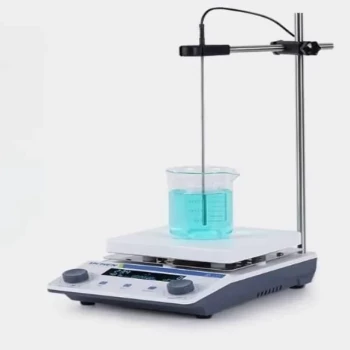
- Laboratory Small Constant Temperature Heated Magnetic Stirrer Heater and Stirrer
- Custom PTFE Teflon Parts Manufacturer for Magnetic Stirring Bar
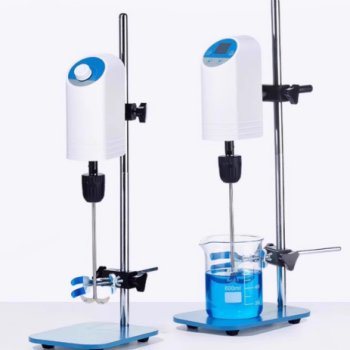
- High Performance Laboratory Stirrers for Diverse Applications
- Three-dimensional electromagnetic sieving instrument
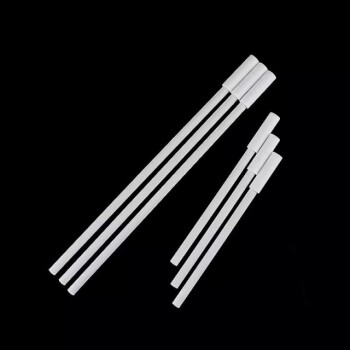
- Custom PTFE Teflon Parts Manufacturer for PTFE Stirring Bar Recovery Rod
People Also Ask
- What role does a magnetic stirrer with heating play in ZnO nanoparticle synthesis? Precision Control for Quality Results
- What role does a constant temperature heating magnetic stirrer play in MFC-HAp synthesis? Achieve Material Homogeneity
- What is the function of a laboratory magnetic stirrer in Ni–Cr–P electrodeposition? Optimize Ion Transport & Coating
- Why is a laboratory magnetic stirrer required for benzoic acid esters? Boost Reaction Speed & Yield with High RPM
- What role does a laboratory magnetic stirrer play in TiO2 and TiO2-Ag sol preparation? Master Chemical Kinetics