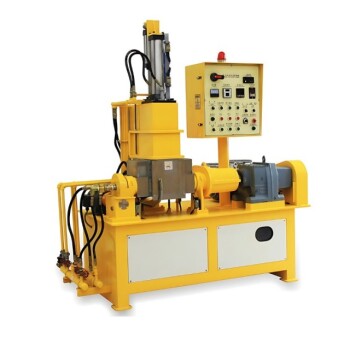
The primary function of a three-dimensional motion mixer combined with tungsten carbide (WC) grinding balls is to ensure uniform chemical composition in WTaVTiZrx high-entropy alloy powder by effectively managing extreme variations in particle size.
Instead of relying solely on simple rotation, this setup employs multi-directional movement to create complex mixing trajectories. This generates moderate impact forces that disperse fine powders and coat them onto larger particles, preventing the segregation that typically occurs when raw materials differ significantly in size.
By utilizing complex mixing trajectories and moderate impact, this process overcomes the segregation caused by particle sizes ranging from 1μm to 150μm. It ensures that fine tungsten powders are evenly dispersed and coated around larger tantalum particles, creating a chemically uniform precursor essential for successful laser cladding.
The Challenge: Extreme Particle Size Discrepancy
The 1μm to 150μm Gap
The preparation of WTaVTiZrx alloy involves mixing raw powders with vastly different physical characteristics. The particle sizes in this specific mixture range from as small as 1μm to as large as 150μm.
The Risk of Segregation
In standard mixing processes, gravity and centrifugal force separate particles based on size and density. Smaller particles tend to sink or agglomerate, while larger ones float to the top or separate to the periphery.
Without intervention, this leads to a chemically heterogeneous powder. If used in laser cladding, this inconsistency would result in distinct weak points or varying material properties across the final alloy layer.
The Mechanism of the 3D Motion Mixer
Multi-Directional Trajectories
Unlike standard mixers that rotate on a single axis, a three-dimensional motion mixer moves the container in multiple directions simultaneously.
This complex motion forces the powder to move in chaotic, non-repeating trajectories. It prevents "dead zones" where powder can stagnate and ensures that gravity does not cause the heavy tungsten particles to separate from lighter elements.
The Role of Tungsten Carbide (WC) Grinding Balls
The addition of WC grinding balls turns a simple mixing process into a precision coating process. As the mixer moves, these balls collide with the powder mixture with moderate impact force.
These balls act as microscopic hammers. They break up agglomerates of the ultra-fine tungsten (W) powder that naturally cling together due to surface energy.
Achieving Chemical Homogeneity
The Coating Effect
The most critical function of this specific setup is the "coating" mechanism described in the primary reference.
The mechanical action of the WC balls forces the extremely small tungsten (W) particles to disperse and coat the surface of the significantly larger tantalum (Ta) particles.
Uniform Dispersion
By coating the small particles onto the large ones, the system effectively neutralizes the size difference. The powders act as a single, composite unit rather than a loose mixture of different sizes.
This ensures that every microscopic region of the powder bed contains the correct ratio of Tungsten, Tantalum, Vanadium, Titanium, and Zirconium (WTaVTiZrx) prior to the laser cladding process.
Understanding the Trade-offs
Moderate Impact vs. High-Energy Alloying
It is vital to distinguish this process from high-energy mechanical alloying (often performed by planetary ball mills, as noted in supplementary contexts).
The 3D motion mixer delivers moderate force intended for mixing and coating. It creates a physical mixture where elements remain distinct but well-distributed.
When High Energy is NOT the Goal
Conversely, high-energy milling is used to fracture particles and force atomic-level alloying (solid solutions) before melting.
For WTaVTiZrx preparation, the goal is homogeneity for laser cladding, not solid-state alloying. Excessive energy could deform the larger Ta particles too severely or introduce unwanted heat and contamination.
Making the Right Choice for Your Goal
The selection of mixing equipment dictates the quality of your high-entropy alloy.
- If your primary focus is Uniform Dispersion of Disparate Sizes: Use a 3D motion mixer with WC balls. This effectively coats fine particles onto large ones (e.g., W onto Ta) without excessive deformation.
- If your primary focus is Mechanical Alloying: Use a planetary ball mill. This provides the high-energy shear forces required to refine particle sizes and achieve atomic-level mixing for sintering processes.
Ultimately, the 3D motion mixer functions not just to mix, but to mechanically stabilize the powder blend, ensuring the laser cladding process begins with a chemically perfect foundation.
Summary Table:
| Feature | 3D Motion Mixer with WC Balls | Standard Mixing Methods |
|---|---|---|
| Mechanism | Multi-directional, non-repeating trajectories | Single-axis rotation/gravity |
| Particle Size Management | Coats fine particles (1μm) onto large ones (150μm) | High risk of segregation & layering |
| Impact Level | Moderate: Prevents agglomeration | Low: No mechanical dispersion |
| Result | Uniform coating & chemical stability | Heterogeneous powder distribution |
| Primary Use | Precursor for Laser Cladding | General powder blending |
Elevate Your Material Research with KINTEK Precision
Achieving the perfect chemical foundation for high-entropy alloys requires more than just mixing; it requires engineered precision. KINTEK specializes in advanced laboratory solutions designed to solve your most complex powder processing challenges.
From high-performance 3D motion mixers and tungsten carbide (WC) grinding balls to our robust crushing and milling systems and planetary ball mills, we provide the tools necessary to eliminate segregation and achieve atomic-level uniformity. Whether you are focused on laser cladding or mechanical alloying, our comprehensive portfolio—including vacuum furnaces, isostatic presses, and high-purity ceramics—is built to meet the rigorous demands of material science.
Ready to optimize your WTaVTiZrx powder preparation? Contact KINTEK today to find the perfect equipment for your lab!
References
- Xiaoyu Ding, Jianhua Yao. Study on Microstructure and High Temperature Stability of WTaVTiZrx Refractory High Entropy Alloy Prepared by Laser Cladding. DOI: 10.3390/e26010073
This article is also based on technical information from Kintek Solution Knowledge Base .
Related Products
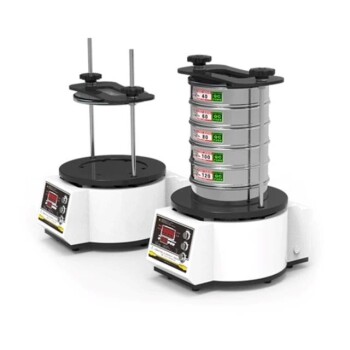
- Laboratory Wet Three-Dimensional Vibratory Sieve Shaker Machine
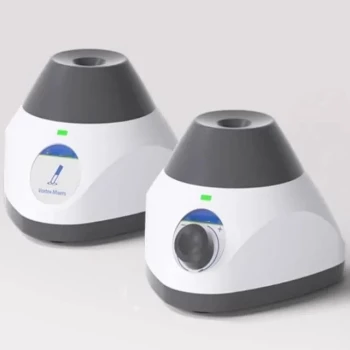
- Laboratory Vortex Mixer Orbital Shaker Multifunctional Rotation Oscillation Mixer
- Laboratory Oscillating Orbital Shaker
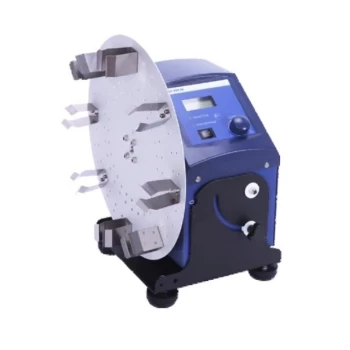
- Laboratory Disc Rotary Mixer for Efficient Sample Mixing and Homogenization
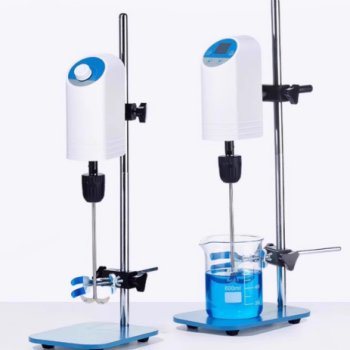
- High Performance Laboratory Stirrers for Diverse Applications
People Also Ask
- How does a laboratory vibratory sieve shaker facilitate the microstructural study of gas-atomized alloy powders?
- Why use a vibratory sieve shaker for PET powder? Achieve Precise Particle Size Control for Chemical Research
- How is a vibratory sieve shaker used in the particle size analysis of mechanically alloyed powders? Expert Guide
- What is the principle of vibratory sieve shaker? Achieve Accurate Particle Size Analysis
- What is the function of a vibratory sieve shaker? Achieve Precise Particle Size Analysis