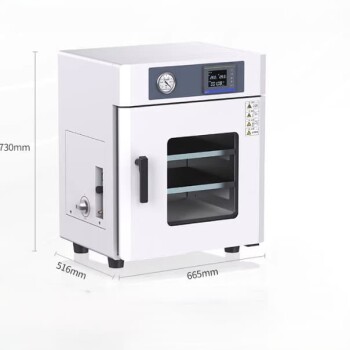
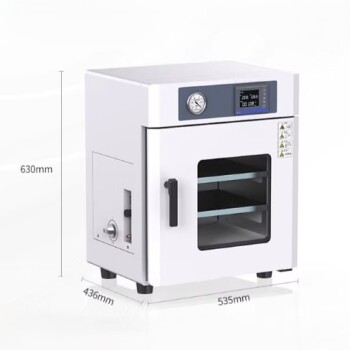
The primary function of a vacuum drying oven in Starbon preparation is the preservation of structural integrity. It is used to process solvent-exchanged starch gels by removing excess solvent (typically ethanol) at controlled, low temperatures around 60°C. By creating a vacuum environment, the oven lowers the boiling point of the solvent, allowing for evaporation without the thermal stress that would otherwise destroy the material's delicate architecture.
The vacuum drying step is the critical bridge between a wet gel and a functional porous carbon. It prevents the starch network from collapsing during drying, effectively "locking in" the pore precursors required for the final material's high surface area.
The Mechanics of Structural Preservation
Lowering the Thermal Threshold
The central advantage of using a vacuum drying oven is the manipulation of the boiling point. Under reduced pressure, solvents like ethanol can vaporize rapidly at significantly lower temperatures than they would at standard atmospheric pressure.
Gentle Solvent Extraction
This environment allows for the removal of ethanol at approximately 60°C. Operating at this modest temperature avoids the harsh thermal conditions that could chemically alter the starch or cause rapid, destructive evaporation rates.
Critical Impact on Material Quality
Preventing Gel Collapse
Starch gels are structurally fragile; standard drying methods often lead to significant shrinkage or total structural failure. The vacuum process creates a low-stress environment where the liquid volume is removed without exerting excessive capillary tension on the gel walls.
Preserving Pore Precursors
The ultimate goal of a Starbon is to serve as a porous carbon material. The vacuum drying step ensures that the initial pore precursors established in the gel stage remain intact.
Ensuring Pyrolysis Readiness
By maintaining an open structure during drying, the material is properly prepped for the subsequent pyrolysis step. If the structure were to collapse during drying, the final carbonized product would suffer from low porosity and poor surface area.
Understanding the Trade-offs
The Risk of Aggressive Drying
While vacuum ovens are efficient, applying too much vacuum too quickly can still be detrimental. Rapid boiling—even at low temperatures—can generate internal pressures that fracture fragile gel structures.
Temperature vs. Time
There is always a balance between temperature and processing time. lowering the temperature preserves the structure but extends the drying duration. Rushing this process by raising the temperature, even under vacuum, undermines the benefits of the technique.
Making the Right Choice for Your Goal
To maximize the quality of your starch-based porous carbons, consider how you tune your drying parameters:
- If your primary focus is Maximum Surface Area: Prioritize lower temperatures and extended drying times to minimize capillary stress and prevent pore collapse.
- If your primary focus is Structural Stability: Ensure the vacuum level is stable to maintain a consistent evaporation rate, preventing rapid boiling that could crack the gel monoliths.
Control the drying environment precisely, and you secure the foundation for a high-performance carbon material.
Summary Table:
| Feature | Impact on Starbon Preparation | Benefit |
|---|---|---|
| Reduced Pressure | Lowers solvent boiling point | Prevents thermal degradation of starch gels |
| Low-Temp Drying | Controlled evaporation at ~60°C | Minimizes capillary tension and structural shrinkage |
| Structural Locking | Preserves gel network architecture | Ensures high surface area in the final carbon material |
| Solvent Removal | Efficient ethanol extraction | Prepares material for successful subsequent pyrolysis |
Elevate Your Material Science with KINTEK Precision
Achieving the perfect porous structure in Starbon production requires uncompromising environmental control. KINTEK specializes in high-performance laboratory solutions, providing the vacuum drying ovens, muffle furnaces, and rotary systems essential for delicate solvent extraction and precise pyrolysis.
Whether you are developing advanced carbon materials or scaling up battery research, our comprehensive range of equipment—from high-temperature reactors to homogenizers and ceramic crucibles—is engineered to meet the rigorous demands of modern laboratories.
Ready to optimize your drying process and lock in superior material porosity? Contact KINTEK today to discover how our expert-grade tools can transform your research outcomes.
References
- I. Sreedhar, Shivani Malik. Carbon capture using amine modified porous carbons derived from starch (Starbons®). DOI: 10.1007/s42452-019-0482-8
This article is also based on technical information from Kintek Solution Knowledge Base .
Related Products
- 56L Vertical Laboratory Vacuum Drying Oven
- 23L Laboratory Vacuum Drying Oven
- Laboratory Scientific Electric Heating Blast Drying Oven
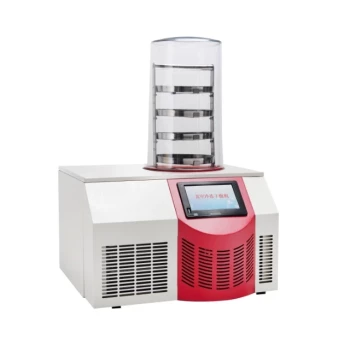
- Benchtop Laboratory Vacuum Freeze Dryer
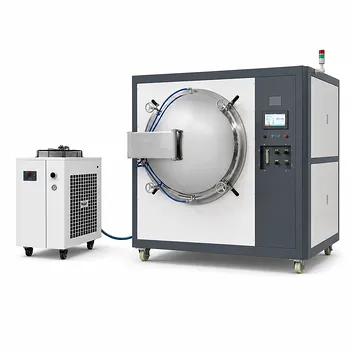
- Dental Porcelain Zirconia Sintering Ceramic Vacuum Press Furnace
People Also Ask
- Why is a laboratory vacuum drying oven recommended for rice straw residues? Protect Your Biomass Integrity
- What role does a laboratory vacuum drying oven play in the preparation of modified multi-walled carbon nanotubes?
- What is the importance of using a laboratory vacuum drying oven? Preserving Slow-Release Microcapsule Integrity
- Why is a Laboratory Vacuum Drying Oven recommended for PBAT microspheres? Protect Sensitive Polymer Integrity
- What role does a laboratory vacuum drying oven play in processing nanoparticle powder samples? Protect Sample Integrity