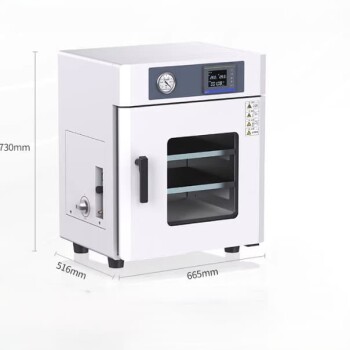
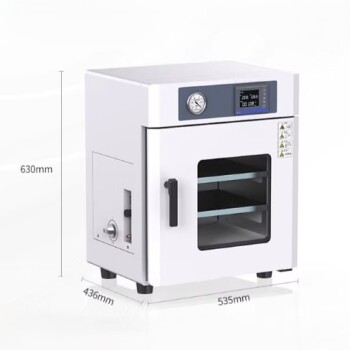
The primary function of a vacuum drying oven in this specific process is to facilitate the efficient removal of organic solvents, such as xylene or n-heptane, from the electrode slurry after coating. By operating under reduced pressure, the oven allows these solvents to evaporate at significantly lower temperatures, which is crucial for maintaining the stability of the battery components.
The core advantage of vacuum drying in this application is the ability to decouple heat from evaporation. By lowering the solvent's boiling point, you can achieve complete drying without subjecting heat-sensitive sulfide electrolytes to thermal degradation.
Preserving Material Integrity During Solvent Removal
The Role of Reduced Pressure
In a standard atmospheric environment, removing solvents like xylene or n-heptane requires high heat to reach their boiling points. A vacuum drying oven drastically reduces the ambient pressure surrounding the coated film.
This pressure drop depresses the boiling point of the solvents, causing them to volatilize and evaporate rapidly at much lower temperatures. This creates a gentle yet effective drying environment.
Protecting Sulfide Solid Electrolytes
The most critical challenge in all-solid-state lithium-sulfur batteries is the thermal sensitivity of sulfide solid electrolytes. These materials can degrade or undergo structural changes if exposed to the high temperatures typically used in conventional battery drying.
The vacuum oven mitigates this risk by enabling the removal of solvents without exceeding the thermal tolerance of the sulfide materials. This ensures the electrolyte retains its ionic conductivity and structural integrity.
Eliminating Residual Solvents
Even trace amounts of residual solvent can be detrimental to battery performance, leading to parasitic side reactions or blocking ion transport pathways. The vacuum environment is highly effective at drawing volatile compounds out of the porous electrode structure.
This thorough removal prevents chemical instability within the cathode film. It ensures that the final electrode is chemically pure and ready for assembly.
Critical Operational Considerations
While vacuum drying is essential, it introduces specific trade-offs that must be managed to ensure process quality.
Balancing Time and Temperature
While vacuum allows for lower temperatures, drying at the absolute minimum temperature can extend the processing time significantly. Operators must find the optimal balance point where the temperature is high enough to drive efficient evaporation but low enough to guarantee material safety.
Moisture Re-introduction Risks
Vacuum ovens are excellent for removing moisture and solvents, but the transition phase is critical. When breaking the vacuum to retrieve samples, there is a risk of atmospheric moisture re-entering the porous cathode.
Given that sulfide electrolytes are extremely sensitive to moisture (generating toxic H2S gas upon contact), the oven must often be integrated into a glovebox or dry room environment to maintain the integrity of the dried film.
Making the Right Choice for Your Goal
To maximize the performance of your all-solid-state Li-S battery, align your drying parameters with your specific material constraints.
- If your primary focus is Electrolyte Stability: Prioritize high-vacuum settings to maximize boiling point depression, allowing you to keep thermal exposure to an absolute minimum.
- If your primary focus is Cycle Life: Ensure extended drying times to eliminate every trace of solvent, as residuals are a primary cause of long-term electrochemical side reactions.
Ultimately, the vacuum drying oven serves as a safeguard, ensuring your cathode film achieves the necessary purity without compromising the delicate chemistry of solid-state electrolytes.
Summary Table:
| Feature | Function in Wet Slurry Casting | Benefit for Li-S Batteries |
|---|---|---|
| Reduced Pressure | Lowers solvent boiling points (xylene/n-heptane) | Enables rapid evaporation at low heat |
| Thermal Control | Decouples heat from evaporation | Prevents degradation of sensitive sulfide electrolytes |
| Deep Evacuation | Extracts volatile traces from porous structures | Eliminates residual solvents and side reactions |
| Controlled Environment | Integrated vacuum/glovebox compatibility | Prevents moisture re-introduction and H2S formation |
Elevate Your Battery Research with Precision Drying Solutions
Maintaining the structural integrity of sulfide electrolytes requires more than just heat—it requires a controlled vacuum environment designed for delicate chemistry. KINTEK specializes in high-performance laboratory equipment tailored for the next generation of energy storage.
Whether you are developing all-solid-state lithium-sulfur batteries or advanced thin-film cathodes, our comprehensive range of vacuum drying ovens, glovebox-integrated systems, and battery research tools ensures your materials remain pure and stable. From high-temperature high-pressure reactors to precision crushing and milling systems for slurry preparation, KINTEK provides the end-to-end solutions your lab needs to achieve breakthrough results.
Ready to optimize your electrode drying process? Contact KINTEK today to consult with our experts on the perfect equipment for your battery research and production goals.
Related Products
- 56L Vertical Laboratory Vacuum Drying Oven
- 23L Laboratory Vacuum Drying Oven
- Laboratory Scientific Electric Heating Blast Drying Oven
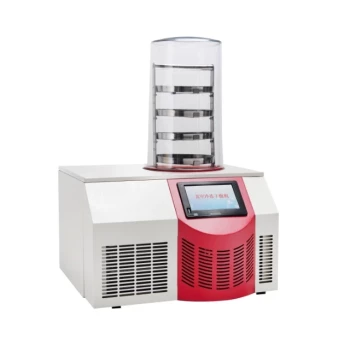
- Benchtop Laboratory Vacuum Freeze Dryer
- Dental Porcelain Zirconia Sintering Ceramic Vacuum Press Furnace
People Also Ask
- Why is a laboratory vacuum drying oven recommended for rice straw residues? Protect Your Biomass Integrity
- What role does a laboratory vacuum drying oven play in the preparation of modified multi-walled carbon nanotubes?
- What is the importance of using a laboratory vacuum drying oven? Preserving Slow-Release Microcapsule Integrity
- Why is a Laboratory Vacuum Drying Oven recommended for PBAT microspheres? Protect Sensitive Polymer Integrity
- What role does a laboratory vacuum drying oven play in processing nanoparticle powder samples? Protect Sample Integrity