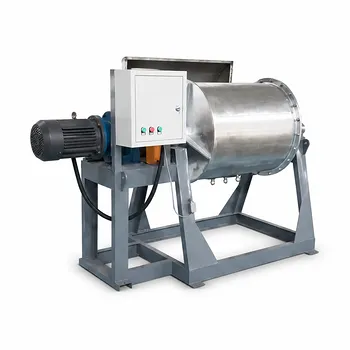
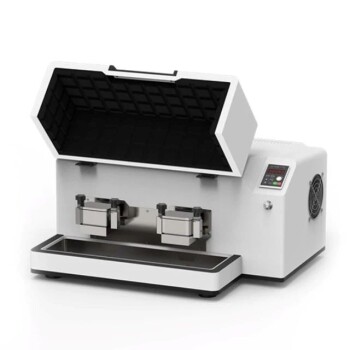
The omnidirectional ball mill acts as the primary engine for solid-state alloying through high-energy mechanical force. For $Fe_3Mn_3Co_{60.66}Si_{33.34}$ alloy powders, the mill utilizes high-frequency rotation to generate intense impact and friction. This process forces the individual Fe, Mn, Co, and Si atoms to interdiffuse, ultimately causing elemental diffraction peaks to disappear as a uniform solid solution forms.
Core Takeaway: The omnidirectional ball mill converts mechanical energy into chemical energy, driving the transition from a mixture of discrete elemental powders to a single-phase alloy with a refined, nanometer-scale grain structure.
Mechanisms of Atomic Transformation
Promoting Interdiffusion and Solid Solution
The primary function of the mill is to facilitate atomic-level interdiffusion between the iron, manganese, cobalt, and silicon powders. By subjecting the mixture to high-frequency rotation, the mill provides the activation energy necessary for atoms to migrate across particle boundaries.
Cycles of Cold Welding and Fracturing
During the milling process, the powder particles undergo continuous cycles of cold welding and fracturing. This repeated mechanical action breaks down the original particle structures and ensures that the different elements are layered and folded into one another.
Disappearance of Elemental Phases
As the mechanical alloying progresses, the individual crystal structures of the raw elements are disrupted. This leads to the disappearance of their specific diffraction peaks in X-ray analysis, signaling the successful formation of a homogeneous alloy matrix.
Refining Material Microstructure
Grain Size Reduction
High-energy ball milling is the most effective method for refining grain sizes in these alloy systems. The intense impact and shear forces can reduce the grain size to the nanometer scale, which significantly enhances the mechanical and functional properties of the final material.
Introduction of Lattice Defects
The process introduces a high density of lattice distortions and defects into the powder particles. These defects serve as a "power source" for mechanochemical reactions, increasing the reactivity of the powders for subsequent processing stages like sintering.
Uniform Component Distribution
The omnidirectional movement ensures that impact forces are delivered from multiple directions, preventing dead zones within the milling jar. This results in an atomic-level uniform distribution of Fe, Mn, Co, and Si, which is essential for the stability of the high-cobalt alloy.
Understanding the Trade-offs
Heat Generation and Phase Stability
The high-frequency rotation required for intense impact generates significant internal heat. If not managed, this thermal energy can cause unwanted phase transformations or lead to the coarsening of refined grains, undoing the benefits of the milling.
Material Contamination
Prolonged exposure to high-energy impact can cause wear on the grinding balls and the internal lining of the mill. This may introduce trace impurities into the alloy powder, which can negatively affect the magnetic or structural performance of the $Fe_3Mn_3Co_{60.66}Si_{33.34}$ composition.
How to Apply This to Your Project
- If your primary focus is achieving a single-phase structure: Extend milling duration until X-ray diffraction confirms the total disappearance of individual elemental peaks.
- If your primary focus is maximizing grain refinement: Utilize the highest stable frequency of rotation while implementing cooling intervals to prevent thermal grain growth.
- If your primary focus is powder purity: Select grinding media with a composition similar to the target alloy to minimize the impact of wear-induced contamination.
By precisely controlling the mechanical energy of the omnidirectional ball mill, you can transform simple elemental mixtures into advanced, high-performance alloy powders.
Summary Table:
| Key Function | Mechanical Mechanism | Impact on Alloy Powder |
|---|---|---|
| Solid Solution Formation | Atomic-level interdiffusion | Creates a uniform, single-phase matrix |
| Microstructure Refinement | Continuous cold welding & fracturing | Reduces grain size to the nanometer scale |
| Mechanochemical Activation | Introduction of lattice defects | Increases powder reactivity for sintering |
| Component Homogeneity | Multi-directional high-energy impact | Ensures atomic-level distribution of elements |
Elevate Your Material Synthesis with KINTEK Precision
Achieving a perfect single-phase solid solution requires high-energy efficiency and precise control. KINTEK specializes in premium laboratory equipment designed for advanced metallurgy, including high-performance crushing and milling systems and omnidirectional ball mills.
Beyond milling, we provide a comprehensive suite of tools to support your entire workflow—from high-temperature muffle and vacuum furnaces for sintering to hydraulic pellet presses and PTFE/ceramic consumables. Our equipment is engineered to minimize contamination and maximize grain refinement, ensuring your research into $Fe_3Mn_3Co_{60.66}Si_{33.34}$ and other advanced alloys yields superior results.
Ready to optimize your alloying process? Contact our technical experts today to find the ideal solution for your lab!
References
- Jiang Zou, Quan Xie. Effect of Sintering Temperature on the Magnetic Properties of Fe3Mn3Co60.66Si33.34. DOI: 10.3390/inorganics11070272
This article is also based on technical information from Kintek Solution Knowledge Base .
Related Products
- High-Energy Omnidirectional Planetary Ball Mill Milling Machine for Laboratory
- High-Energy Omnidirectional Planetary Ball Mill Machine for Laboratory
- Laboratory Planetary Ball Mill Rotating Ball Milling Machine
- Laboratory Horizontal Planetary Ball Mill Milling Machine
- High Energy Planetary Ball Mill for Laboratory Horizontal Tank Type Milling Machine
People Also Ask
- How does a planetary ball mill solve mixing challenges with PEO? Unlock solid-state synthesis for insoluble dopants
- What is the role of a planetary ball mill in preparing doped high-nickel cathode materials? Enhance Battery Stability
- Why is a planetary ball mill used for LNMO precursor powders? Optimize Particle Uniformity & Battery Performance
- What is the function of a planetary ball mill in the solid-state synthesis of LiTa2PO8? Achieve High-Purity Electrolytes
- What is the critical role of a planetary ball mill in the processing of inorganic fillers? Enhance Battery Performance