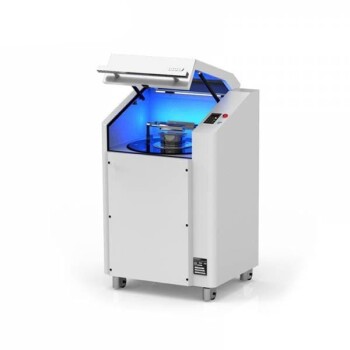
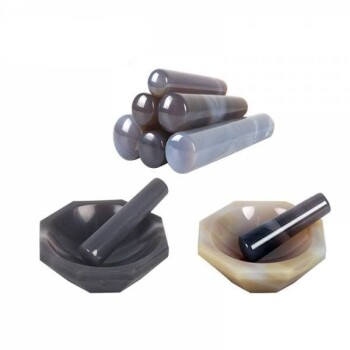
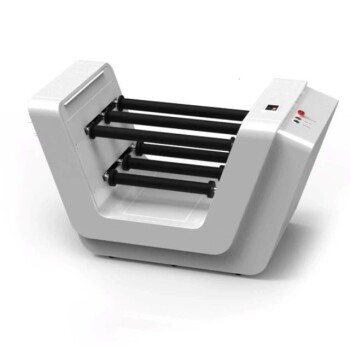
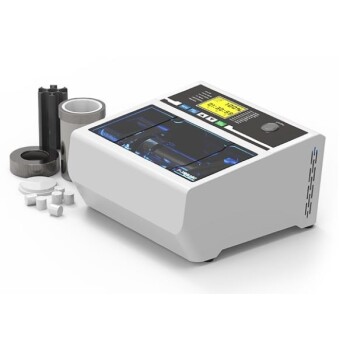
The primary function of grinding equipment in LLZO synthesis is to mechanically activate the chemical reaction. By utilizing high-energy mechanical force, this equipment mixes and refines precursor powders—such as aluminum oxide, lithium hydroxide, lanthanum oxide, and zirconium oxide—to significantly increase their reactive surface area. This step is essential to ensure that solid-phase diffusion proceeds thoroughly during high-temperature calcination, ultimately yielding a high-purity garnet-type electrolyte.
The success of solid-state synthesis is defined by particle contact. Grinding transforms coarse, separate raw materials into a highly reactive, homogeneous mixture, creating the physical conditions necessary to form a pure, high-conductivity crystal structure.
The Mechanics of Precursor Refinement
Overcoming Diffusion Limitations
Solid-state reactions are inherently sluggish because they rely on atoms moving (diffusing) across solid interfaces.
Grinding equipment overcomes this by breaking down particle sizes.
By pulverizing the raw materials, you drastically increase the specific surface area available for reaction.
Ensuring Homogeneity
To form complex crystal structures like the garnet-type LLZO, the ratio of elements (Lithium, Lanthanum, Zirconium) must be consistent throughout the mixture.
High-energy mixing ensures that these distinct precursor powders are blended at a microscopic level.
This prevents the formation of secondary phases or "dead spots" where the reaction remains incomplete.
Critical Equipment Configurations
The Role of Grinding Media
The choice of grinding jars and balls is not merely about hardness; it is a matter of chemical purity.
Zirconia (ZrO2) is the preferred material for both jars and grinding balls due to its high hardness and chemical inertness.
Using zirconia prevents the introduction of metallic impurities that would otherwise degrade the ionic conductivity of the final electrolyte.
Optimizing Media Gradation
Efficiency is lost if the grinding media is uniform in size.
To maximize refinement, it is effective to use a gradation of ball diameters (e.g., a mix of 5mm, 8mm, and 10mm).
This combination ensures that void spaces are filled and impact forces are distributed, leading to a more uniform particle size distribution.
Understanding the Trade-offs
Process Duration vs. Purity
There is often a tension between achieving maximum fineness and maintaining purity.
Prolonged grinding is necessary to reach the desired particle size for optimal reactivity.
However, extended processing times increase the risk of wear on the grinding media, which can introduce contaminants.
This makes the selection of high-quality, inert materials like zirconia non-negotiable for high-performance applications.
Making the Right Choice for Your Goal
To achieve the best results in LLZO synthesis, align your grinding protocol with your specific performance targets:
- If your primary focus is high ionic conductivity: Prioritize the use of high-purity Zirconia grinding media to strictly prevent metallic contamination.
- If your primary focus is reaction efficiency: Implement a mixed-media gradation strategy (varying ball sizes) to improve the uniformity and speed of particle refinement.
- If your primary focus is phase purity: Ensure the grinding process is energetic enough to fully refine precursors like Aluminum Oxide and Lithium Hydroxide, guaranteeing complete diffusion during calcination.
The quality of your final solid-state electrolyte is directly determined by the uniformity and reactivity achieved during this initial mechanical processing step.
Summary Table:
| Factor | Role in LLZO Synthesis | Key Benefit |
|---|---|---|
| Particle Refinement | Breaks down precursor powders (Li, La, Zr oxides) | Increases surface area for faster solid-state diffusion |
| Homogenization | Microscopic blending of diverse chemical elements | Prevents secondary phases; ensures pure garnet structure |
| Grinding Media | Use of high-purity Zirconia (ZrO2) jars/balls | Prevents metallic contamination & maintains ionic conductivity |
| Media Gradation | Mixing ball diameters (e.g., 5mm, 8mm, 10mm) | Optimizes impact force and ensures uniform particle size |
Elevate Your Battery Research with KINTEK Precision
Achieving peak ionic conductivity in LLZO electrolytes requires more than just chemistry—it requires precision engineering. KINTEK specializes in high-performance laboratory equipment designed for the rigorous demands of solid-state synthesis. From our ultra-pure Zirconia grinding media and advanced crushing and milling systems to our precision high-temperature furnaces and hydraulic pellet presses, we provide the end-to-end solutions necessary to transform precursors into high-purity garnet electrolytes.
Ready to optimize your material synthesis? Contact our technical experts today to discover how our high-temperature furnaces, planetary ball mills, and specialized consumables can enhance your laboratory's efficiency and research outcomes.
Related Products
- Three-dimensional electromagnetic sieving instrument
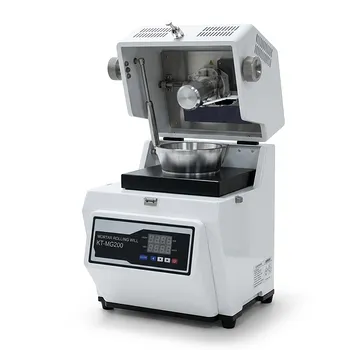
- Laboratory Grinding Mill Mortar Grinder for Sample Preparation
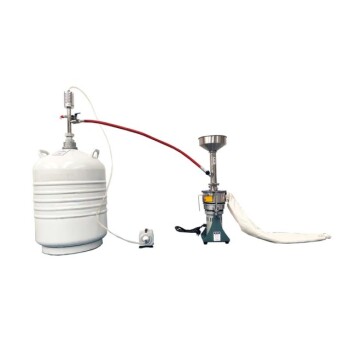
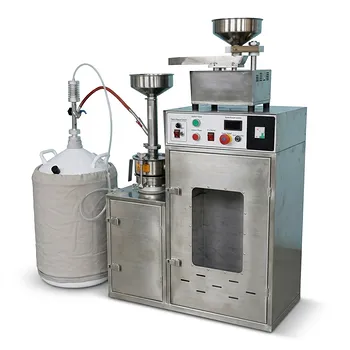
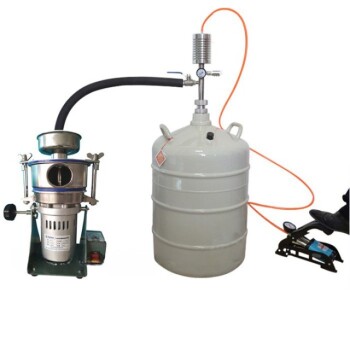
- Liquid Nitrogen Cryogenic Grinder Mill Cryomill Airflow Ultrafine Pulverizer
- Mini Planetary Ball Mill Machine for Laboratory Milling
- Laboratory Jar Mill with Agate Grinding Jar and Balls
People Also Ask
- Why is sieving equipment essential for the classification of processed bio-activated carbon? Optimize Performance
- What are the limitations of sieving? Understanding the Constraints of Particle Size Analysis
- What are advantages and disadvantages of sieving method? A Guide to Reliable & Cost-Effective Particle Sizing
- How is sieving important? The Critical Role of Particle Size Analysis in Quality Control
- What is sieving and how does it work? A Guide to Accurate Particle Size Analysis