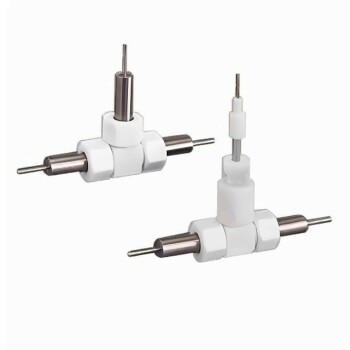
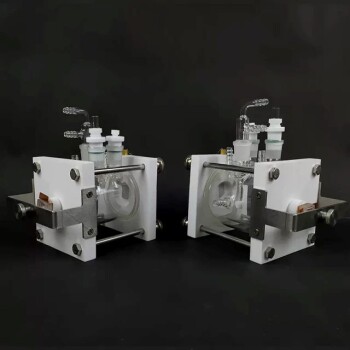
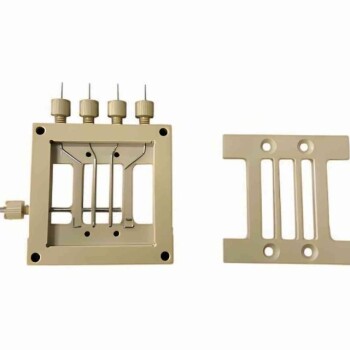
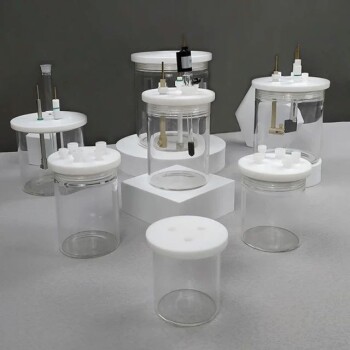
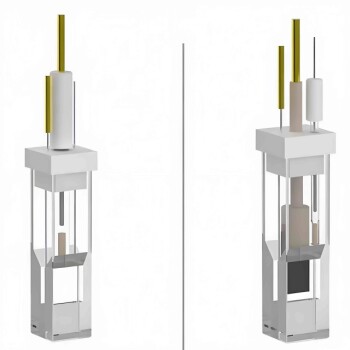
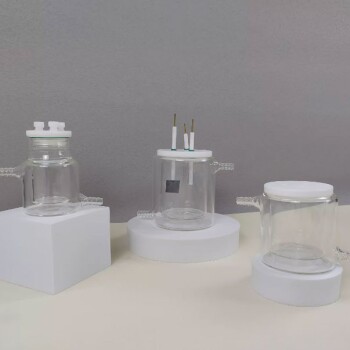
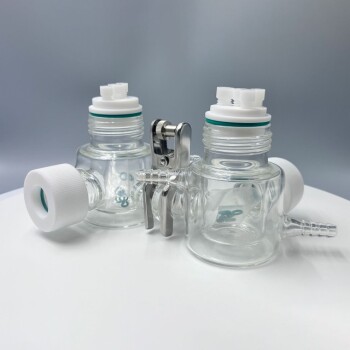
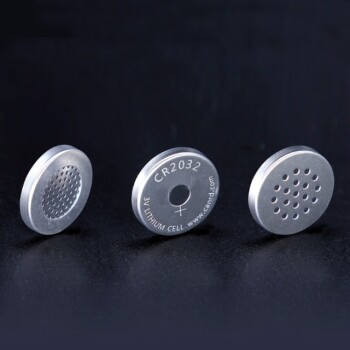
The primary function of specialized electrolytic cells and testing molds is to bridge the gap between laboratory material synthesis and real-world battery application. These tools enable researchers to construct functional zinc-air battery prototypes, allowing for the direct measurement of power density, specific capacity, and long-term stability under actual operating conditions.
Specialized testing hardware is essential for validating catalysts by simulating the complex mechanical and electrochemical stressors of a functional battery. It moves evaluation beyond basic laboratory powders to prove commercial viability, structural durability, and energy efficiency.
From Laboratory Powder to Device Prototype
Verifying Catalyst Feasibility
Specialized electrolytic cells allow synthesized catalysts, such as P-FeNC/CNT, to be applied as a functional air cathode. This setup provides the necessary environment to compare non-noble metal catalysts directly against commercial platinum-carbon (Pt/C) benchmarks.
Measuring Practical Performance Metrics
Testing molds enable the measurement of maximum power density and specific capacity. These metrics translate laboratory-scale material properties into actual device performance data, reflecting how the catalyst will behave in a commercial product.
Establishing Open-Circuit Potential
By assembling a full cell, researchers can determine the open-circuit potential (OCP) and power density curves. This helps quantify how features like porous graphene structures contribute to improved discharge platforms and overall energy efficiency.
Simulating the Electrochemical Environment
Maintaining Component Alignment
Electrochemical test molds are designed to precisely secure the porous air cathode, separator, and zinc anode. This mechanical precision is vital for simulating the actual geometric and physical constraints found in commercial battery shells.
Evaluating Chemical Resistance
Zinc-air batteries utilize strong alkaline electrolytes, which are highly corrosive. Specialized cells allow researchers to monitor whether a catalyst can resist structural collapse or chemical degradation while submerged in these harsh environments over extended periods.
Monitoring the Voltage Gap
High-precision systems record voltage changes in real-time during galvanostatic charge-discharge cycling. By monitoring the evolution of the voltage gap, engineers can assess how efficiently the catalyst facilitates the movement of ions over hundreds or thousands of hours.
Assessing Long-Term Structural Integrity
Managing OER and ORR Switching
The catalyst must frequently switch between the Oxygen Reduction Reaction (ORR) and the Oxygen Evolution Reaction (OER). Specialized testing molds evaluate the catalyst's ability to maintain its structural integrity during these frequent electrochemical shifts.
Tracking Activity Attenuation
Long-term cycling tests, often exceeding 140 hours, are used to observe how quickly a catalyst loses its effectiveness. Monitoring activity attenuation in a real electrochemical environment is a key requirement for determining the potential for commercialization.
Utilizing In-Situ Diagnostics
Some specialized cells are designed for in-situ infrared spectroscopy (SEIRAS). These allow for the detection of adsorbed intermediates (like *COOH and *CO) on the catalyst surface while the reaction is in progress, revealing the actual molecular pathways.
Understanding the Trade-offs
Laboratory Scale vs. Industrial Scaling
While specialized cells provide high-quality data, laboratory-scale prototypes may not perfectly capture the thermal management issues found in large-scale battery packs. Results from a small testing mold must be interpreted as a proof-of-concept rather than a final performance guarantee for mass production.
Complexity and Cost of Specialized Hardware
The use of multi-channel battery testing systems and in-situ diagnostic cells significantly increases research costs and technical complexity. Researchers must balance the need for high-fidelity data with the practical constraints of project timelines and equipment availability.
How to Apply This to Your Project
Recommendations for Catalyst Evaluation
When transitioning from material synthesis to device testing, choose your hardware based on your primary validation goal.
- If your primary focus is commercial viability: Use specialized molds to measure maximum power density and compare your results directly against Pt/C commercial standards.
- If your primary focus is long-term durability: Utilize a multi-channel testing system to conduct galvanostatic cycling for at least 120-140 hours to monitor voltage gap stability.
- If your primary focus is mechanistic understanding: Employ a specialized cell capable of in-situ spectroscopy to identify reaction intermediates and confirm the catalyst's active sites.
By utilizing these specialized cells and molds, you ensure that your catalyst is not just a high-performing powder, but a viable component for the future of energy storage.
Summary Table:
| Component | Primary Research Function | Key Metrics Measured |
|---|---|---|
| Specialized Electrolytic Cells | Bridges material synthesis and device application | Power density, specific capacity, and OCP |
| Electrochemical Testing Molds | Simulates mechanical/chemical battery environments | Voltage gap stability, chemical resistance |
| Multi-channel Systems | Evaluates long-term structural integrity | Galvanostatic charge-discharge cycling (140h+) |
| In-Situ Diagnostic Cells | Identifies real-time molecular pathways | Adsorbed intermediates (e.g., *COOH, *CO) |
Accelerate Your Battery Innovation with KINTEK
Transitioning from laboratory catalyst synthesis to a commercially viable battery prototype requires precision and reliability. KINTEK specializes in high-performance laboratory equipment, providing the essential tools for advanced energy research.
We offer a comprehensive range of electrolytic cells and electrodes, battery research tools, and specialized consumables designed to withstand the harsh alkaline environments of zinc-air battery testing. Whether you are measuring maximum power density or conducting long-term cycling tests for ORR/OER efficiency, our hardware ensures high-fidelity data and structural durability.
Ready to validate your catalysts and optimize your battery prototypes? Contact us today to discuss how our professional-grade research equipment can enhance your lab's performance.
References
- Jianghai Deng, Qiuyun Zhou. The Semi-Closed Molten Salt-Assisted One-Step Synthesis of N-P-Fe Tridoped Porous Carbon Nanotubes for an Efficient Oxygen Reduction Reaction. DOI: 10.3390/catal13050824
This article is also based on technical information from Kintek Solution Knowledge Base .
Related Products
- Electrolytic Electrochemical Cell for Coating Evaluation
- Customizable Swagelok Type Test Cells for Advanced Battery Research Electrochemical Analysis
- Flat Corrosion Electrolytic Electrochemical Cell
- PTFE Electrolytic Cell Electrochemical Cell Corrosion-Resistant Sealed and Non-Sealed
- Custom Ion Conductivity Test Fixtures for Fuel Cell Research
People Also Ask
- What is the volume range of the coating evaluation electrolytic cell? A Guide to Choosing the Right Size
- How does the design of an electrochemical electrolytic cell influence the coating uniformity? Optimize Your Catalysts
- What is the correct shutdown and disassembly procedure after an experiment? Ensure Safety and Protect Your Equipment
- How do the electrochemical cell and three-electrode testing system collaborate? Optimize Zinc Anode Deposition Control
- What is the difference between a voltaic cell and an electrochemical cell? Understand the Two Types of Energy Conversion