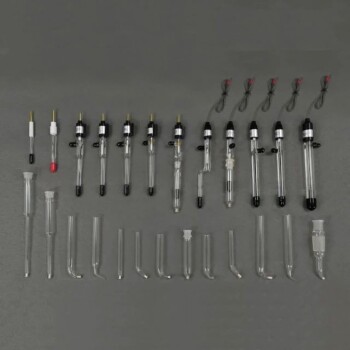
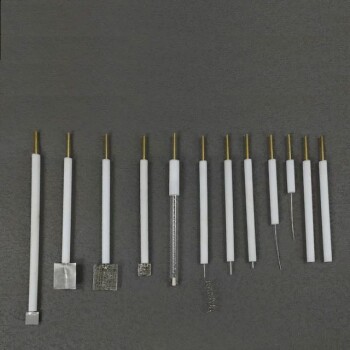
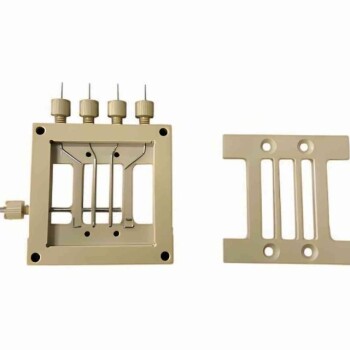
The functional design of a laboratory three-electrode electrolytic cell centers on the precise physical arrangement of three distinct components within a specific volume of electrolyte: the working electrode (your titanium alloy sample), a reference electrode (such as Ag/AgCl), and an auxiliary (or counter) electrode (typically graphite). This architecture is engineered to separate the circuit into two distinct functional loops, ensuring that the electrochemical behavior of the titanium alloy is measured in isolation from external system noise.
Core Takeaway: By decoupling the path of current flow from the point of potential measurement, this design effectively eliminates errors caused by solution resistance and electrode polarization, providing an unadulterated view of the titanium alloy's surface reactions.
The Core Architecture of the Cell
The Three-Electrode Configuration
The system is defined by the coexistence of three specific electrodes immersed in the corrosive solution.
The Working Electrode (WE) is the titanium alloy sample itself, which serves as the primary subject of the test.
The Reference Electrode (RE), often silver/silver chloride (Ag/AgCl), maintains a stable, known potential against which the working electrode is measured.
The Auxiliary Electrode (AE), also known as the counter electrode, is typically an inert material like a graphite rod that completes the circuit.
The Role of the Electrolyte
These components are physically isolated yet electrically connected through a conductive electrolyte.
In a titanium alloy measurement system, this "corrosive solution" acts as the medium for charge transfer and simulates the specific environment (such as harsh acidic or alkaline conditions) required to test the material's durability.
Functional Mechanics: Separating Current and Potential
The Current Loop (WE to AE)
The design directs the applied current to flow primarily between the Working Electrode and the Auxiliary Electrode.
By forcing the heavy lifting of charge transfer onto the auxiliary electrode, the system prevents high currents from passing through the sensitive reference electrode.
The Sensing Loop (WE to RE)
Simultaneously, the measurement of electrical potential occurs strictly between the Working Electrode and the Reference Electrode.
Because negligible current flows through this loop, the reference electrode maintains a stable potential, unaffected by the polarization that occurs at the auxiliary electrode.
Eliminating Measurement Error
This dual-loop configuration addresses the "IR drop" problem common in two-electrode systems.
By physically isolating the potential measurement from the current path, the design negates errors caused by the inherent resistance of the solution and the polarization of the counter electrode.
Understanding the Trade-offs
System Complexity
Unlike simpler two-electrode setups, this design requires precise hardware integration with an electrochemical workstation (potentiostat/galvanostat).
Proper spatial arrangement is critical; if the reference electrode is not positioned correctly relative to the titanium surface, residual solution resistance can still impact accuracy.
Auxiliary Electrode Selection
The auxiliary electrode must remain inert to ensure it does not introduce contaminants into the solution.
While graphite is common, utilizing the wrong material for the auxiliary electrode can lead to unintended chemical byproducts that alter the titanium alloy's corrosion behavior.
Making the Right Choice for Your Goal
To maximize the utility of this three-electrode cell design, align your setup with your specific analytical objectives:
- If your primary focus is Corrosion Resistance: Ensure the reference electrode is stable in the specific corrosive solution used to test the titanium alloy to avoid drift.
- If your primary focus is Reaction Mechanism Study: Verify that the auxiliary electrode has a larger surface area than the titanium sample to ensure the reaction is not limited by the counter electrode's kinetics.
Ultimately, the three-electrode cell transforms your measurement from a simple observation of voltage into a precise, noise-free characterization of intrinsic material behavior.
Summary Table:
| Component | Material Example | Primary Function |
|---|---|---|
| Working Electrode (WE) | Titanium Alloy Sample | The subject of electrochemical testing and surface reaction analysis. |
| Reference Electrode (RE) | Ag/AgCl | Provides a stable potential to measure the WE without current interference. |
| Auxiliary Electrode (AE) | Graphite Rod | Completes the circuit by facilitating current flow from the WE. |
| Electrolyte | Corrosive Solution | Acts as the medium for charge transfer and simulates real-world environments. |
Elevate Your Electrochemical Research with KINTEK
Precision in material science starts with the right equipment. At KINTEK, we specialize in high-performance electrolytic cells and electrodes specifically engineered for the rigorous demands of titanium alloy testing and corrosion research.
Whether you need stable reference electrodes, inert graphite counter electrodes, or complete electrochemical workstation integration, our team provides the laboratory equipment and consumables necessary to eliminate noise and ensure data accuracy. From high-temperature reactors to specialized crushing and milling systems, KINTEK supports every stage of your material characterization.
Ready to optimize your lab setup? Contact our experts today to find the perfect solution for your research goals.
References
- Polina V. Abramova, Андрей Владимирович Коршунов. ВЛИЯНИЕ ДЕФОРМАЦИОННО-ТЕРМИЧЕСКОЙ ОБРАБОТКИ (a+b)-СПЛАВОВ ТИТАНА ВТ6 И ВТ22 НА ИХ КОРРОЗИОННУЮ СТОЙКОСТЬ. DOI: 10.18799/24131830/2023/4/4124
This article is also based on technical information from Kintek Solution Knowledge Base .
Related Products
- H Type Electrolytic Cell Triple Electrochemical Cell
- PTFE Electrolytic Cell Electrochemical Cell Corrosion-Resistant Sealed and Non-Sealed
- Electrolytic Electrochemical Cell Gas Diffusion Liquid Flow Reaction Cell
- Customizable PEM Electrolysis Cells for Diverse Research Applications
- Quartz Electrolytic Electrochemical Cell for Electrochemical Experiments
People Also Ask
- What is a H type cell? A Guide to Divided Electrochemical Cells for Accurate Experiments
- How should the electrolyte be prepared and added to the H-type electrolytic cell? Best Practices for Purity and Safety
- What is the technical necessity of using an H-type electrolytic cell for NO3RR tests? Protect Your Ammonia Yields
- How does the design of an H-type electrolytic cell benefit the neutral water electrolysis process for metal recovery?
- What is the primary function of an H-type electrolytic cell in NitRR? Ensure Accurate Product Yields