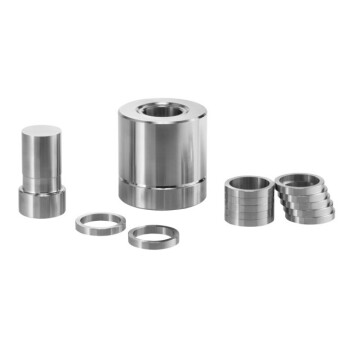
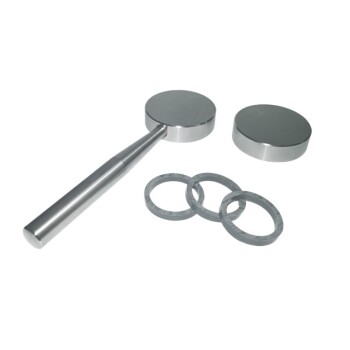
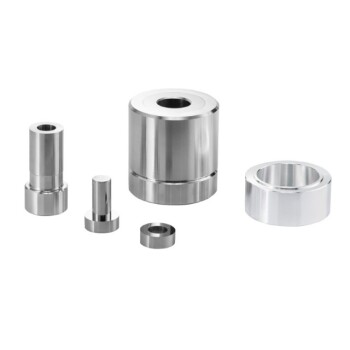
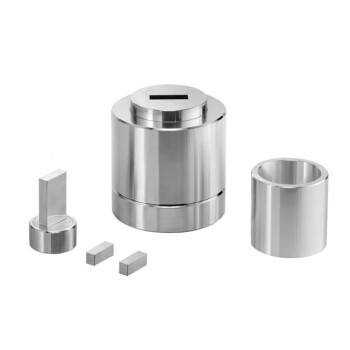
The fundamental principle of the KBr pellet method relies on the mechanical plasticity of alkali halides. When subjected to high pressure, powdered potassium bromide (KBr) undergoes cold flow, transforming from a loose powder into a solid, transparent sheet. This creates an optical window in which a sample can be physically dispersed and analyzed without spectral interference from the holding matrix.
Core Insight: The KBr pellet is not merely a sample holder; it is a solid-state solution created by force. The high pressure fuses the halide particles into a unified, glass-like disk that is transparent to infrared light, allowing the detector to isolate the specific absorption spectrum of the suspended sample molecules.
The Physics of Pellet Formation
Plastic Deformation Under Pressure
The core mechanism at work is the plastic flow of alkali halides. Unlike many other solids that shatter under stress, materials like KBr and Cesium Iodide (CsI) become pliable when compressed.
When you apply significant load (typically 8 to 10 tons for a standard 13 mm die), the crystalline powder collapses. It fills the interstitial voids and fuses into a continuous, cohesive solid.
The Suspension Matrix
The sample is not chemically dissolved into the KBr; it is physically dispersed.
To achieve this, the sample is ground into a fine powder and mixed with KBr at a ratio of approximately 1:100. During the pressing phase, the KBr flows around the sample particles, suspending them in a fixed position within the transparent "window."
Why Potassium Bromide is the Standard
Optical Transparency
The primary reason KBr is selected is its electromagnetic transparency. Within the standard infrared region, KBr does not absorb light.
Because the matrix itself is invisible to the spectrometer, any peaks observed in the final data can be attributed directly to the sample, ensuring high data integrity.
Extending the Range with CsI
While KBr is the standard, the principle applies to other alkali halides for different spectral ranges.
If your analysis requires data in the low-wavenumber region (400 to 250 cm⁻¹), Cesium Iodide (CsI) is used as the matrix material. It behaves identically under pressure but remains transparent in regions where KBr begins to absorb IR radiation.
Understanding the Trade-offs
The Hygroscopic Vulnerability
The most significant weakness of this method is that KBr is highly hygroscopic. It naturally and rapidly absorbs moisture from the atmosphere.
If the KBr is not kept dry or the pellet is exposed to air for too long, water bands will appear in your spectrum, obscuring the sample data. Background measurements using a "blank" KBr pellet are essential to correct for this.
The Necessity of Homogeneity
The quality of the spectrum is strictly limited by the particle size of the mixture.
If the sample or KBr particles are too large, they will scatter the infrared light rather than allowing it to pass through. This results in a sloping baseline and reduced sensitivity. Thorough grinding to a fine powder is not optional; it is a physical requirement for optical clarity.
Vacuum Degassing
Trapped air is an impurity that compromises the pellet's structural integrity and transparency.
Applying a vacuum during the pressing stage is critical to degas the mixture. Without this step, air pockets remain, leading to brittle pellets that scatter light and yield poor spectral resolution.
Making the Right Choice for Your Goal
To apply this principle effectively, tailor your approach to your specific analytical needs:
- If your primary focus is standard IR analysis: Use KBr with a 100:1 ratio and apply roughly 8–10 tons of pressure to ensure full fusion.
- If your primary focus is low-frequency regions (Far IR): Substitute KBr with CsI to maintain transparency between 400 and 250 cm⁻¹.
- If your primary focus is data accuracy: Always prepare a "blank" pure KBr pellet to run a background scan, correcting for moisture and scattering losses.
Treat the pellet not as a pill, but as a precision optical element created through pressure.
Summary Table:
| Feature | KBr Pellet Principle | Impact on Analysis |
|---|---|---|
| Mechanism | Plastic flow/cold flow under high pressure | Transforms powder into a transparent optical window |
| Sample State | Physical dispersion (1:100 ratio) | Ensures sample molecules are isolated for detection |
| Optical Range | Transparent in mid-IR regions | Prevents matrix interference with sample peaks |
| Material Choice | KBr (standard) or CsI (low-wavenumber) | Allows for tailored spectral range (down to 250 cm⁻¹) |
| Key Requirement | Vacuum degassing & fine grinding | Eliminates light scattering and moisture interference |
Elevate Your Spectroscopic Precision with Kintek
At KINTEK, we understand that the quality of your infrared analysis depends on the integrity of your sample preparation. Our premium hydraulic pellet presses, precision dies, and high-purity consumables are engineered to deliver the perfect plastic deformation required for flawless KBr pellets.
Whether you are performing standard mid-IR analysis or specialized low-wavenumber studies, our comprehensive range of laboratory equipment—including grinding and milling systems, vacuum solutions, and high-quality KBr/CsI powders—ensures your lab achieves consistent, publishable results every time.
Ready to optimize your sample prep workflow? Contact our experts today to find the ideal pressing solution for your research and industrial needs.
Related Products
- kbr pellet press 2t
- Laboratory Hydraulic Pellet Press for XRF KBR FTIR Lab Applications
- Automatic Laboratory Hydraulic Press for XRF & KBR Pellet Press
- XRF & KBR steel ring lab Powder Pellet Pressing Mold for FTIR
- XRF & KBR plastic ring lab Powder Pellet Pressing Mold for FTIR
People Also Ask
- How do you prepare samples for IR spectroscopy? A Step-by-Step Guide for Solids, Liquids, and Gases
- What measurement methods are commonly used for powder samples in infrared spectroscopy? Optimize Your FTIR Analysis
- Why KBr is used in IR spectrophotometry? A Key to Transparent Sample Analysis
- How are a KBr pellet press and mortar utilized in FTIR analysis of activated carbon? Expert Sample Prep Guide
- How do you prepare KBr pellets for FTIR analysis? Master the Technique for High-Quality IR Spectra