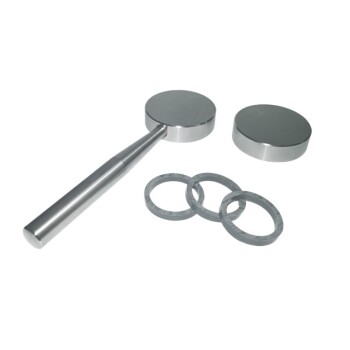
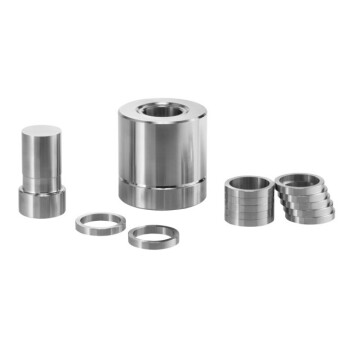
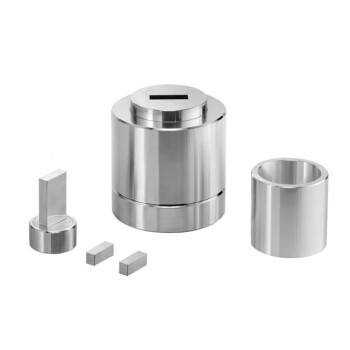
The primary function of a laboratory hydraulic press and precision powder pellet die is to mechanically transform loose mixtures of cathode active materials, solid electrolytes, and conductive additives into dense, cohesive electrode pellets. By applying high uniaxial pressure, typically between 370 and 400 MPa, this equipment eliminates voids and maximizes physical contact between particles.
Core Takeaway Unlike liquid electrolyte batteries that rely on wetting, all-solid-state batteries depend entirely on physical contact for conduction. The hydraulic press serves as the critical enabler of this technology by forcing solid particles together to establish the continuous ion and electron transport channels required for electrochemical performance.
The Mechanics of Densification
Eliminating Particle Voids
The raw material for a composite cathode is a loose powder mixture containing significant air gaps. The hydraulic press applies immense force to compact these powders, physically removing the pores between sulfide electrolyte particles and active materials.
Increasing Solid-Solid Contact
Liquids naturally flow into gaps, but solids do not. High-pressure densification forces the solid electrolyte and electrode materials into tight physical contact. This increases the active surface area where chemical reactions can occur.
Establishing Transport Channels
For a battery to function, ions and electrons must move freely through the cathode. The compression process creates a continuous, dense network within the pellet, ensuring effective ion and electron transport channels are established throughout the material.
Impact on Battery Performance
Reducing Interface Impedance
Poor contact between solids leads to high resistance, known as interface impedance. By using a hydraulic press to achieve high-intensity mechanical pressure, you significantly reduce this impedance. This ensures efficient energy transfer within the battery system.
Enhancing Grain Boundary Connectivity
In solid electrolytes, the boundaries between grains can act as barriers to ion flow. High-pressure pressing reduces grain boundary resistance, facilitating smoother ionic conductivity across the electrolyte-electrode interface.
The Role of the Precision Die
Ensuring Surface Flatness
The precision powder pellet die is not just a container; it dictates the geometry of the final product. It ensures the high-loading cathode achieves a flat, smooth surface, which is critical for making uniform contact with subsequent layers in the battery stack.
Maintaining Uniform Thickness
A precision die ensures the pressure is distributed evenly, resulting in a pellet with uniform thickness. This prevents stress concentration points that could lead to mechanical failure or uneven current distribution during battery operation.
Understanding the Trade-offs
Pressure Sensitivity
While high pressure is necessary, it must be carefully calibrated. The typical range is 370 to 400 MPa for many sulfide-based systems. Deviating significantly from this range can lead to issues; too little pressure leaves voids, while excessive pressure could potentially damage the crystal structure of sensitive active materials or the die itself.
Material Compatibility
The die material matters. As noted in advanced applications, using composite molds (such as stainless steel with PEEK) allows the system to withstand these high pressures without deforming, ensuring the applied force translates directly to densification rather than tool expansion.
Making the Right Choice for Your Goal
To maximize the effectiveness of your laboratory hydraulic press and die, align your process with your specific experimental objectives:
- If your primary focus is Ion Transport: Prioritize achieving pressures in the 370–400 MPa range to minimize grain boundary resistance and maximize density.
- If your primary focus is Stack Assembly: Ensure your precision die is perfectly maintained to produce pellets with superior flatness, preventing interfacial gaps between layers.
Ultimately, the hydraulic press transforms a non-conductive powder mixture into a high-performance solid-state energy storage component.
Summary Table:
| Feature | Primary Function / Value | Target Specification |
|---|---|---|
| Pressure Application | Eliminates voids and maximizes particle-to-particle contact | 370 - 400 MPa (Typical) |
| Densification | Establishes continuous ion and electron transport channels | High-density pellet formation |
| Precision Die Role | Ensures surface flatness and uniform pellet thickness | Micron-level geometric control |
| Interface Quality | Reduces interface impedance and grain boundary resistance | Optimized electrochemical performance |
| Material Compatibility | Prevents tool deformation under extreme uniaxial loads | Composite molds (e.g., PEEK/Steel) |
Elevate Your All-Solid-State Battery Research with KINTEK
Precision densification is the cornerstone of high-performance solid-state energy storage. KINTEK specializes in advanced laboratory equipment designed to meet the rigorous demands of battery material synthesis.
Our high-precision hydraulic pellet presses (manual, electric, and isostatic) and specialized powder pellet dies provide the consistent 400 MPa+ pressure required to minimize interface impedance and maximize ionic conductivity. Beyond pressing, KINTEK offers a comprehensive ecosystem for battery research, including:
- High-Temperature Furnaces: Muffle, vacuum, and atmosphere furnaces for active material sintering.
- Material Processing: Crushing, milling systems, and sieving equipment for uniform powder preparation.
- Advanced Lab Solutions: High-pressure reactors, glovebox-compatible tools, and specialized ceramics/crucibles.
Ready to achieve superior grain boundary connectivity and flawless electrode surfaces?
Contact Our Technical Experts Today to find the perfect pressing solution for your lab’s specific material requirements.
Related Products
- Automatic Laboratory Hydraulic Pellet Press Machine for Lab Use
- XRF & KBR plastic ring lab Powder Pellet Pressing Mold for FTIR
- XRF & KBR steel ring lab Powder Pellet Pressing Mold for FTIR
- Laboratory Hydraulic Press Lab Pellet Press Machine for Glove Box
- Laboratory Manual Hydraulic Pellet Press for Lab Use
People Also Ask
- What is the role of a laboratory hydraulic pellet press and stainless steel molds in the fabrication of RuO2/NbC anodes?
- What role does a laboratory pellet press play in the enhancement of biomass energy products? Optimize Fuel Efficiency
- What is the purpose of using a laboratory pellet press when evaluating the electronic conductivity of carbon powders? Guide
- How does a laboratory hydraulic pellet press contribute to SiCw/2024 aluminum composite preforms? Optimize Densification
- What is the significance of applying 200 MPa of pressure with a laboratory hydraulic pellet press for composite ceramics?