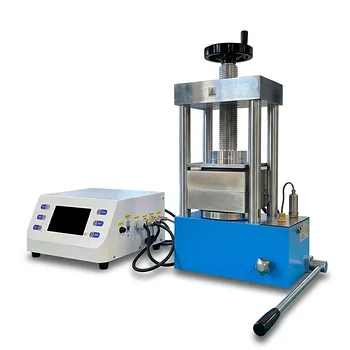
The pelletizing die and laboratory hydraulic press function as a unified system to transform loose magnesium mixtures into dense, structurally sound pellets. While the die provides the containment and geometric shape, the hydraulic press delivers the high-tonnage force necessary to compress the powder, a step that is critical for optimizing reaction kinetics in later processing stages.
The core purpose of this equipment is to maximize particle-to-particle contact. By densifying the powder mixture, you significantly shorten the diffusion distance between reactants, which is the primary driver for efficient solid-phase diffusion reactions.
The Mechanics of Compaction
The Role of the Die
The pelletizing die acts as a durable, high-strength container for the loose magnesium powder mixture. It typically features an internal plunger system that transfers force to the sample.
When placed within the press, the die confines the powder, preventing lateral expansion. This ensures that all applied energy is directed toward reducing the volume of the sample and increasing its density.
The Role of the Hydraulic Press
The laboratory hydraulic press applies precise, high-pressure force (often uniaxial) to the die’s plunger. This force overcomes the friction between particles and the resistance of the material itself.
This compression eliminates voids and air pockets within the loose powder. The result is a "green" pellet with specific density and sufficient mechanical strength to be handled without crumbling.
Why Densification Drives Performance
Enhancing Solid-Phase Diffusion
The most critical contribution of this process is the reduction of the diffusion distance.
In a loose powder state, reactant particles are separated by voids, making chemical reactions slow and inefficient. High-pressure pelletizing forces these particles into intimate, tight contact. This proximity significantly accelerates solid-phase diffusion reactions, leading to higher reaction efficiency during the reduction process.
Optimizing Furnace Operations
Beyond chemistry, pelletizing solves practical logistical problems in high-temperature reduction furnaces.
Compressed pellets allow for easier, more uniform material loading compared to loose powders, which can be dusty and difficult to handle. Furthermore, pellets enable better gas permeability management within the furnace, ensuring that reducing gases can flow effectively through the charge without blockage.
Understanding the Trade-offs
Balancing Density and Permeability
While high density is generally desired for particle contact, excessive compression can potentially hinder gas escape if not managed correctly.
The goal is to achieve a density that maximizes reactant contact while maintaining enough porosity for necessary gas transport. The press allows you to dial in specific pressures to find this optimal balance.
Internal Density Gradients
A common challenge in uniaxial pressing is the development of density gradients within the pellet.
Friction between the powder and the die walls can cause the edges of the pellet to be denser than the center. Using a high-quality die and applying pressure gradually can help minimize these inconsistencies, preventing cracks or structural failure during heating.
Making the Right Choice for Your Goal
To maximize the effectiveness of your magnesium pellet formation, consider your specific processing priorities:
- If your primary focus is reaction speed: Prioritize higher pressures to maximize density and particle contact, thereby minimizing diffusion distances for faster kinetics.
- If your primary focus is material handling: Focus on achieving a "green strength" threshold that ensures pellets do not degrade during furnace loading, even if maximum density is not required.
Success relies on using the press to achieve the precise density that balances structural integrity with chemical reactivity.
Summary Table:
| Component | Primary Function | Impact on Pellet Formation |
|---|---|---|
| Pelletizing Die | Material containment & shaping | Ensures directional force; prevents lateral expansion. |
| Hydraulic Press | Application of uniaxial force | Eliminates voids; increases green strength and density. |
| Dense Pellet | Reduced diffusion distance | Accelerates solid-phase diffusion; improves reaction speed. |
| Uniform Sizing | Optimized loading | Enhances gas permeability and handling in the furnace. |
Precision Pelletizing Solutions for Your Laboratory
Maximize your material research efficiency with KINTEK’s industry-leading sample preparation tools. Whether you are optimizing magnesium pellet density or conducting complex solid-phase diffusion studies, our high-performance laboratory hydraulic presses (pellet, hot, isostatic) and precision-engineered pelletizing dies provide the consistency and durability your lab demands.
Beyond compaction, KINTEK offers a comprehensive range of equipment to support your entire workflow, including:
- High-temperature furnaces (muffle, tube, vacuum, and more) for reduction and sintering.
- Crushing and milling systems for precursor preparation.
- High-temperature high-pressure reactors and autoclaves for advanced chemical synthesis.
- Specialized consumables like ceramics, crucibles, and PTFE products.
Ready to elevate your research results? Contact us today to discuss your specific application needs with our technical experts and discover the KINTEK advantage.
Related Products
- Automatic Laboratory Hydraulic Pellet Press Machine for Lab Use
- Laboratory Hydraulic Pellet Press for XRF KBR FTIR Lab Applications
- kbr pellet press 2t
- Laboratory Manual Hydraulic Pellet Press for Lab Use
- Laboratory Manual Hydraulic Pellet Press for Lab Use
People Also Ask
- What is the role of a laboratory hydraulic pellet press and stainless steel molds in the fabrication of RuO2/NbC anodes?
- What role does a laboratory pellet press play in the enhancement of biomass energy products? Optimize Fuel Efficiency
- What is the purpose of using a laboratory pellet press when evaluating the electronic conductivity of carbon powders? Guide
- How does a laboratory hydraulic pellet press contribute to SiCw/2024 aluminum composite preforms? Optimize Densification
- What is the significance of applying 200 MPa of pressure with a laboratory hydraulic pellet press for composite ceramics?