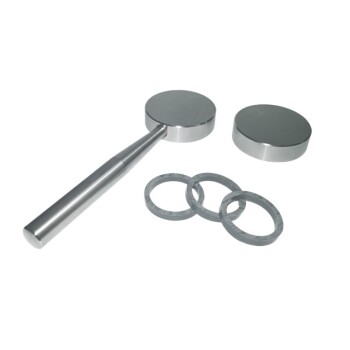
Graphite molds serve as dual-purpose structural and thermal instruments in the hot pressing sintering of (W0.4Al0.6)C0.65–Co cemented carbides. Specifically, they function as high-strength containment vessels capable of defining the alloy's shape while transmitting 40 MPa of mechanical pressure at temperatures ranging from 1400°C to 1500°C. Beyond physical shaping, their high thermal and electrical conductivity regulate the induction heating process to ensure the alloy achieves a uniform microstructure.
Core Takeaway The graphite mold is not merely a passive container; it is an active participant in the sintering process that bridges the gap between extreme mechanical force and precise thermal regulation. Its ability to maintain dimensional stability under high load while ensuring uniform heat transfer is the critical factor in achieving the structural integrity of the final cemented carbide.
The Mechanics of Containment and Densification
Defining Geometry Under Stress
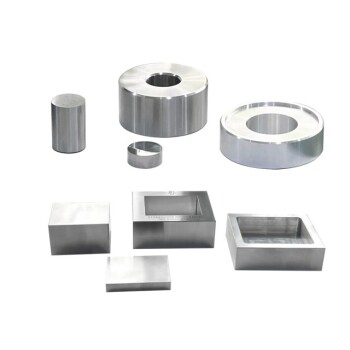
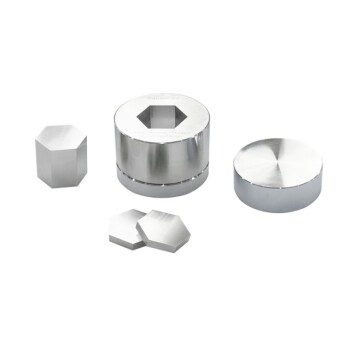
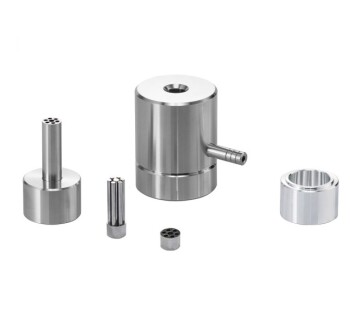
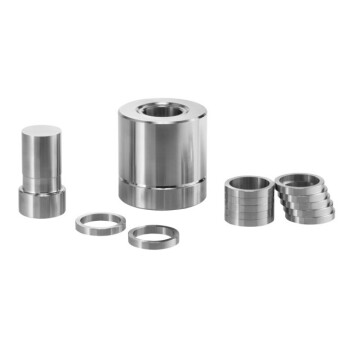
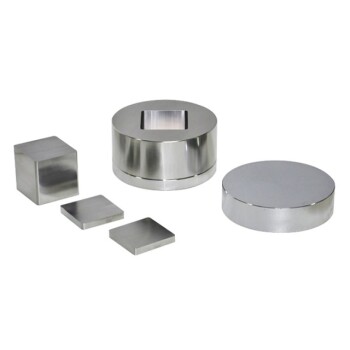
The primary function of the graphite mold is to act as a precision container that defines the macroscopic shape of the powder mixture.
Because the powder cannot support itself, the mold provides the rigid boundary necessary to restrict lateral movement. This containment forces the material to consolidate into the desired geometry rather than dispersing.
Withstanding Extreme Pressure and Temperature
For (W0.4Al0.6)C0.65–Co cemented carbides, the densification process requires an aggressive environment where standard metals would fail.
The graphite mold is specifically selected for its ability to withstand mechanical pressures of 40 MPa while simultaneously enduring temperatures between 1400°C and 1500°C.
Facilitating Mechanical Densification
The mold acts as the transmission medium for the hydraulic or mechanical force applied to the system.
It must possess sufficient high-temperature strength to transfer this axial pressure directly to the internal powder without deforming itself. This transfer is what drives the particle rearrangement and plastic flow necessary to eliminate voids and densify the product.
Thermal Regulation and Microstructure
Enabling Induction Heating
In this specific sintering context, the process utilizes an induction heating field.
The high electrical conductivity of the graphite allows the mold to couple effectively with the induction field. This interaction generates the heat required for sintering, turning the mold itself into a crucial component of the thermal generation system.
Ensuring Microstructural Uniformity
The quality of the final alloy depends heavily on how evenly heat is applied.
Graphite’s high thermal conductivity ensures that heat is distributed uniformly throughout the powder compact. This prevents thermal gradients (hot or cold spots) that could lead to uneven grain growth or structural defects, thereby guaranteeing the microstructural uniformity of the sintered alloy.
Operational Considerations and Environment
The Necessity of Protection
While graphite is robust at high temperatures, it is susceptible to oxidation.
To preserve the mold's integrity and extend its service life, this process typically occurs within a vacuum or protective atmosphere. This minimizes oxidative loss, ensuring the mold retains the precise dimensions required for accurate component forming.
Balancing Strength and Conductivity
The selection of the graphite grade is a balance between mechanical durability and thermal performance.
The mold must be dense enough to resist the 40 MPa pressure without cracking, yet conductive enough to facilitate the rapid and uniform heating cycles required for efficient production.
Making the Right Choice for Your Goal
To optimize the sintering of (W0.4Al0.6)C0.65–Co cemented carbides, align your process parameters with the mold's capabilities:
- If your primary focus is Maximum Density: Ensure the graphite grade selected has high compressive strength to maintain dimensional stability under the full 40 MPa load at peak temperatures.
- If your primary focus is Microstructural Homogeneity: Prioritize graphite with superior thermal conductivity specifications to maximize heat transfer efficiency within the induction field.
Success in hot pressing this alloy relies on treating the graphite mold as a precision thermal-mechanical tool rather than a simple consumable.
Summary Table:
| Function Category | Specific Role in Sintering Process | Impact on Material |
|---|---|---|
| Mechanical | Transmits 40 MPa axial pressure & defines geometry | Drives densification & eliminates voids |
| Thermal | Couples with induction field for heat generation | Enables rapid, consistent heating cycles |
| Structural | High-temperature strength (1400°C–1500°C) | Maintains dimensional stability & shape |
| Conductive | High thermal conductivity across the mold | Ensures microstructural uniformity |
| Environmental | Requires vacuum or protective atmosphere | Prevents oxidation & extends mold life |
Elevate Your Material Research with KINTEK Precision Solutions
Achieving perfect densification and microstructural integrity in cemented carbides requires more than just high temperatures—it demands high-performance thermal-mechanical tools. KINTEK specializes in premium laboratory equipment designed for the most demanding sintering environments.
From high-strength graphite molds and crucibles to advanced high-temperature vacuum furnaces and hydraulic presses, we provide the end-to-end solutions your lab needs to master materials like (W0.4Al0.6)C0.65–Co. Our portfolio also features high-pressure reactors, crushing systems, and cooling solutions to support every stage of your R&D workflow.
Ready to optimize your sintering process? Contact KINTEK today to consult with our experts on the right equipment for your specific application.
Related Products
- Special Heat Press Mold for Lab Use
- Ball Press Mold for Lab
- Double Plate Heating Press Mold for Lab
- Ultra-High Temperature Graphite Vacuum Graphitization Furnace
- Anti-Cracking Press Mold for Lab Use
People Also Ask
- How to use a press mold? Master the Art of Creating Consistent Ceramic Forms
- What is the press mould method? A Guide to Consistent, Detailed Ceramic Forms
- What is a press mold used for? Achieve Repeatable Precision and Efficiency
- What is the function of press molds during the preparation of SiCf/Ti-43Al-9V composites? Achieve Structural Precision
- What is the purpose of specialized pressure devices in sulfide solid-state batteries? Ensure Chemo-Mechanical Stability