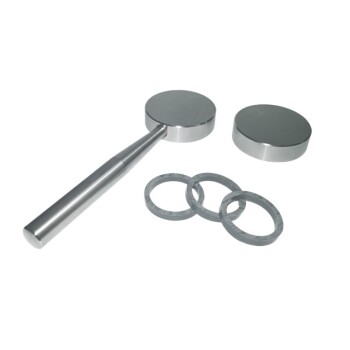
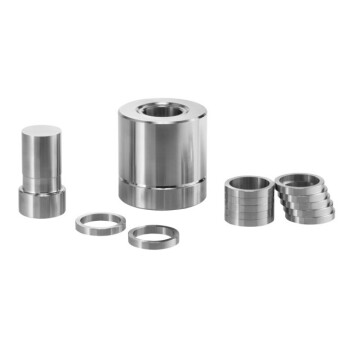
To withstand pressures up to 780 MPa, pressing dies for NASICON powder cold sintering must be constructed from materials with exceptional compressive strength, such as tungsten carbide or special alloy steel. Beyond simple mechanical durability, these dies must also possess high thermal conductivity to effectively transfer heat from the laboratory press to the sample, ensuring precise densification without deformation.
Core Takeaway: Success in high-pressure cold sintering relies on a dual-function die: it must maintain rigid structural integrity under immense mechanical load while simultaneously acting as an efficient thermal conduit for the sintering process.
Material Composition and Mechanical Strength
To handle the extreme stress of 780 MPa, the physical composition of the die is the single most critical factor. Standard tooling materials will likely fail or deform under these conditions.
Essential Material Hardness
The die must be fabricated from special alloy steel or tungsten carbide. These materials are specifically selected for their high hardness and ability to resist fracture under heavy mechanical loading.
Preventing Structural Deformation
At 780 MPa, softer metals can experience plastic deformation, which destroys the die and ruins the sample's dimensional accuracy. The chosen material must possess extremely high compressive strength to remain rigid throughout the pressing cycle.
Thermal Performance and Integration
Cold sintering is not purely mechanical; it is a thermodynamically driven process. The die acts as the critical bridge between your equipment and your chemistry.
Effective Heat Transfer
The die serves as the thermal interface between the heated hydraulic press and the NASICON powder. It must have high thermal conductivity to ensure the powder reaches the necessary temperature for sintering mechanisms to activate.
Ensuring Optimal Densification
Proper heat flow is required to achieve the target density of the ceramic. If the die insulates the sample rather than conducting heat, the combination of pressure and temperature will fail to produce a solid, well-sintered pellet.
Operational Considerations and Trade-offs
While the die is the primary hardware constraint, the success of the pressing operation depends on how the die interacts with the powder and the broader process variables.
Material Stiffness vs. Brittleness
Materials like tungsten carbide offer superior rigidity compared to steel, but they can be more brittle. While they resist deformation at 780 MPa better than steel, they require careful handling to avoid catastrophic fracture if subjected to shock loading or misalignment.
The Role of Powder Quality
Even a perfect die cannot compensate for poor starting material. As noted in broader pressing contexts, the powder must be free-flowing and easily compacted.
Impact of Powder Preparation
Using spray-dried powder or adjusting binder content can improve flowability and green body formation. If the powder does not distribute evenly within the die, it can create localized pressure gradients that may damage the die or lead to uneven densification.
Making the Right Choice for Your Goal
Selecting the correct die configuration is a balance between durability, thermal properties, and cost.
- If your primary focus is maximum durability: Prioritize tungsten carbide dies, as they offer the highest resistance to deformation at pressures approaching 780 MPa.
- If your primary focus is process consistency: Ensure the die material has verified thermal conductivity specifications to guarantee uniform heating of the NASICON sample.
- If your primary focus is sample quality: Combine a high-strength die with optimized, free-flowing powder to ensure even compaction and precise dimensions.
Invest in tooling that treats heat transfer as equally important to mechanical strength to ensure your NASICON electrolytes achieve full density.
Summary Table:
| Requirement Category | Specification for 780 MPa | Rationale |
|---|---|---|
| Material Choice | Tungsten Carbide or Special Alloy Steel | Prevents fracture and plastic deformation under extreme mechanical load. |
| Mechanical Property | High Compressive Strength & Hardness | Maintains dimensional accuracy and structural integrity of the die. |
| Thermal Property | High Thermal Conductivity | Ensures efficient heat transfer from the press to the powder for sintering. |
| Powder Interaction | Free-flowing, Uniform Distribution | Prevents localized pressure gradients that can damage tooling or samples. |
Elevate Your Material Research with KINTEK Precision Engineering
Achieving full density in NASICON electrolytes requires more than just pressure—it requires high-performance tooling designed for extreme environments. KINTEK specializes in premium laboratory equipment, offering high-strength tungsten carbide dies and hydraulic pellet presses engineered to withstand 780 MPa and beyond.
From our robust crushing and milling systems for powder preparation to our advanced high-temperature furnaces and isostatic presses, we provide the end-to-end solutions your lab needs for ceramic and battery research.
Ready to optimize your sintering process? Contact KINTEK today to consult with our experts on the perfect die and press configuration for your application!
Related Products
- XRF & KBR plastic ring lab Powder Pellet Pressing Mold for FTIR
- Ring Press Mold for Lab Applications
- XRF & KBR steel ring lab Powder Pellet Pressing Mold for FTIR
People Also Ask
- What is the purpose of using a mold for pellet pressing when preparing catalyst test samples? Ensure Data Consistency
- How does the selection of a pressure mold affect the performance of all-solid-state batteries? Expert Pelletizing Guide
- What is the pressed powder pellet method? A Guide to Accurate FTIR Sample Preparation
- What is the XRF method of sampling? Achieve Accurate Elemental Analysis with Proper Sample Prep
- What is the XRF pressed pellet method? A Fast, Cost-Effective Sample Prep Guide