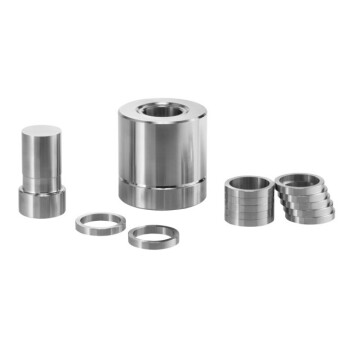
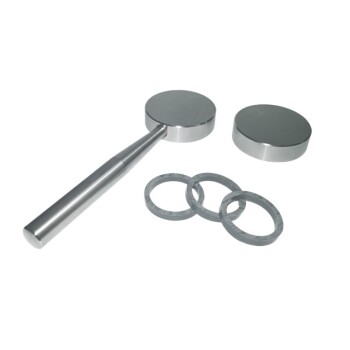
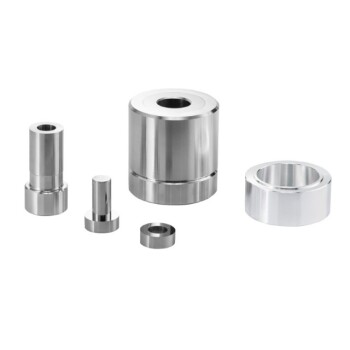
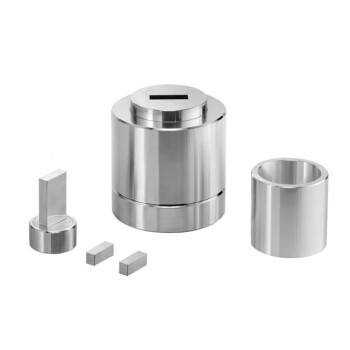
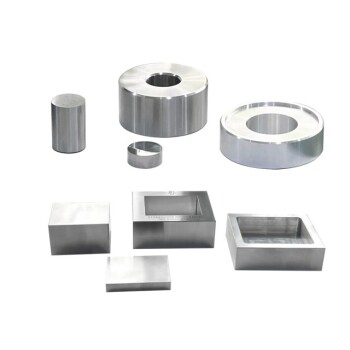
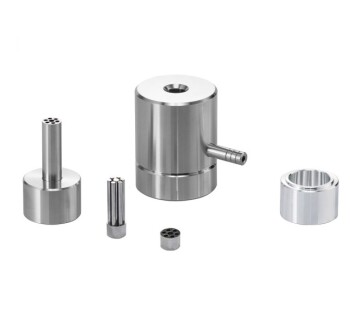
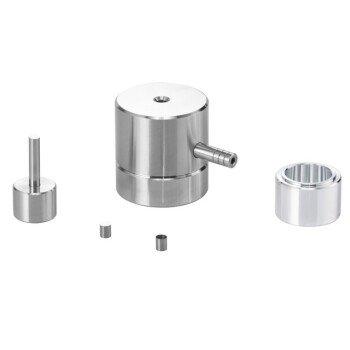
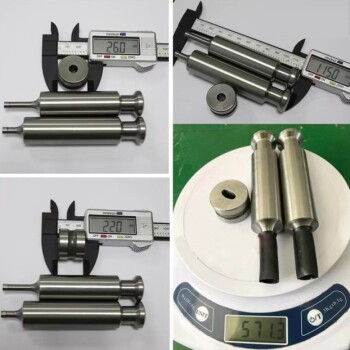
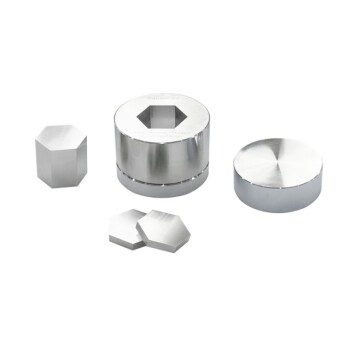
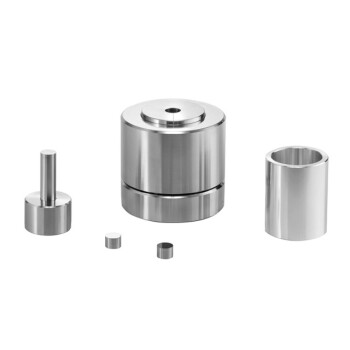
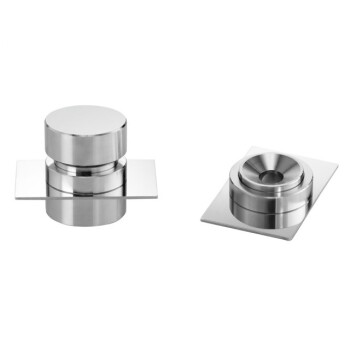
The primary purpose of using a mold during catalyst preparation is to transform loose powder into a dense, cohesive pellet that can withstand the rigors of high-temperature treatment. By compressing the catalyst powder—typically mixed with a binder like acetic acid—you increase its bulk density, creating a stable block that serves as the foundation for controlled particle sizing.
The mold is not used to create the final shape, but to establish structural stability. It allows the material to be calcined effectively so it can be subsequently crushed and sieved into specific, uniform particle sizes for consistent testing.
The Role of Density and Stability
The fundamental reason for using a mold is to alter the physical state of the raw catalyst material.
Increasing Bulk Density
Loose catalyst powder often lacks the density required for consistent handling. Pressing the powder in a mold significantly increases its bulk density.
Creating a Cohesive Unit
By applying pressure to the powder and binder mixture, you create a solid block. This ensures the material acts as a single, cohesive unit rather than a collection of loose particulates.
Enhancing Structural Integrity
The molded shape provides structural stability. This prevents the catalyst from disintegrating or behaving unpredictably during the initial stages of handling and processing.
Facilitating Thermal Treatment
Once the pellet is formed, it must undergo thermal processing. The mold plays a critical role in preparing the sample for this step.
Stable Calcination
Catalysts frequently require calcination (high-temperature heating). A compressed pellet withstands this intense heat better than loose powder, maintaining its integrity throughout the process.
Binder Integration
The reference notes the use of an acetic acid binder mixed with the powder. The molding process ensures this binder effectively holds the particles together until the structure is set by the heat.
Achieving Precision in Particle Size
The ultimate goal of the molding process is not the pellet itself, but the specific particles derived from it.
Enabling the "Crush and Sieve" Method
After the molded pellet is calcined, the resulting block is crushed. Because the block was pressed to a uniform density, it fractures more predictably.
Isolating Specific Ranges
The crushed material is then sieved. This allows researchers to isolate a precise particle size range.
Ensuring Experimental Consistency
By starting with a uniform molded block, you ensure that the final particles used in tests are consistent. This eliminates variables in particle size that could skew experimental data.
Understanding the Process Trade-offs
While molding is essential for consistency, it introduces specific requirements that must be managed.
The Necessity of Post-Processing
It is important to remember that the molded pellet is temporary. It is designed to be destroyed (crushed) later; its purpose is to facilitate the intermediate steps of calcination and sizing, not to serve as the final form.
Binder Dependency
The success of the molding process relies on the mixture. The acetic acid binder is necessary to create adhesion; without it, the powder may not hold the mold shape or achieve the necessary density.
Making the Right Choice for Your Goal
To ensure your catalyst testing yields reliable data, consider how you apply this pelletizing process.
- If your primary focus is Structural Stability: Ensure the pressing force and binder ratio are sufficient to create a block that survives calcination without crumbling.
- If your primary focus is Data Consistency: Prioritize the uniformity of your molding process, as density variations in the pellet will lead to irregular particle sizes after crushing.
Using a mold is a disciplined step to convert a chaotic powder into a controllable, standardized testing material.
Summary Table:
| Feature | Purpose in Catalyst Preparation |
|---|---|
| Increased Bulk Density | Transforms loose powder into a dense, handleable cohesive unit. |
| Structural Stability | Prevents disintegration during high-temperature calcination. |
| Binder Integration | Ensures acetic acid or binders effectively hold particles together. |
| Crush & Sieve Method | Enables precise particle size isolation for standardized testing. |
| Data Consistency | Minimizes variables by ensuring uniform density before sizing. |
Precision Catalyst Preparation Starts with KINTEK
Unlock superior experimental consistency with high-performance laboratory solutions from KINTEK. Whether you are preparing catalyst samples or advancing material science, our precision hydraulic presses (pellet, hot, isostatic) and custom-engineered molds provide the uniform density required for reliable 'crush and sieve' analysis.
Beyond sample preparation, KINTEK offers a comprehensive ecosystem for your lab, including:
- High-Temperature Muffle & Tube Furnaces for stable calcination.
- Crushing & Milling Systems for precise particle size reduction.
- Sieving Equipment to ensure range uniformity.
- Specialized Reactors & Autoclaves for advanced catalyst testing.
Don't let sample variability compromise your research. Contact KINTEK today to discover how our equipment can enhance your lab's efficiency and data accuracy.
References
- Cheng‐Di Dong, Chang‐Mao Hung. Platinum particles supported on mesoporous carbons: fabrication and electrocatalytic performance in methanol-tolerant oxygen-reduction reactions. DOI: 10.1038/srep05790
This article is also based on technical information from Kintek Solution Knowledge Base .
Related Products
- XRF Boric Acid Lab Powder Pellet Pressing Mold for Laboratory Use
- XRF & KBR steel ring lab Powder Pellet Pressing Mold for FTIR
- XRF & KBR plastic ring lab Powder Pellet Pressing Mold for FTIR
- Ring Press Mold for Lab Applications
- Assemble Square Lab Press Mold for Laboratory Applications
People Also Ask
- What is the XRF method of sampling? Achieve Accurate Elemental Analysis with Proper Sample Prep
- What is the XRF pressed pellet method? A Fast, Cost-Effective Sample Prep Guide
- How are samples prepared for XRF analysis? Achieve Accurate and Reliable Results
- How do you make XRF pellets? A 4-Step Guide to Flawless Sample Preparation
- How to make XRF pellets? A Step-by-Step Guide for Accurate Sample Preparation