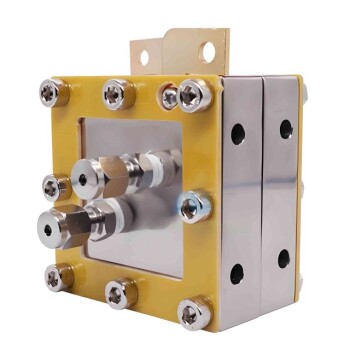
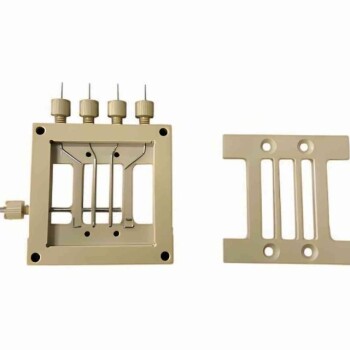
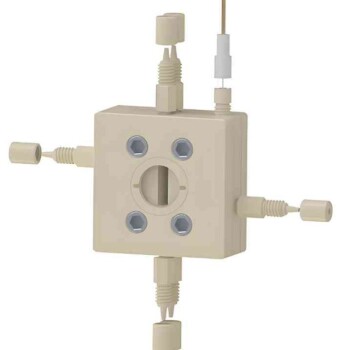
The configuration of a laboratory electrolytic cell is the defining factor in data reliability. It directly impacts the accuracy of critical measurements, such as overpotential and Tafel slopes, by establishing a precise relationship between working, auxiliary, and reference electrodes. Furthermore, the physical structure of the system dictates the efficiency of ion conduction and the effectiveness of gas separation during the reaction.
Core Takeaway Success in Water Electrolysis Hydrogen Evolution Reaction (HER) experiments relies not just on the catalyst, but on the testing environment. A properly configured cell system eliminates structural inefficiencies, ensuring that the measured kinetic barriers are intrinsic to the nanomaterial and not artifacts of the experimental setup.
The Role of Precision in Electrochemical Measurements
Establishing a Controlled Environment
To evaluate the true potential of nanomaterials, you must minimize external interference. Laboratory electrolytic cell systems provide a controlled electrochemical environment necessary for rigorous testing.
This control is achieved through the precise arrangement of working, auxiliary, and reference electrodes.
Capturing Key Performance Metrics
The configuration of these electrodes allows for the accurate extraction of fundamental performance data.
Specifically, it enables the precise measurement of overpotential, Tafel slopes, and exchange current densities. These metrics are essential for determining the electrocatalytic activity of the material in question.
Versatility Across Conditions
A robust cell configuration is designed to function effectively across various chemical environments.
This flexibility allows researchers to evaluate electrocatalysts across various pH levels, ensuring the material can overcome water-splitting kinetic barriers under different operating conditions.
The Physical Design and System Efficiency
Optimizing Ion Conduction
The structural design of the cell is not merely a vessel; it is an active component of the circuit.
The geometry and layout directly influence the ion conduction efficiency of the electrolyte. Poor design can lead to increased resistance, masking the true performance of the catalyst.
Managing Gas Evolution
In HER experiments, the management of reaction products is critical.
The system's configuration determines the effectiveness of the collection and separation of generated hydrogen and oxygen gases. Efficient separation is vital for safety and for accurate quantification of the reaction yield.
Common Pitfalls to Avoid
Misinterpreting Structural Inefficiencies
A common error in cell configuration is failing to account for geometric limitations.
If the structural design inhibits ion flow or gas escape, you may observe artificially high kinetic barriers. This can lead to the incorrect conclusion that a nanomaterial has poor catalytic activity, when the fault actually lies in the cell's design.
Inconsistent Electrode Placement
The precision of the system relies on the fixed relationship between the three electrodes.
Inconsistent spacing or alignment can skew overpotential measurements. This introduces variability that makes it difficult to compare Tafel slopes and exchange current densities between different experiments.
Making the Right Choice for Your Experiment
To ensure your HER data is valid and reproducible, align your cell configuration with your specific research goals.
- If your primary focus is material characterization: Prioritize a configuration with precise reference electrode placement to ensure accurate measurement of overpotential and Tafel slopes.
- If your primary focus is system efficiency: Ensure the structural design maximizes ion conduction efficiency and provides robust mechanisms for gas separation.
The quality of your data is only as good as the engineering of your electrolytic cell.
Summary Table:
| Feature | Impact on HER Experiment | Key Performance Benefit |
|---|---|---|
| Electrode Arrangement | Establishes precise 3-electrode relationship | Accurate overpotential and Tafel slope data |
| Structural Geometry | Influences electrolyte resistance | Maximized ion conduction efficiency |
| Gas Management | Controls product collection | Safe and effective separation of H₂ and O₂ |
| Versatility | Enables testing across pH levels | Reliable kinetic barrier assessment in all media |
Elevate Your Electrochemical Research with KINTEK
Don't let structural inefficiencies compromise your data. KINTEK specializes in precision-engineered electrolytic cells and electrodes designed to minimize resistance and ensure the highest data reliability for your hydrogen evolution reaction (HER) studies.
Our comprehensive laboratory portfolio includes:
- High-Temperature Equipment: Muffle, tube, and vacuum furnaces for material synthesis.
- Sample Preparation: Crushing, milling, and high-performance hydraulic presses.
- Specialized Reactors: High-temperature high-pressure reactors and autoclaves for advanced catalysis.
- Cooling & Processing: ULT freezers, freeze dryers, and homogenizers.
Whether you are evaluating nanomaterials or optimizing system efficiency, KINTEK provides the tools needed for reproducible, world-class results. Contact us today to find the perfect cell configuration for your lab!
References
- Jhonatan Luiz Fiorio, Giovanna Machado. Nanoengineering of Catalysts for Enhanced Hydrogen Production. DOI: 10.3390/hydrogen3020014
This article is also based on technical information from Kintek Solution Knowledge Base .
Related Products
- Electrolytic Electrochemical Cell for Coating Evaluation
- Customizable PEM Electrolysis Cells for Diverse Research Applications
- Electrolytic Electrochemical Cell Gas Diffusion Liquid Flow Reaction Cell
- Electrolytic Electrochemical Cell with Five-Port
- PTFE Electrolytic Cell Electrochemical Cell Corrosion-Resistant Sealed and Non-Sealed
People Also Ask
- What is the volume range of the coating evaluation electrolytic cell? A Guide to Choosing the Right Size
- How does the design of an electrochemical electrolytic cell influence the coating uniformity? Optimize Your Catalysts
- What is the correct shutdown and disassembly procedure after an experiment? Ensure Safety and Protect Your Equipment
- How do the electrochemical cell and three-electrode testing system collaborate? Optimize Zinc Anode Deposition Control
- What is the difference between a voltaic cell and an electrochemical cell? Understand the Two Types of Energy Conversion