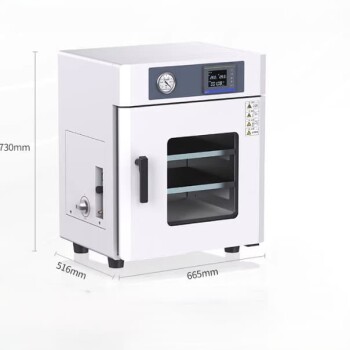
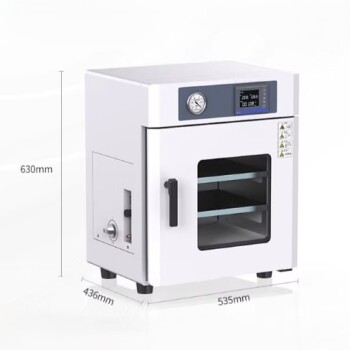
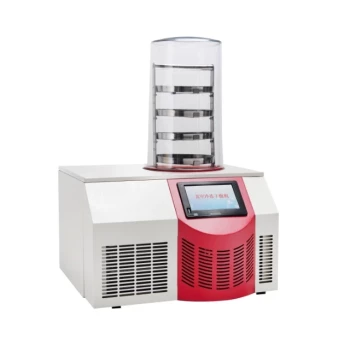
The use of a vacuum drying oven is essential for preserving the structural integrity and chemical activity of Bismuth Oxybromide (BiOBr) powder. This specific drying method allows you to remove residual moisture and ethanol at significantly lower temperatures (typically 60°C), preventing the thermal damage associated with standard atmospheric drying.
By substituting high heat with reduced pressure, you prevent the BiOBr microspheres from oxidizing or fusing together, ensuring the final powder remains loose, dispersible, and chemically active.
Protecting Morphological Integrity
The primary challenge in drying Bismuth Oxybromide is removing solvents without altering the physical structure of the powder.
Lowering the Thermal Stress
Standard drying relies on high heat to evaporate solvents, which can degrade sensitive materials. A vacuum oven reduces the ambient pressure, which significantly lowers the boiling point of residual ethanol and water.
This allows these solvents to evaporate efficiently at a gentle 60°C, protecting the fundamental structure of the BiOBr.
Preventing Agglomeration
High temperatures often cause powder particles to sinter or stick together.
By keeping the temperature low, vacuum drying prevents this powder agglomeration. This ensures the final product consists of distinct, loose microspheres rather than hard, fused clumps.
Maintaining "Looseness"
The "looseness" of the powder is a critical quality metric.
Only a loose, non-agglomerated powder can be handled effectively during subsequent processing steps. Vacuum drying ensures the material retains this free-flowing characteristic.
Preserving Chemical Activity
Beyond the physical shape, the chemical surface of the particle determines its performance.
Inhibiting Surface Oxidation
BiOBr is susceptible to oxidation when exposed to high temperatures in an air-rich environment.
The vacuum environment removes oxygen from the chamber, minimizing the risk of surface oxidation. This preserves the material's purity and inherent chemical properties.
Ensuring Effective Dispersion
The ultimate goal of preparing BiOBr is often to integrate it into a matrix, such as epoxy resin.
If the powder is agglomerated or oxidized, it will not disperse evenly. Vacuum drying guarantees the activity and dispersion quality required to reinforce these matrix materials effectively.
Understanding the Trade-offs
While vacuum drying is technically superior for BiOBr, it introduces specific operational constraints that must be managed.
Throughput vs. Quality
Vacuum drying is generally a batch process that may take longer than high-temperature conveyor drying. You are trading processing speed for material quality. If speed is the only metric, vacuum drying appears inefficient; however, for functional materials like BiOBr, the quality loss from faster methods is usually unacceptable.
Equipment Complexity
Unlike simple convection ovens, this process requires a vacuum pump and a sealable chamber. This adds a layer of maintenance regarding pump oil, seals, and pressure monitoring. Failures in the vacuum seal can lead to inconsistent drying or localized oxidation.
Making the Right Choice for Your Goal
To maximize the performance of your Bismuth Oxybromide preparation, align your drying parameters with your end goals.
- If your primary focus is Composite Reinforcement (e.g., Epoxy): Prioritize vacuum drying to ensure the microspheres remain distinct and loose, allowing for uniform dispersion within the resin matrix.
- If your primary focus is Chemical Purity: Rely on the vacuum environment to lower the boiling point of solvents, ensuring complete removal of ethanol without thermally inducing surface oxidation.
The vacuum drying stage is not merely a drying step; it is a preservation technique that defines the final quality and usability of your BiOBr microspheres.
Summary Table:
| Feature | Vacuum Drying (60°C) | Standard Atmospheric Drying | Benefit to BiOBr |
|---|---|---|---|
| Boiling Point | Lowered via reduced pressure | High (requires more heat) | Prevents thermal degradation |
| Morphology | Preserves loose microspheres | Causes sintering/agglomeration | Ensures easy dispersion in resins |
| Chemical Purity | Low oxygen prevents oxidation | High oxygen risk at heat | Maintains surface activity |
| Physical State | Free-flowing powder | Hard, fused clumps | Improved handling and processing |
Elevate Your Material Research with KINTEK Precision
Don't compromise the integrity of your sensitive BiOBr microspheres or advanced functional materials. KINTEK specializes in high-performance laboratory solutions designed to protect your chemical activity and structural results. Whether you require advanced vacuum drying ovens for delicate powders, high-temperature furnaces (muffle, tube, or vacuum) for synthesis, or high-pressure reactors and autoclaves for hydrothermal preparation, we provide the tools necessary for scientific excellence.
From crushing and milling systems to ensure particle uniformity to PTFE products and ceramics for chemical resistance, KINTEK is your partner in laboratory efficiency.
Ready to optimize your drying process and ensure superior powder quality? Contact our technical experts today to find the perfect equipment for your lab's specific needs!
References
- Yuan Jia, Zhen Liu. The Enhancement of the Thermal Conductivity of Epoxy Resin Reinforced by Bromo-Oxybismuth. DOI: 10.3390/polym15234616
This article is also based on technical information from Kintek Solution Knowledge Base .
Related Products
- 56L Vertical Laboratory Vacuum Drying Oven
- 23L Laboratory Vacuum Drying Oven
- Laboratory Scientific Electric Heating Blast Drying Oven
- Benchtop Laboratory Vacuum Freeze Dryer
- Vacuum Heat Treat Sintering Brazing Furnace
People Also Ask
- Why is a laboratory vacuum drying oven recommended for rice straw residues? Protect Your Biomass Integrity
- What role does a laboratory vacuum drying oven play in the preparation of modified multi-walled carbon nanotubes?
- What is the importance of using a laboratory vacuum drying oven? Preserving Slow-Release Microcapsule Integrity
- Why is a Laboratory Vacuum Drying Oven recommended for PBAT microspheres? Protect Sensitive Polymer Integrity
- What role does a laboratory vacuum drying oven play in processing nanoparticle powder samples? Protect Sample Integrity