Knowledge laboratory mill What is the particle size of a colloid mill? Achieve 1-5 Micron Emulsions for Superior Stability
Author avatar

Tech Team · Kintek Solution

Updated 3 months ago

What is the particle size of a colloid mill? Achieve 1-5 Micron Emulsions for Superior Stability


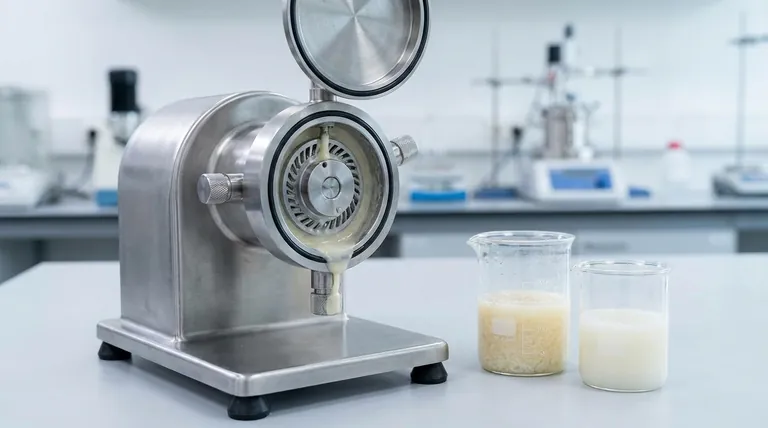
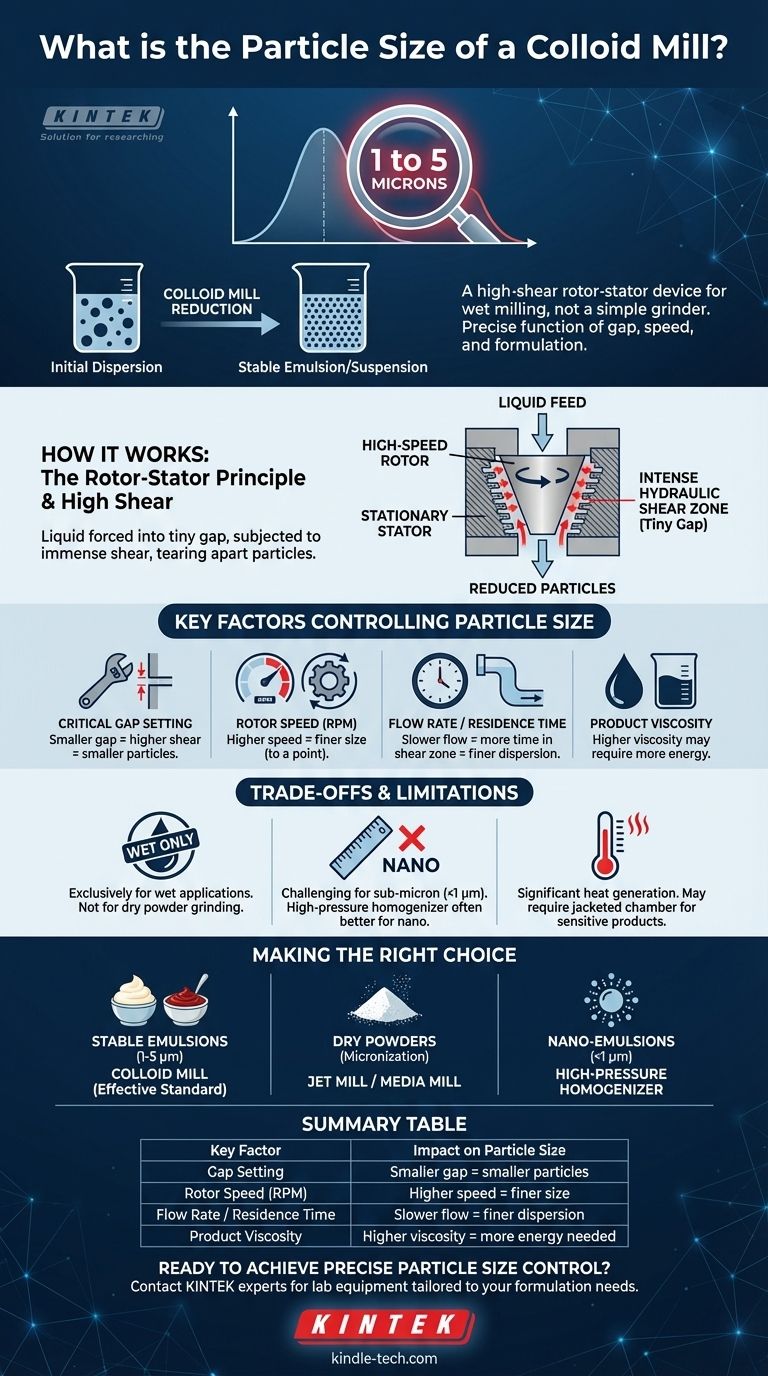
In a properly configured colloid mill, you can expect to achieve a particle or droplet size distribution typically in the range of 1 to 5 microns. This technology excels at reducing the size of particles or droplets already dispersed within a liquid to create stable emulsions and suspensions.

A colloid mill is not a simple grinder; it is a high-shear rotor-stator device designed for wet milling applications. The final particle size is less about brute force and more a precise function of the gap setting, rotor speed, and the formulation of your product.
What is the particle size of a colloid mill? Achieve 1-5 Micron Emulsions for Superior Stability

How a Colloid Mill Achieves Particle Reduction

A colloid mill operates on a simple but effective mechanical principle to create extremely high shear forces. Understanding this mechanism is key to controlling the outcome.

The Rotor-Stator Principle

The core of the machine consists of a high-speed rotor that spins with very close proximity to a stationary stator. Both the rotor and stator are typically conical and feature intricate patterns of grooves and channels.

The Role of High Shear

As the liquid product is fed into the mill, it is forced into the tiny gap between the spinning rotor and the fixed stator. The intense velocity difference in this gap subjects the material to immense hydraulic shear, which tears apart and reduces the size of suspended particles or liquid droplets.

Key Factors Controlling Final Particle Size

Achieving your target particle size is not automatic. It requires careful control over several operational variables.

The Critical Gap Setting

The most influential factor is the adjustable gap between the rotor and stator. A smaller gap (measured in thousandths of an inch) creates higher shear forces and results in smaller particles.

Rotor Speed (RPM)

The rotational speed of the rotor directly impacts the amount of shear energy applied to the product. Higher speeds generally lead to finer particle sizes, though there is a point of diminishing returns.

Residence Time and Flow Rate

The amount of time the product spends within the high-shear zone is critical. A slower flow rate increases the residence time, allowing each portion of the product to receive more energy, typically resulting in a finer dispersion.

Product Viscosity and Formulation

The physical properties of your liquid base and the presence of stabilizers (surfactants) play a significant role. Higher viscosity products may require more energy to achieve the same particle size reduction.

Understanding the Trade-offs and Limitations

While powerful, a colloid mill is a specialized tool with specific strengths and weaknesses. It is not the correct solution for every particle reduction task.

Designed for Wet Milling Only

A colloid mill is exclusively for wet applications where solid particles or immiscible liquids are already suspended in a liquid carrier. It cannot be used for dry powder grinding.

Sub-Micron Challenges

While a colloid mill can approach 1 micron, producing particles consistently well below this size (in the nanometer range) is difficult. For true nano-emulsions, a high-pressure homogenizer is often a more effective technology.

Significant Heat Generation

The intense shear energy is converted into heat. For temperature-sensitive products like certain pharmaceuticals or food emulsions, this heat generation must be managed, often with a jacketed milling chamber.

Making the Right Choice for Your Application

Selecting the correct milling technology requires a clear understanding of your starting material and final product goals.

  • If your primary focus is creating stable emulsions or dispersions (like sauces, creams, or inks) in the 1-5 micron range: A colloid mill is a highly effective and standard piece of equipment for this task.
  • If your primary focus is grinding dry powders into fine particles (micronization): You should investigate a completely different technology, such as a jet mill or a media mill.
  • If your primary focus is producing nano-emulsions or dispersions consistently below 1 micron: A high-pressure homogenizer is the more appropriate and powerful technology for the job.

Ultimately, choosing the right equipment begins with a clear definition of your target particle size and processing requirements.

Summary Table:

Key Factor Impact on Particle Size
Gap Setting Smaller gap = higher shear = smaller particles
Rotor Speed (RPM) Higher speed = finer particle size
Flow Rate / Residence Time Slower flow = more time in shear zone = finer dispersion
Product Viscosity Higher viscosity may require more energy for size reduction

Ready to achieve precise particle size control for your emulsions or dispersions? The experts at KINTEK are here to help. We specialize in lab equipment and consumables, providing colloid mills and other high-shear technologies tailored to your formulation needs—whether you're developing pharmaceuticals, food products, or specialty chemicals. Contact our team today to discuss your application and discover the ideal solution for your laboratory.

Visual Guide
What is the particle size of a colloid mill? Achieve 1-5 Micron Emulsions for Superior Stability Visual Guide

Related Products

People Also Ask

Related Products

Stainless Steel Laboratory Ball Mill for Dry Powder and Liquid with Ceramic Polyurethane Lining

Stainless Steel Laboratory Ball Mill for Dry Powder and Liquid with Ceramic Polyurethane Lining

Discover the versatile stainless steel dry powder/liquid horizontal ball mill with ceramic/polyurethane lining. Ideal for ceramic, chemical, metallurgical, and building materials industries. High grinding efficiency and uniform particle size.

Laboratory Four-Body Horizontal Jar Mill

Laboratory Four-Body Horizontal Jar Mill

The four-body horizontal tank mill ball mill can be used with four horizontal ball mill tanks with a volume of 3000ml. It is mostly used for mixing and grinding laboratory samples.

Laboratory Single Horizontal Jar Mill

Laboratory Single Horizontal Jar Mill

KT-JM3000 is a mixing and grinding instrument for placing a ball milling tank with a volume of 3000ml or less. It adopts frequency conversion control to realize timing, constant speed, direction change, overload protection and other functions.

Laboratory Jar Mill with Agate Grinding Jar and Balls

Laboratory Jar Mill with Agate Grinding Jar and Balls

Grind your materials with ease using Agate Grinding Jars with Balls. Sizes from 50ml to 3000ml, perfect for planetary and vibration mills.

Laboratory Ball Mill Jar Mill with Metal Alloy Grinding Jar and Balls

Laboratory Ball Mill Jar Mill with Metal Alloy Grinding Jar and Balls

Grind and mill with ease using metal alloy grinding jars with balls. Choose from 304/316L stainless steel or tungsten carbide and optional liner materials. Compatible with various mills and features optional functions.

High Energy Vibratory Ball Mill for Lab Use

High Energy Vibratory Ball Mill for Lab Use

The high-energy vibrating ball mill is a high-energy oscillating and impacting multifunctional laboratory ball mill. The table-top type is easy to operate, small in size, comfortable and safe.

Laboratory Disc Cup Vibratory Mill for Sample Grinding

Laboratory Disc Cup Vibratory Mill for Sample Grinding

The vibrating disc mill is suitable for non-destructive crushing and fine grinding of samples with large particle sizes, and can quickly prepare samples with analytical fineness and purity.

High-Energy Omnidirectional Planetary Ball Mill Machine for Laboratory

High-Energy Omnidirectional Planetary Ball Mill Machine for Laboratory

The KT-P2000E is a new product derived from the vertical high-energy planetary ball mill with a 360°rotation function. The product not only has the characteristics of the vertical high-energy ball mill, but also has a unique 360°rotation function for the planetary body.

High-Energy Omnidirectional Planetary Ball Mill Milling Machine for Laboratory

High-Energy Omnidirectional Planetary Ball Mill Milling Machine for Laboratory

The KT-P4000E is a new product derived from the vertical high-energy planetary ball mill with a 360° swivel function. Experience faster, uniform, and smaller sample output results with 4 ≤1000ml ball mill jars.

Laboratory Micro Horizontal Jar Mill for Precision Sample Preparation in Research and Analysis

Laboratory Micro Horizontal Jar Mill for Precision Sample Preparation in Research and Analysis

Discover the Micro Horizontal Jar Mill for precise sample preparation in research and analysis. Ideal for XRD, geology, chemistry, and more.

Laboratory Horizontal Planetary Ball Mill Milling Machine

Laboratory Horizontal Planetary Ball Mill Milling Machine

Improve sample uniformity with our Horizontal Planetary Ball Mills. KT-P400H reduces sample deposition and KT-P400E has multi-directional capabilities. Safe, convenient and efficient with overload protection.

Laboratory Grinding Mill Mortar Grinder for Sample Preparation

Laboratory Grinding Mill Mortar Grinder for Sample Preparation

KT-MG200 mortar grinder can be used for mixing and homogenizing powder, suspension, paste and even viscous samples. It can help users realize the ideal operation of sample preparation with more regularization and higher repeatability.

Laboratory Ten-Body Horizontal Jar Mill for Lab Use

Laboratory Ten-Body Horizontal Jar Mill for Lab Use

The Ten-body horizontal jar mill is for 10 ball mill pots (3000ml or less). It has frequency conversion control, rubber roller movement, and PE protective cover.

Laboratory Planetary Ball Mill Rotating Ball Milling Machine

Laboratory Planetary Ball Mill Rotating Ball Milling Machine

KT-P400E is a desktop multi-directional planetary ball mill with unique grinding and mixing capabilities. It offers continuous and intermittent operation, timing, and overload protection, making it ideal for various applications.

Mini Planetary Ball Mill Machine for Laboratory Milling

Mini Planetary Ball Mill Machine for Laboratory Milling

Discover the KT-P400 desktop planetary ball mill, ideal for grinding and mixing small samples in the lab. Enjoy stable performance, long service life, and practicality. Functions include timing and overload protection.

High Energy Planetary Ball Mill Milling Machine for Laboratory

High Energy Planetary Ball Mill Milling Machine for Laboratory

Experience fast and effective sample processing with the F-P2000 high-energy planetary ball mill. This versatile equipment offers precise control and excellent grinding capabilities. Perfect for laboratories, it features multiple grinding bowls for simultaneous testing and high output. Achieve optimal results with its ergonomic design, compact structure, and advanced features. Ideal for a wide range of materials, it ensures consistent particle size reduction and low maintenance.

High Energy Planetary Ball Mill Milling Machine for Laboratory

High Energy Planetary Ball Mill Milling Machine for Laboratory

The biggest feature is that the high energy planetary ball mill can not only perform fast and effective grinding, but also has good crushing ability

Hybrid High Energy Vibratory Ball Mill for Lab Use

Hybrid High Energy Vibratory Ball Mill for Lab Use

KT-BM400 is used for rapid grinding or mixing of dry, wet and frozen small amount of samples in the laboratory. It can be configured with two 50ml ball mill jars

High Energy Planetary Ball Mill for Laboratory Horizontal Tank Type Milling Machine

High Energy Planetary Ball Mill for Laboratory Horizontal Tank Type Milling Machine

KT-P4000H uses the unique Y-axis planetary motion trajectory, and utilizes the collision, friction and gravity between the sample and the grinding ball to have a certain anti-sinking ability, which can obtain better grinding or mixing effects and further improve the sample output.

High Energy Planetary Ball Mill Machine for Laboratory Horizontal Tank Type

High Energy Planetary Ball Mill Machine for Laboratory Horizontal Tank Type

The KT-P2000H uses a unique Y-axis planetary trajectory, and utilizes the collision, friction and gravity between the sample and the grinding ball.


Leave Your Message