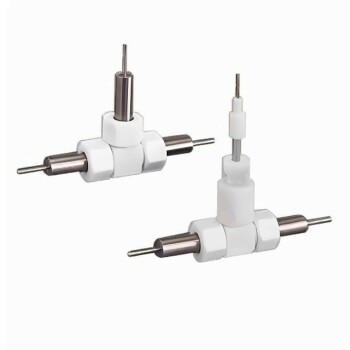
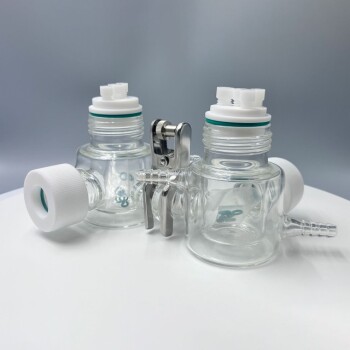
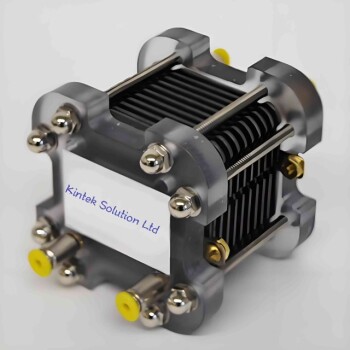
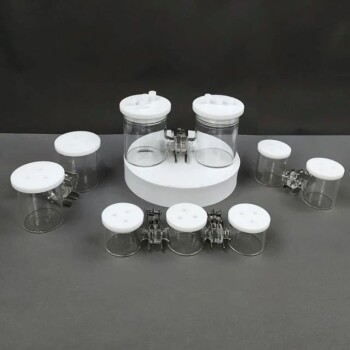
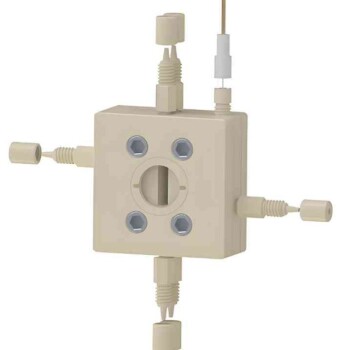
The primary benefit is the ability to conduct rigorous testing using minute reagent volumes. Micro-electrochemical cells allow researchers to utilize volumes as small as 200 microliters, making it feasible to study chemical reagents that are either prohibitively expensive to synthesize or physically scarce. This ensures that high-cost or low-availability materials do not become a bottleneck for experimental throughput.
Micro-electrochemical cells solve the "cost-per-data-point" dilemma by allowing for high-precision testing of concentration gradients without depleting valuable chemical stocks or compromising data integrity.
The Economics of Micro-Scale Testing
Reducing Consumable Costs
Traditional corrosion testing often requires liters of electrolyte solution. When dealing with standard saline, this is negligible; however, when using custom-synthesized inhibitors or rare compounds, the cost is substantial.
Micro-electrochemical cells reduce the required volume to approximately 200 microliters. This massive reduction converts a potentially budget-breaking experiment into a routine, cost-effective procedure.
Enabling Research on "Unobtainable" Materials
Some reagents are not just expensive; they are scarce. They may be available only in milligram quantities following complex synthesis in a lab.
Micro-cells allow you to run multiple tests on these limited stocks. You do not need to scale up synthesis—a time-consuming and difficult process—just to perform a basic corrosion characterization.
Data Quality and Precision
Testing High Concentration Gradients
A robust corrosion study often requires testing a reagent across a wide range of concentrations (gradients) to understand its performance limits.
In a bulk cell, creating these gradients consumes vast amounts of material. Micro-cells allow you to test high concentration gradients freely, as the total volume used across the entire series remains minimal.
Maintaining Experimental Integrity
Shrinking the experiment does not mean shrinking the data quality. The specific design of these cells ensures that despite the small volume, the electrochemical feedback remains precise.
You obtain the same fidelity in data regarding corrosion rates and mechanisms as you would from a bulk experiment, but with a fraction of the material investment.
Understanding the Trade-offs
Sensitivity to Handling
Working with volumes as small as 200 microliters requires a steady hand and precise instrumentation. Slight errors in pipetting or cell assembly can represent a significant percentage error relative to the total volume.
Environmental Control
Small volumes are more susceptible to environmental factors than bulk solutions. For example, evaporation can alter concentrations more rapidly in a 200-microliter droplet than in a 1-liter beaker, requiring strict control of the experimental environment.
Making the Right Choice for Your Research
To determine if micro-electrochemical cells are the right tool for your specific project, consider your primary constraints.
- If your primary focus is Rare Reagents: Use micro-cells to maximize the number of data points you can generate from a limited synthetic yield.
- If your primary focus is Cost Reduction: Implement these cells to drastically lower the overhead of testing expensive commercial inhibitors or specialized electrolytes.
- If your primary focus is Screening: Use the low-volume requirement to rapidly screen high concentration gradients before committing to larger-scale validation.
By decoupling the quality of your data from the quantity of your reagents, micro-electrochemical cells empower you to explore complex chemistries that were previously economically unfeasible.
Summary Table:
| Feature | Traditional Electrochemical Cells | Micro-Electrochemical Cells |
|---|---|---|
| Minimum Volume | Typically 100mL - 1000mL | Approximately 200 microliters |
| Cost per Test | High (for rare/custom reagents) | Extremely Low |
| Material Availability | Requires bulk synthesis | Ideal for milligram-scale yields |
| Data Precision | High fidelity | Equivalent high-precision feedback |
| Best Use Case | Standard saline/common solutions | Rare inhibitors, scarce compounds, & gradient screening |
Revolutionize Your Material Research with KINTEK Precision
Don't let the high cost or scarcity of reagents stall your innovation. KINTEK specializes in advanced laboratory solutions, offering a comprehensive range of high-performance electrolytic cells and electrodes specifically designed for precision and efficiency. Whether you are conducting complex corrosion studies or pioneering battery research, our high-quality consumables—from PTFE products and ceramics to specialized reactors and autoclaves—ensure your data remains accurate while your costs stay low.
Ready to scale down your volumes and scale up your results?
Contact KINTEK Today for Expert Guidance
References
- Richard J. Wilbraham, Colin Boxall. The effect of SO<sub>3</sub>-Ph-BTBP on stainless steel corrosion in nitric acid. DOI: 10.1515/nuka-2015-0117
This article is also based on technical information from Kintek Solution Knowledge Base .
Related Products
- Customizable PEM Electrolysis Cells for Diverse Research Applications
- Electrolytic Electrochemical Cell for Coating Evaluation
- PTFE Electrolytic Cell Electrochemical Cell Corrosion-Resistant Sealed and Non-Sealed
- Electrolytic Electrochemical Cell with Five-Port
- Thin-Layer Spectral Electrolysis Electrochemical Cell
People Also Ask
- What are the risks of improper voltage control in an electrolysis cell? Avoid Costly Damage and Inefficiency
- What are the opening configurations for the non-sealed and sealed versions of the electrolysis cell? Optimize Your Electrochemical Setup
- What is an electrolysis cell? A Guide to Driving Chemical Reactions with Electricity
- What parameters must be strictly controlled during the electrolysis process? Ensure Precision and Efficiency
- What are the precautions for heating or sterilizing an electrolysis cell? Avoid Damaging Sensitive Components