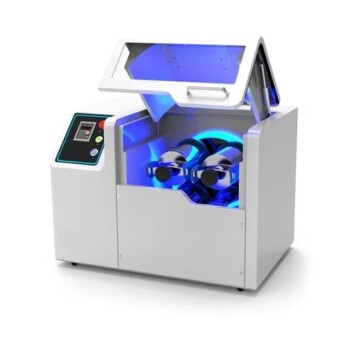
The high-energy ball mill functions as the primary engine for mechanical alloying, delivering the intense kinetic energy required to force nano-sized oxide particles into a ferritic steel matrix. Unlike simple mixing, this process utilizes repeated fracturing and cold welding to trap oxides inside the metal particles, achieving a uniform dispersion that is impossible to replicate through conventional melting techniques.
Core Takeaway: The ball mill does not merely mix powders; it fundamentally alters their structure through high-intensity mechanical impact. By creating a "forced solid solution" and introducing microscopic defects, it transforms separate metal and oxide powders into a single, highly reactive composite material ready for high-density sintering.
The Mechanism of Mechanical Alloying
The production of ODS (Oxide Dispersion Strengthened) alloys relies on a solid-state process called mechanical alloying. The high-energy ball mill drives this process through two distinct physical actions.
Repeated Fracturing and Cold Welding
As the mill rotates, grinding media (balls) collide with the powder mixture under high impact and shear forces. This energy causes the ductile metal particles to flatten and fracture.
Simultaneously, these fresh surfaces are pressed together and "cold welded" back into larger particles. This continuous cycle of breaking apart and welding together traps the nano-oxide particles (such as yttrium oxide) deep inside the metal grains.
Achieving Atomic-Level Mixing
The energy input is high enough to induce chemical changes that go beyond physical mixing. The impact forces cause substantial deformation, facilitating the mutual diffusion of alloying elements (like Fe, Cr, and Al).
This results in a "forced solid solution," where elements are mixed at the atomic level. This transformation converts the initial heterogeneous powder mixture into a single-phase alloy, which is critical for the material's final stability.
Preparing the Foundation for Sintering
The ball mill is not just about dispersion; it is about preparing the powder for the final densification stage.
Increasing Powder Reactivity
According to the primary technical data, the milling process introduces significant microscopic defects into the crystalline structure of the powder.
These defects increase the internal energy and reactivity of the material. This heightened reactivity is intentional; it establishes the necessary thermodynamic foundation for successful densification during the subsequent sintering phase.
Uniform Nanometric Dispersion
The ultimate goal of this equipment is homogeneity. Without high-energy milling, oxides would agglomerate (clump together), creating weak points in the alloy.
The milling process ensures that yttria nanoparticles are evenly distributed throughout the ferritic matrix. This uniform distribution creates stable barriers to dislocation movement, which is the direct cause of the alloy's superior creep strength and radiation resistance.
Understanding the Trade-offs
While high-energy ball milling is essential for ODS alloys, it introduces specific processing challenges that must be managed.
Risk of Contamination
Because the process relies on violent collision between grinding media and the container, wear is inevitable. Trace amounts of material from the balls or jar can contaminate the alloy powder, potentially altering its chemical composition.
Atmosphere Sensitivity
The creation of fresh, reactive surfaces during fracturing makes the powder highly susceptible to unwanted oxidation from the air. To prevent this, the process must strictly occur under a protective atmosphere, typically argon.
Energy and Time Intensity
This is not a rapid process. Achieving a true solid solution and uniform dispersion requires significant time and energy input. Insufficient milling time will result in an inhomogeneous product that fails under high-temperature stress.
Making the Right Choice for Your Goal
The effectiveness of your ODS alloy depends on how you tune the milling parameters to achieve specific microstructural goals.
- If your primary focus is High-Temperature Creep Strength: Prioritize milling duration and intensity to ensure maximum dispersion of oxide nanoparticles, as these act as the pinners for dislocation movement.
- If your primary focus is Sintering Density: Focus on the introduction of lattice defects; the stored energy from the milling process is the driving force that will allow the powder to densify fully during consolidation.
By controlling the kinetic energy transfer in the ball mill, you dictate the mechanical DNA of the final alloy.
Summary Table:
| Process Action | Technical Result | Benefit for ODS Alloys |
|---|---|---|
| Cold Welding & Fracturing | Traps nano-oxides in metal matrix | Ensures uniform dispersion, prevents agglomeration |
| Atomic Diffusion | Creates forced solid solutions | Homogenizes heterogeneous powder mixtures |
| Lattice Deformation | Introduces microscopic defects | Increases reactivity and energy for better sintering |
| Kinetic Impact | Particle size reduction | Refines microstructure for radiation & creep resistance |
Elevate Your Material Research with KINTEK Precision
Unlock the full potential of your Oxide Dispersion Strengthened (ODS) alloys with KINTEK’s industry-leading crushing and milling systems. Our high-energy ball mills are engineered to provide the precise kinetic energy required for flawless mechanical alloying, ensuring your ferritic steel matrices achieve the nanometric dispersion necessary for extreme radiation and creep resistance.
Beyond milling, KINTEK offers a comprehensive ecosystem for advanced material science, including:
- High-Temperature Vacuum & Atmosphere Furnaces for specialized sintering.
- Hydraulic Presses (Pellet, Hot, Isostatic) for high-density consolidation.
- Ceramic Crucibles & PTFE Consumables to maintain purity during processing.
Whether you are refining battery research or developing high-performance alloys, our experts are ready to provide the tools and support you need to succeed.
Ready to optimize your lab’s workflow? Contact KINTEK today for a tailored solution!
References
- Ana R. Salazar-Román, J.C. Rendón-Ángeles. Effect of yttria addition on the microstructure and mechanical behavior of ODS ferritic alloys processed by High Energy Milling and Spark Plasma Sintering. DOI: 10.3989/revmetalm.236
This article is also based on technical information from Kintek Solution Knowledge Base .
Related Products
- High Energy Planetary Ball Mill Milling Machine for Laboratory
- High Energy Planetary Ball Mill for Laboratory Horizontal Tank Type Milling Machine
- High-Energy Omnidirectional Planetary Ball Mill Milling Machine for Laboratory
- High Energy Planetary Ball Mill Milling Machine for Laboratory
- High Energy Planetary Ball Mill Machine for Laboratory Horizontal Tank Type
People Also Ask
- How does a planetary ball mill provide mechanical activation for scandium recovery? Maximize Your Leaching Efficiency
- What role do planetary ball mills and zirconia media play in LLZT preparation? Optimize Your Solid Electrolyte Research
- What is the function of a planetary ball mill in the preparation of high-entropy rare earth silicate multi-phase ceramics?
- What is the purpose of using a planetary ball mill for cathode material regeneration? Achieve Atomic-Level Mixing
- What is the primary function of a planetary ball mill? Mastering SiC/Al Composite Mixing for Homogeneity