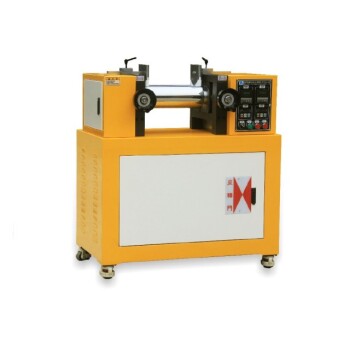
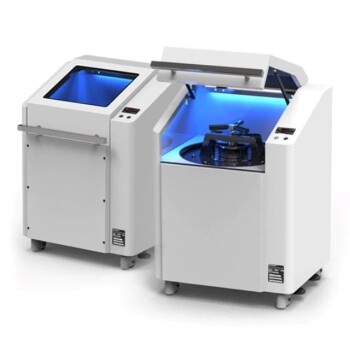
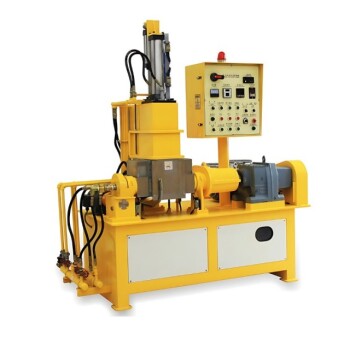
The primary function of a milling machine during the preparation of CuCrFeMnNi high-entropy alloys is to facilitate mechanical alloying through extended dry and wet grinding processes. By utilizing the mechanical impact force of grinding balls, the machine refines particle size and homogenizes the mixed elemental powders to create pre-alloyed material suitable for sintering.
Mechanical alloying goes beyond simple mixing; it applies intense kinetic energy to force elemental powders into a chemically homogeneous, refined state essential for the structural integrity of the final alloy.
The Role of Mechanical Alloying
Achieving Chemical Homogeneity
The central goal of using a milling machine in this context is to transform distinct elemental metal powders into a unified precursor.
Simple mixing is often insufficient for high-entropy alloys due to the complexity of the composition. The milling process ensures that the elemental components are distributed uniformly at a microscopic level.
Particle Refinement
The machine significantly reduces the particle size of the metal powders.
Refining the powder increases the specific surface area of the particles. This refinement is a critical prerequisite for successful sintering, as finer particles generally lead to higher density and better mechanical properties in the final product.
The Physical Mechanism
Impact Force and Energy
The milling machine operates by generating substantial mechanical impact force through the movement of grinding balls.
As the milling jars rotate or revolve, the grinding media collide with the powder. This kinetic energy is transferred to the metal particles, driving the physical changes necessary for alloying.
Crushing and Cold Welding
While the primary reference highlights impact force, the mechanical alloying process fundamentally relies on a cycle of fracture and welding.
The impact fractures brittle particles and cold-welds ductile ones. This repetitive process continuously exposes fresh surfaces and forces different elements to bond, effectively creating a pre-alloyed powder from the initial mix.
Understanding the Trade-offs
Process Intensity vs. Material Purity
High-energy milling is aggressive by design. While necessary for homogenization, the intense friction and impact can lead to contamination from the grinding media (balls and jars) if not carefully monitored.
Wet vs. Dry Grinding
The process utilizes both wet and dry grinding stages. Wet grinding can help prevent excessive cold welding and agglomeration, but it introduces a fluid medium that must be managed to avoid oxidation or chemical reaction with the alloy powder.
Making the Right Choice for Your Goal
To maximize the effectiveness of the milling process for CuCrFeMnNi alloys, consider the following regarding your specific application:
- If your primary focus is Sintering Density: Prioritize the refinement aspect of milling to achieve the smallest possible particle size, which improves packing and densification during heating.
- If your primary focus is Compositional Uniformity: Ensure the milling duration is sufficient to overcome density differences between elements, guaranteeing a fully homogenized matrix before processing stops.
Effective powder preparation is the single most critical variable in determining the final performance of a high-entropy alloy.
Summary Table:
| Feature | Function in Powder Preparation | Impact on High-Entropy Alloys |
|---|---|---|
| Mechanical Alloying | Forces elemental powders into a unified state | Ensures chemical homogeneity at the microscopic level |
| Particle Refinement | Reduces particle size via impact force | Increases surface area for higher sintering density |
| Impact Energy | Transfers kinetic energy via grinding media | Drives repetitive fracture and cold-welding cycles |
| Medium Choice | Wet vs. Dry grinding options | Prevents agglomeration and manages material oxidation |
Elevate Your Alloy Research with KINTEK Precision Solutions
High-performance CuCrFeMnNi alloys demand exceptional powder preparation. KINTEK specializes in advanced crushing and milling systems designed to deliver the mechanical impact and homogeneity required for superior mechanical alloying. From high-energy mills to a comprehensive range of laboratory equipment including high-temperature furnaces, hydraulic presses, and specialized ceramics, we provide the tools necessary to optimize your sintering density and compositional uniformity.
Ready to refine your results? Contact us today to discover how KINTEK’s expert laboratory solutions can streamline your material science workflows and ensure the structural integrity of your high-entropy alloys.
Related Products
- Laboratory Horizontal Planetary Ball Mill Milling Machine
- Laboratory Planetary Ball Mill Rotating Ball Milling Machine
- Laboratory Planetary Ball Mill Cabinet Planetary Ball Milling Machine
- High-Energy Omnidirectional Planetary Ball Mill Milling Machine for Laboratory
- High Energy Planetary Ball Mill Milling Machine for Laboratory
People Also Ask
- What is the primary purpose of using a planetary ball mill for iridium powder? Achieve Microscopic Mixing Uniformity
- What is the primary function of a planetary ball mill for Al2O3-TiC/CaF2 powders? Achieving Microstructural Homogeneity
- What is the role of a planetary ball mill in sulfide-based solid-state batteries? Engineer High-Performance Cathodes
- What is the function of a planetary ball mill in MAX phase powder preparation? Unlock High-Purity Atomic Homogeneity
- Why are planetary ball mills used for intermetallic precursors? Achieve Precise Atomic-Level Mechanical Alloying