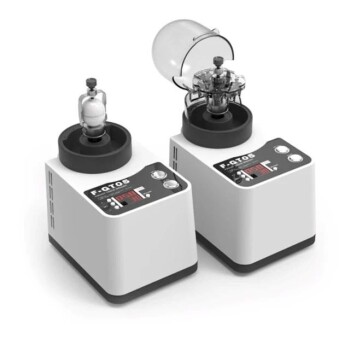
The primary function of a planetary ball mill in preparing La0.95Ba0.05F2.95 (LBF) is to drive high-energy mechanochemical synthesis. Through intense impact and shearing forces, the mill mixes LaF3 and BaF2 precursors at the atomic scale while simultaneously reducing grain size to the nanometer level. Crucially, this process induces lattice defects within the structure, which directly enhances the fluoride ion conductivity of the final electrolyte.
Core Takeaway The planetary ball mill serves as more than just a grinder; it is a reactor that alters the material's microstructure. By generating nanometer-sized grains and specific lattice defects under an inert atmosphere, it unlocks the high ionic conductivity essential for effective LBF solid electrolytes.
The Mechanics of Synthesis
Achieving Atomic-Scale Homogeneity
The planetary ball mill subjects the raw material powders—specifically LaF3 and BaF2—to extreme mechanical stress.
Unlike simple stirring or low-energy blending, the high-energy impact and shear forces effectively mash the precursors together. This achieves uniform mixing at the atomic scale, ensuring that the Barium (Ba) dopant is evenly distributed throughout the Lanthanum Fluoride (LaF3) matrix.
Nanostructuring the Material
A critical output of this process is the significant reduction of particle dimensions.
The milling process pulverizes the powder until the grain size reaches the nanometer level. This increase in surface area and reduction in diffusion distances is fundamental to the performance of solid-state electrolytes.
Enhancing Electrochemical Performance
Inducing Lattice Defects
The most sophisticated function of the ball mill in this context is the intentional introduction of structural imperfections.
The high-energy mechanochemical forces induce lattice defects within the crystal structure. In solid fluoride electrolytes, these defects are not "flaws" but necessary features; they create the pathways that allow fluoride ions to move freely, thereby significantly increasing ionic conductivity.
Controlling the Reaction Environment
The synthesis must occur under controlled conditions to maintain chemical purity.
The primary reference specifies that this milling occurs under an inert gas atmosphere. This prevents the highly reactive, nanosized powders from reacting with oxygen or moisture in the air, which would degrade the electrolyte's performance.
Understanding Process Constraints
The Intensity Trade-off
While high-energy milling is effective, it is an aggressive process.
The reliance on intense impact and shearing generates significant heat and mechanical wear. While this energy is necessary to drive the mechanochemical reaction and amorphization, it requires precise control to prevent overheating or contamination from the milling media (jars and balls).
Complexity of Atmosphere Control
The requirement for an inert gas atmosphere adds a layer of operational complexity.
You cannot mill these materials in open air. The process demands specialized sealed containers or glovebox integration to ensure the inert environment is maintained throughout the long duration of the milling cycle.
Making the Right Choice for Your Goal
To maximize the effectiveness of your LBF preparation, consider these specific objectives:
- If your primary focus is maximizing conductivity: Prioritize milling parameters (speed and duration) that maximize the induction of lattice defects, as these are the primary drivers of ion transport.
- If your primary focus is material purity: Ensure your setup strictly maintains an inert gas atmosphere to prevent surface oxidation of the newly formed nanometer-sized grains.
The planetary ball mill is the bridge between raw chemical powders and a highly conductive, nanostructured solid electrolyte.
Summary Table:
| Feature | Function in LBF Preparation | Benefit to Electrolyte |
|---|---|---|
| High-Energy Impact | Mechanochemical synthesis of LaF3 and BaF2 | Atomic-scale homogeneity & doping |
| Shearing Forces | Grain size reduction to nanometer level | Shorter ion diffusion paths |
| Structural Alteration | Induction of lattice defects | Enhanced fluoride ion conductivity |
| Atmosphere Control | Processing under inert gas | Prevention of oxidation & impurities |
Elevate Your Material Research with KINTEK
Precision in mechanochemical synthesis requires robust and reliable equipment. KINTEK specializes in advanced laboratory solutions designed for high-performance battery research and electrolyte preparation. Whether you are developing solid fluoride electrolytes (LBF) or next-generation energy storage, our comprehensive range of planetary ball mills, crushing and milling systems, and high-temperature vacuum furnaces ensure optimal grain refinement and structural integrity.
Why choose KINTEK?
- Versatile Milling Systems: Achieve nanometer-scale precision with our high-energy planetary mills.
- Complete Laboratory Suite: From hydraulic pellet presses for sample preparation to glovebox-integrated systems for inert atmosphere control.
- Expert Consumables: High-quality ceramics, crucibles, and milling media to prevent contamination.
Ready to optimize your electrolyte conductivity and material purity? Contact our technical team today to find the perfect equipment solution for your laboratory’s unique requirements.
Related Products
- High Energy Planetary Ball Mill for Laboratory Horizontal Tank Type Milling Machine
- High-Energy Omnidirectional Planetary Ball Mill Milling Machine for Laboratory
- Laboratory Planetary Ball Mill Rotating Ball Milling Machine
- High Energy Planetary Ball Mill Milling Machine for Laboratory
- High Energy Planetary Ball Mill Machine for Laboratory Horizontal Tank Type
People Also Ask
- What is the role of a planetary ball mill in sulfide-based solid-state batteries? Engineer High-Performance Cathodes
- What are the parameters of a planetary ball mill? Master Speed, Time, and Media for Perfect Grinding
- What is the function of a planetary ball mill for nanostructured eutectic steel? Essential Prep for High-Strength Alloys
- What role does a planetary ball mill play in the preparation of NASICON-type solid electrolytes like LATP and LAGP?
- What is the function of a planetary ball mill in solid-state electrolyte prep? Milling vs. SDS Methods Explained