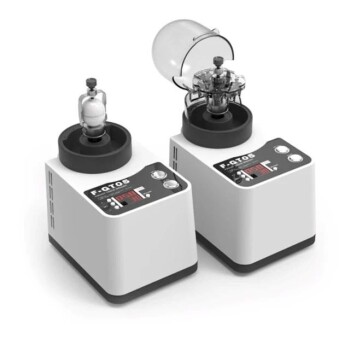
The primary function of a planetary ball mill in the synthesis of Tantalum-doped garnet-type solid electrolyte (LLZTO) is high-energy mechanical homogenization and particle refinement. By subjecting specific raw materials—Lithium Hydroxide, Lanthanum Oxide, Zirconium Dioxide, and Tantalum Pentoxide—to intense mechanical forces, the mill breaks down agglomerates and reduces particle sizes to the micrometer level to ensure a consistent mixture.
Core Takeaway The planetary ball mill acts as a critical preparatory stage rather than the final synthesis step for LLZTO. Its role is to maximize the reaction contact area by physically refining precursors, ensuring a uniform distribution of chemical components necessary for a successful subsequent high-temperature solid-phase reaction.
The Mechanics of Material Refinement
Breaking Down Agglomerates
Raw material powders often arrive in clustered states known as agglomerates. The planetary ball mill utilizes high-energy impact to physically shatter these clusters.
This step is vital for exposing the individual grains of the starting materials.
Micrometer-Level Size Reduction
Beyond simple declumping, the milling process actively grinds the particles down. The target for LLZTO precursors is a reduction to the micrometer level.
Smaller particles possess a larger specific surface area. This increased surface area significantly improves the contact between the different chemical reactants.
Achieving Chemical Uniformity
Homogenizing the Precursors
The synthesis of LLZTO involves a complex mixture of chemically distinct ingredients: LiOH·H2O, La2O3, ZrO2, and Ta2O5.
The ball mill ensures these distinct components are mixed intimately. This prevents "hot spots" or isolated pockets of a single material, which would lead to impurities in the final crystal structure.
Preparing for Solid-Phase Reactions
The mixing process described is a prerequisite for the next stage of synthesis. The ball mill ensures that the distribution of elements is uniform before the material enters the high-temperature solid-phase reaction.
Without this mechanical refinement, the diffusion distances between atoms would be too great during heating, leading to incomplete reactions or secondary phases.
Distinction from Other Electrolyte Processes
Physical Mixing vs. Mechanochemical Synthesis
It is important to distinguish the role of the ball mill in LLZTO synthesis from its role in other electrolyte types.
In sulfide-based electrolytes (like Argyrodites), the ball mill often drives a mechanochemical reaction, where the milling energy itself synthesizes the new phase or amorphous precursor at an atomic scale.
The Role of Heat Treatment
In the specific case of LLZTO, the ball mill is primarily a physical mixing and refining tool.
While it ensures microscopic uniformity, the actual formation of the garnet crystal phase occurs during the subsequent high-temperature sintering or calcination, not inside the mill itself.
Making the Right Choice for Your Goal
To maximize the effectiveness of your LLZTO synthesis, apply the following principles based on your specific objectives:
- If your primary focus is Phase Purity: Ensure your milling protocol runs long enough to completely homogenize the Tantalum (Ta2O5) and Zirconium (ZrO2) sources, as inhomogeneity here leads to secondary phases.
- If your primary focus is Reaction Kinetics: Optimize the milling energy to achieve the smallest possible micrometer particle size, as this reduces the diffusion path required during the heat treatment step.
Success in LLZTO synthesis relies on treating the ball milling stage not just as a grinding step, but as the foundation for chemical uniformity.
Summary Table:
| Process Stage | Function of Planetary Ball Mill | Objective for LLZTO Synthesis |
|---|---|---|
| Particle Refinement | High-energy impact & grinding | Break agglomerates and reduce size to micrometer level |
| Homogenization | Intimate mechanical mixing | Ensure uniform distribution of LiOH, La2O3, ZrO2, and Ta2O5 |
| Surface Activation | Increasing specific surface area | Maximize contact area to facilitate subsequent thermal reactions |
| Phase Preparation | Pre-reaction foundation | Minimize atomic diffusion distances for high-temperature sintering |
Elevate Your LLZTO Research with KINTEK Precision
Achieving phase purity in garnet-type solid electrolytes requires the highest standard of mechanical homogenization. KINTEK specializes in advanced crushing and milling systems and planetary ball mills designed specifically for high-energy material refinement. Beyond milling, we support your entire battery research workflow with high-temperature furnaces (muffle, vacuum, and tube) for calcination, hydraulic presses for pellet formation, and high-performance glove boxes and electrolytic cells.
Don't let chemical inhomogeneity compromise your solid-state battery performance. Contact KINTEK today to discover how our laboratory equipment and specialized consumables—from ceramics to crucibles—can streamline your synthesis process and ensure consistent, high-quality results.
Related Products
- High Energy Planetary Ball Mill for Laboratory Horizontal Tank Type Milling Machine
- Laboratory Planetary Ball Mill Cabinet Planetary Ball Milling Machine
- Laboratory Horizontal Planetary Ball Mill Milling Machine
- Mini Planetary Ball Mill Machine for Laboratory Milling
- Laboratory Planetary Ball Mill Rotating Ball Milling Machine
People Also Ask
- What is the role of a planetary ball mill in sulfide-based solid-state batteries? Engineer High-Performance Cathodes
- What are the parameters of a planetary ball mill? Master Speed, Time, and Media for Perfect Grinding
- What is the function of a planetary ball mill for nanostructured eutectic steel? Essential Prep for High-Strength Alloys
- What role does a planetary ball mill play in the preparation of NASICON-type solid electrolytes like LATP and LAGP?
- What is the function of a planetary ball mill in solid-state electrolyte prep? Milling vs. SDS Methods Explained