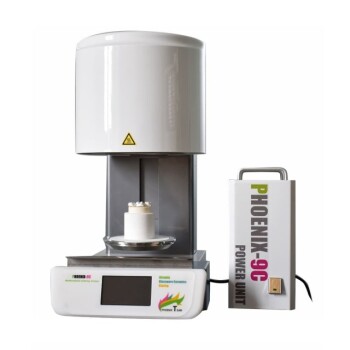
The primary function of a porcelain furnace is to process raw dental porcelain powders to their optimal state of maturity. This specific firing process is essential for establishing the restoration's final physical properties while preserving critical aesthetic characteristics, including surface texture, translucency, hue, and chroma.
While simple in concept, the porcelain furnace is the deciding factor in whether a restoration looks natural or artificial. Its role is to mature the ceramic material without compromising the delicate balance of light reflection and transmission required to mimic natural teeth.
The Science of Ceramic Maturation
The core purpose of the furnace is not merely to harden material, but to achieve a specific state of "maturity" in the porcelain.
Defining Optimal Maturity
Raw dental porcelain begins as a powder. The furnace applies controlled heat to sinter these particles together.
The goal is to reach a state where the material is solid and durable, yet retains the specific optical properties intended by the dental technician.
Preserving Optical Properties
A restoration is useless if it does not blend with natural dentition. The furnace must lock in the "personality" of the tooth.
This includes translucency (how light passes through), value (brightness), and chroma (saturation).
Surface Texture Retention
In addition to color, the texture of the tooth surface determines how it reflects light.
A precise firing cycle ensures that the detailed surface anatomy created by the technician is not melted away or distorted during processing.
Understanding the Risks of Temperature Variance
The difference between a lifelike crown and a remake often comes down to temperature accuracy. This is where the limitations of the hardware become apparent.
The Dangers of Overfiring
If the furnace exceeds the required temperature or holding time, the ceramic matrix creates excessive internal glass.
This results in too much light transmission. The restoration will appear glassy, unnaturally translucent, and often greyish in the mouth.
The Risks of Underfiring
Conversely, failing to reach the optimal temperature results in an unmatured ceramic.
Underfired restorations appear highly reflective and aesthetically "dead." They lack the depth and translucency required to look like a real tooth.
Structural Implications
Beyond aesthetics, temperature precision dictates the longevity of the piece.
In advanced materials, inaccurate firing can prevent the material from reaching full hardness or lead to crack propagation, causing the restoration to fail under biting pressure.
Operational Considerations
While the thermal outcome is paramount, modern furnaces also address the "how" of the process.
Interface and Efficiency
Modern porcelain furnaces often utilize true-color touch screens.
This interface simplifies the programming of complex firing cycles, ensuring reproducibility and improving overall production efficiency in the laboratory.
Making the Right Choice for Your Goals
To select or operate a porcelain furnace effectively, you must align the machine's capabilities with your specific output requirements.
- If your primary focus is Aesthetic Perfection: Prioritize furnaces with documented temperature stability to avoid the "glassy" look of overfired porcelain.
- If your primary focus is Laboratory Efficiency: Look for units with intuitive touch interfaces that reduce setup time for repetitive firing cycles.
Ultimately, the porcelain furnace is not just a heating element, but the final arbiter of a restoration's beauty and function.
Summary Table:
| Feature | Optimal Maturity | Overfiring Risks | Underfiring Risks |
|---|---|---|---|
| Visual Appearance | Lifelike & natural translucency | Glassy, greyish, and overly translucent | Reflective, opaque, and aesthetically "dead" |
| Material State | Fully sintered & durable | Excessive internal glass formation | Unmatured, porous ceramic matrix |
| Surface Integrity | Detailed anatomy preserved | Melted or distorted surface texture | Rough or highly reflective surface |
| Structural Strength | Maximum hardness & longevity | Increased brittleness | Weak, prone to cracks and failure |
Elevate Your Dental Restorations with KINTEK Precision
Achieving the perfect balance of translucency and strength requires more than skill—it requires world-class thermal precision. KINTEK specializes in advanced laboratory equipment, offering high-performance dental furnaces specifically engineered for the rigorous demands of dental laboratories.
Our technology ensures uniform heating and stable temperature control, preventing the common pitfalls of overfiring or underfiring. Beyond dental solutions, KINTEK provides a comprehensive range of high-temperature furnaces, crushing systems, and hydraulic presses, supporting researchers and technicians in every step of material processing.
Ready to enhance your lab's efficiency and aesthetic results? Contact us today to explore our dental porcelain furnace solutions!
Related Products
- Dental Porcelain Zirconia Sintering Ceramic Vacuum Press Furnace
- Dental Porcelain Zirconia Sintering Ceramic Furnace Chairside with Transformer
- Vacuum Dental Porcelain Sintering Furnace
- High Temperature Alumina (Al2O3) Furnace Tube for Engineering Advanced Fine Ceramics
- Vacuum Heat Treat Furnace with Ceramic Fiber Liner
People Also Ask
- What does sintering do to zirconia? Unlock Its Full Strength and Aesthetic Potential
- What is the shrinkage of zirconia during sintering? Mastering the 20-25% Dimensional Change
- What is the sintering temperature of zirconia ceramic? Mastering the 1400°C-1600°C Thermal Profile
- What is the price of zirconia sintering furnace? Invest in Precision, Not Just a Price Tag
- What factors are important to consider when choosing a dental sintering furnace? Match Your Workflow for Optimal Results