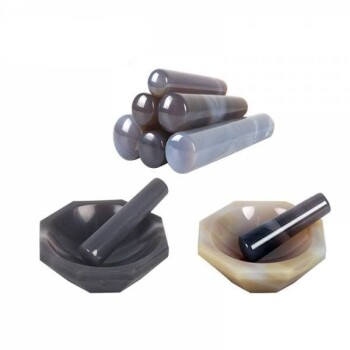
The primary technical objective of using mechanical grinding tools, such as agate mortars and pestles, in liquid metal alloying is to physically disrupt the natural oxide film barrier found on metal particles. This process simultaneously increases the surface area of the metal powders, removing the obstacles that prevent solid metal precursors from dissolving into the liquid metal substrate.
Mechanical grinding serves as a critical activation step that forces the integration of solid and liquid phases. By stripping away passivation layers, it ensures the formation of a uniform, shiny alloy catalyst rather than a heterogeneous mixture.
Overcoming the Oxide Barrier
The Natural Obstacle
Most metal particles possess a thin, naturally occurring oxide film on their surface. This film acts as a persistent shield, preventing the solid metal from interacting chemically or physically with the liquid metal body.
Mechanical disruption
The physical impact and shearing forces applied during grinding fracture this oxide shell. This mechanical action is necessary to expose the "active" metal beneath the oxidized surface.
Facilitating Dissolution
Once the barrier is removed, the solid metal precursors can overcome surface tension. This allows them to fully insert and dissolve into the liquid metal substrate, creating a cohesive alloy.
Enhancing Reaction Efficiency
Increasing Surface Area
Beyond breaking oxide layers, grinding reduces the particle size of the metal powders. This significantly increases the total surface area available for the alloying reaction.
Forced Contact
The grinding process does not merely mix the materials; it applies pressure that forces the solid particles into the liquid matrix. This facilitates the "wetting" of the solid metal by the liquid metal, which is a prerequisite for successful alloying.
Homogeneity
The result of this mechanical intervention is a uniform distribution of components. Without this step, the mixture would likely remain segregated, failing to achieve the properties of a true alloy catalyst.
Understanding the Trade-offs
Kinetic Energy Transfer
While manual tools like agate mortars provide control, they rely on human effort to generate force. For more demanding applications involving harder metals, the efficiency of kinetic energy transfer becomes critical. In those cases, high-hardness tools (like stainless steel) might be required to ensure sufficient crushing force is applied to facilitate cold welding.
Material Compatibility
The grinding tool itself must be harder than the material being processed to prevent wear. If the tool degrades, it introduces impurities into the alloy, compromising the purity of the final catalyst.
Making the Right Choice for Your Goal
To ensure your liquid metal alloying process is successful, assess your specific requirements:
- If your primary focus is creating a uniform alloy: Prioritize consistent, repetitive grinding to fully strip oxide layers and ensure complete dissolution of precursors into the liquid substrate.
- If your primary focus is embedding complex additives: Ensure you apply sufficient kinetic energy to facilitate mechanical crushing and cold welding, which helps embed additives into the metal matrix.
Mechanical grinding is not just a mixing technique; it is the enabler that transforms distinct solid and liquid components into a unified, functional material.
Summary Table:
| Objective | Mechanism | Outcome |
|---|---|---|
| Oxide Disruption | Physical shearing & fracturing | Removes barriers to solid-liquid integration |
| Surface Activation | Increasing reactive surface area | Speeds up dissolution of metal precursors |
| Phase Integration | Forced mechanical contact | Overcomes surface tension for better wetting |
| Homogeneity | Uniform material distribution | Prevents segregation in the final alloy catalyst |
Elevate Your Materials Synthesis with KINTEK
Precise alloying starts with the right tools. At KINTEK, we specialize in providing high-performance laboratory equipment designed for the most demanding research applications. Whether you are disrupting oxide layers with our premium agate mortars and pestles or scaling up with our advanced crushing and milling systems, we ensure your materials reach the highest levels of purity and homogeneity.
From high-temperature furnaces and vacuum systems to hydraulic presses and crucibles, KINTEK is your partner in laboratory excellence. Don't let oxide barriers hinder your innovation—leverage our expertise to optimize your alloying process.
Contact our specialists today to find the perfect equipment for your lab!
References
- Karma Zuraiqi, Torben Daeneke. Liquid Metals in Catalysis for Energy Applications. DOI: 10.1016/j.joule.2020.10.012
This article is also based on technical information from Kintek Solution Knowledge Base .
Related Products
- Nature Agate Mortar and Pestle for Grinding and Mixing
- Laboratory Jar Mill with Agate Grinding Jar and Balls
People Also Ask
- Why are agate mortars and pestles used for grinding iron oxide? Ensure Sample Purity for XRD Analysis
- What is the function of an agate mortar and pestle? Ensure Purity in Halide Solid-State Electrolyte Synthesis
- What is the primary function of an agate mortar and pestle? Optimize VO2+ CaZn2(PO4)2 Nanopowder Pre-Treatment
- Why is an agate mortar and pestle required for grinding Zr3(Al1-xSix)C2? Ensure Maximum Sample Purity
- Why is an agate mortar and pestle preferred for grinding MAX phase? Ensure Sample Purity & Zero Contamination