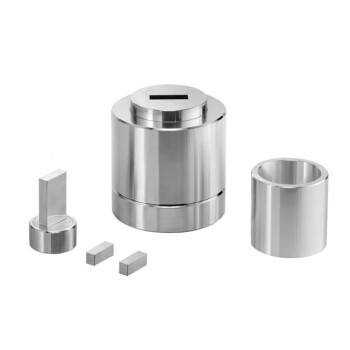
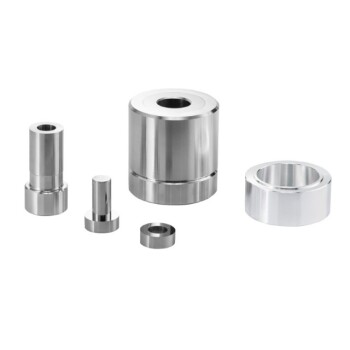
The primary purpose of a laboratory hydraulic press in FTIR analysis is to transform a mixture of pulverized coating material and potassium bromide (KBr) powder into a solid, optically transparent pellet. By applying high, uniform axial pressure—typically around 6.89 MPa—the press fuses the loose powder into a glass-like disc that allows the infrared beam to pass through with minimal scattering.
Core Takeaway: The hydraulic press acts as an optical clarifier. It forces the sample matrix to transition from a scattering powder into a transparent medium, enabling the FTIR instrument to read the chemical "fingerprint" of the coating without the noise caused by physical particle interference.
Creating the Optical Window
To understand the role of the press, one must first understand the challenge of FTIR analysis: obtaining a clear signal from a solid material.
The Challenge of Opacity
Most coating samples, whether polymers or mineral-based, are too dense or opaque for infrared light to penetrate directly.
If you simply placed a powder sample in the machine, the infrared light would hit the individual particles and scatter in all directions. This prevents the detector from receiving a usable signal regarding the material's chemical bonds.
The KBr Matrix Solution
To solve this, the coating sample is diluted with potassium bromide (KBr) powder, usually at a ratio of 1 part sample to 100 parts KBr.
KBr is chosen because it is transparent to infrared light. However, mixing them is not enough; the mixture remains a loose powder. This is where the hydraulic press becomes critical.
Compressing for Clarity
The hydraulic press applies balanced axial pressure to the die containing the mixture.
This pressure eliminates the air gaps and physical boundaries between the powder particles. It effectively cold-welds the KBr and sample into a unified, transparent disc.
This creates a clear path for the infrared beam to interact with the diluted coating molecules, allowing for the accurate detection of chemical bonding states and adsorption properties.
Critical Technical Requirements
The press does not simply "squish" the sample; it must provide specific mechanical conditions to ensure spectral accuracy.
Eliminating Scattering Effects
The primary reference highlights that the press must eliminate scattering effects.
If the pressure is uneven or insufficient, the pellet will remain cloudy (opaque). A cloudy pellet scatters the IR beam, resulting in a sloping baseline on the spectrum and poor resolution of the chemical peaks.
Ensuring Uniform Density
The press applies force uniformly to ensure the pellet has a consistent density and geometry.
For coatings, which may rely on precise polymer-to-substrate ratios, this uniformity is vital. It ensures that the absorption of light is due to the chemical composition of the coating, not variations in the thickness or density of the pellet itself.
Understanding the Trade-offs
While the hydraulic press is essential for high-quality FTIR results using the pellet method, there are constraints to consider.
The Pressure Balance
Applying insufficient pressure results in a fragile, opaque pellet that yields noisy data due to light scattering.
Conversely, while not explicitly detailed in the primary text, applying excessive pressure beyond the required threshold (e.g., significantly over 6.89 MPa for prolonged periods) can sometimes alter the crystalline structure of certain sensitive samples or damage the die, though the primary goal remains achieving transparency.
Sample Dilution Sensitivity
The press creates a fixed path length. If the initial mixture contains too much coating sample (violating the 1:100 ratio), even a perfect press cycle will result in a pellet that is "black" to the IR beam.
The press cannot correct for improper dilution; it can only process the mixture provided.
Making the Right Choice for Your Goal
When using a hydraulic press for FTIR analysis of coatings, your approach should be dictated by your specific analytical needs.
- If your primary focus is Qualitative Identification: Ensure the press applies enough pressure to achieve visual transparency in the pellet; this confirms that scattering is minimized and chemical peaks will be sharp.
- If your primary focus is Quantitative Analysis: Focus on the reproducibility of the pressure applied (e.g., consistently hitting 6.89 MPa) to ensure that every pellet has identical physical properties for valid comparison.
In summary, the laboratory hydraulic press is the tool that converts a physically opaque coating sample into an optically transparent medium, making molecular analysis possible.
Summary Table:
| Feature | Requirement for FTIR Analysis |
|---|---|
| Primary Goal | Create an optically transparent pellet |
| Pressure Target | Approximately 6.89 MPa (axial) |
| Sample Matrix | 1:100 Ratio (Sample to KBr powder) |
| Key Outcome | Minimal IR scattering and sharp spectral peaks |
| Common Issue | Cloudy pellets caused by insufficient pressure |
Precision results in FTIR analysis start with the right sample preparation. KINTEK specializes in high-performance laboratory hydraulic presses (pellet, hot, isostatic) designed to ensure uniform density and optical clarity for your most sensitive coating samples. Beyond pressing, we offer a comprehensive range of lab solutions including high-temperature furnaces, crushing systems, and specialized consumables like PTFE and ceramics.
Ready to eliminate spectral noise and enhance your lab's efficiency? Contact KINTEK today to find the perfect equipment for your research and industrial needs!
References
- Innocent J. Macha, Wolfgang Müller. Development of antimicrobial composite coatings for drug release in dental, orthopaedic and neural prostheses applications. DOI: 10.1007/s42452-018-0064-1
This article is also based on technical information from Kintek Solution Knowledge Base .
Related Products
- Laboratory Hydraulic Pellet Press for XRF KBR FTIR Lab Applications
- Automatic Laboratory Hydraulic Press for XRF & KBR Pellet Press
- kbr pellet press 2t
- Automatic Laboratory Hydraulic Pellet Press Machine for Lab Use
- Laboratory Hydraulic Press Lab Pellet Press Machine for Glove Box
People Also Ask
- What is the role of a laboratory hydraulic pellet press and stainless steel molds in the fabrication of RuO2/NbC anodes?
- What is the significance of applying 200 MPa of pressure with a laboratory hydraulic pellet press for composite ceramics?
- How does a laboratory hydraulic pellet press contribute to SiCw/2024 aluminum composite preforms? Optimize Densification
- What is the necessity of using a laboratory hydraulic pellet press in the preparation of biomass fuel pellets? Guide
- What key role does a laboratory pellet press play in FTIR analysis? Master KBr Sample Preparation Excellence