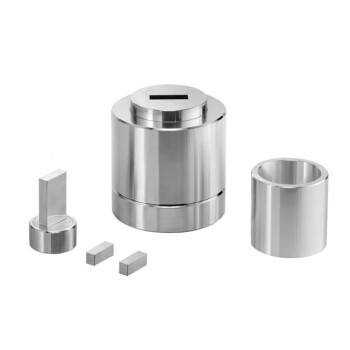
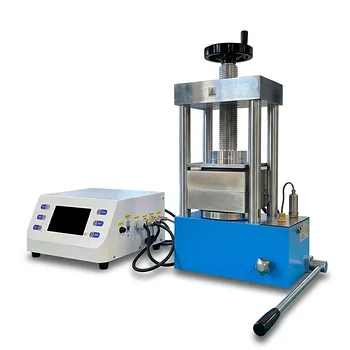
A hydraulic pellet press is the critical enabler of transmission-mode FTIR for powders because it physically transforms the nanofiller into a transparent, optical-grade medium. By compressing the nanofiller powder with potassium bromide (KBr), the press creates a thin, unified disk that allows the infrared beam to penetrate the sample without being scattered by loose particles.
Core Takeaway Nanofillers alone are too opaque and scattering for direct infrared transmission; the hydraulic press fuses them into a transparent KBr matrix. This process is strictly necessary to achieve the high signal-to-noise ratio required to identify specific chemical bonds, functional groups, and oxidation states.
Overcoming the Limitations of Powder Samples
The Challenge of Light Scattering
Nanofillers typically exist as fine, opaque powders. If you attempt to pass an infrared beam directly through loose powder, the light scatters off the particle surfaces.
The Role of the KBr Matrix
To solve this, the nanofiller is mixed with potassium bromide (KBr). KBr is chosen because it is transparent to infrared light, acting as an invisible "window" that holds the sample in place.
Fusing the Mixture
The hydraulic press applies immense, precise pressure to this mixture. This force crushes the KBr crystals and nanofiller together, eliminating air gaps and fusing them into a solid, glass-like pellet.
Achieving Optical Transparency
Minimizing Signal Loss
The primary goal of the press is to create a pellet that is optically clear. By compacting the material into a dense disk, the press eliminates light scattering between individual particles.
Ensuring Beam Penetration
A successfully pressed pellet allows the infrared beam to pass through the material rather than bouncing off it. This transmission is vital for the detector to measure which wavelengths were absorbed by the nanofiller.
Controlling Path Length
The press allows for the creation of an extremely thin sample. A thin profile prevents the sample from absorbing too much light (saturation), which would obscure the details of the spectral peaks.
Enabling Precise Chemical Characterization
High Signal-to-Noise Ratio
Because the pellet reduces scattering, the resulting data has a clean baseline and distinct peaks. This high signal-to-noise ratio is essential for distinguishing real chemical features from background interference.
Identifying Functional Groups
With a clear spectrum, you can accurately identify specific functional groups. The resolution provided by the pellet method allows you to see the unique fingerprints of the material's molecular structure.
Detecting Micro-Structural Changes
The clarity provided by the press allows for the detection of subtle changes. You can assess oxidation or reduction processes and detect the formation of new chemical bonds, such as C=C or C=N stretching vibrations within the composite.
Understanding the Trade-offs
Moisture Sensitivity
KBr is hygroscopic, meaning it absorbs moisture from the air. If the pressing process is too slow or the environment is humid, water bands will appear in your spectrum, potentially masking important data.
Sample Concentration Risks
The ratio of nanofiller to KBr must be exact. If the pellet is too "dark" (too much nanofiller), the infrared beam will be fully blocked, resulting in flat-lined data with no discernible peaks.
Mechanical Failure
If the pressure applied is uneven or the die is dirty, the pellet may crack or remain cloudy. A cloudy pellet causes significant scattering, rendering the resulting spectrum unreliable for quantitative analysis.
Making the Right Choice for Your Goal
To effectively utilize a hydraulic pellet press for FTIR, align your preparation with your specific analytical needs:
- If your primary focus is detailed structural analysis: Ensure the pellet is pressed to maximum transparency to resolve complex features like new chemical bonds or lattice vibrations.
- If your primary focus is rapid screening: You may use lower pressure or faster cycles, but accept that baseline noise will increase and subtle peaks may be lost.
Ultimately, the hydraulic press is not just a preparation tool; it is the mechanism that converts a physical powder into optical data.
Summary Table:
| Feature | Benefit for FTIR Characterization |
|---|---|
| KBr Matrix Integration | Creates an IR-transparent 'window' to hold opaque powder samples. |
| High-Pressure Fusion | Eliminates air gaps and scattering by creating a unified, glass-like disk. |
| Controlled Path Length | Produces thin pellets that prevent signal saturation and peak distortion. |
| Enhanced Signal Quality | Delivers a high signal-to-noise ratio for precise bond identification. |
| Optical Clarity | Ensures maximum beam penetration for accurate chemical fingerprinting. |
Elevate Your Material Analysis with KINTEK
Precise chemical characterization begins with flawless sample preparation. At KINTEK, we specialize in the engineering of high-performance hydraulic pellet presses (manual, electric, and isostatic) and precision die sets designed specifically for FTIR and XRF applications.
Whether you are characterizing advanced nanofillers, developing battery materials, or conducting high-temperature research, our comprehensive range of laboratory equipment—from crushing and milling systems to high-temperature furnaces and PTFE consumables—ensures your lab achieves the highest signal-to-noise ratios and most reliable data.
Ready to eliminate scattering and achieve optical-grade pellets? Contact our experts today to find the perfect pressing solution for your research goals!
References
- Shin Yiing Kee, Koon Chun Lai. Effect of Preparation Methods on the Tensile, Morphology and Solar Energy Conversion Efficiency of RGO/PMMA Nanocomposites. DOI: 10.3390/polym9060230
This article is also based on technical information from Kintek Solution Knowledge Base .
Related Products
- Laboratory Hydraulic Pellet Press for XRF KBR FTIR Lab Applications
- Automatic Laboratory Hydraulic Pellet Press Machine for Lab Use
- Automatic Laboratory Hydraulic Press for XRF & KBR Pellet Press
- Laboratory Manual Hydraulic Pellet Press for Lab Use
- Laboratory Manual Hydraulic Pellet Press for Lab Use
People Also Ask
- What is the role of a laboratory hydraulic pellet press and stainless steel molds in the fabrication of RuO2/NbC anodes?
- What is the necessity of using a laboratory hydraulic pellet press in the preparation of biomass fuel pellets? Guide
- What is the significance of applying 200 MPa of pressure with a laboratory hydraulic pellet press for composite ceramics?
- How does a laboratory hydraulic pellet press contribute to SiCw/2024 aluminum composite preforms? Optimize Densification
- What key role does a laboratory pellet press play in FTIR analysis? Master KBr Sample Preparation Excellence