The primary function of the grinding process is to mechanically deconstruct the large, solidified aggregates that inevitably form during high-temperature heat treatment. By breaking these lumps down into a fine, uniform powder, the process restores the physical characteristics necessary for the material to function effectively as a photocatalyst.
Grinding is not just a sizing step; it is a critical restoration of surface potential. It maximizes the effective specific surface area and ensures the uniform dispersibility required for optimal interaction with light and reactants in wastewater treatment.
Overcoming the Effects of Heat Treatment
Addressing Particle Aggregation
High-temperature treatment is essential for chemically modifying Titanium Dioxide, but it creates a physical side effect: aggregation.
Under high heat, individual particles tend to fuse or clump together into large, solidified masses. Grinding is the specific mechanical intervention used to break these bonds and return the material to a usable powder form.
Creating Uniformity
Consistency is vital for chemical applications. The grinding process ensures that the resulting powder is uniform in size.
This uniformity allows for predictable behavior when the catalyst is eventually introduced into a treatment system, preventing issues associated with irregular particle sizes.
Enhancing Photocatalytic Performance
Maximizing Specific Surface Area
The most critical technical benefit of grinding is the significant increase in effective specific surface area.
When particles are trapped inside large aggregates, their surfaces are inaccessible and cannot participate in chemical reactions. Grinding exposes these surfaces, drastically increasing the active sites available for catalysis.
Improving Light Contact Efficiency
For a photocatalyst to work, it must interact with light.
Large lumps prevent light from penetrating to the inner material. By creating a fine powder, grinding ensures maximum light contact efficiency, allowing photons to activate the entire volume of the catalyst rather than just the outer shell.
Ensuring Dispersibility
In applications like wastewater treatment, the catalyst must be suspended in liquid.
Large aggregates sink or clump, leading to uneven treatment. Fine powders possess superior dispersibility, allowing them to mix thoroughly with the wastewater and interact with contaminants more effectively.
Understanding the Process Trade-offs
The Heat vs. Surface Area Conflict
There is an inherent trade-off in the synthesis of modified Titanium Dioxide.
High-temperature treatment is required to achieve the desired chemical modification, but this heat naturally reduces surface area by causing particles to sinter and clump.
The Necessity of Mechanical Intervention
Grinding is not optional; it is the mandatory counterbalance to heat treatment.
Without this step, the chemically improved material would remain physically compromised. The process sacrifices the structural integrity of the "lump" to regain the surface availability lost during the heating phase.
Making the Right Choice for Your Goal
To maximize the efficacy of your Titanium Dioxide photocatalyst, consider the following processing priorities:
- If your primary focus is Reaction Rate: Prioritize grinding to maximize the specific surface area, exposing the highest possible number of active sites.
- If your primary focus is Application Stability: Ensure the grinding yields a uniform powder to guarantee consistent dispersibility within the wastewater matrix.
Grinding transforms a chemically potent but physically unusable solid into a highly active, practical catalyst.
Summary Table:
| Factor | Effect of Heat Treatment | Benefit of Grinding Process |
|---|---|---|
| Physical State | Large, solidified aggregates | Fine, uniform powder |
| Surface Area | Reduced due to sintering | Maximized active catalytic sites |
| Light Interaction | Poor penetration (outer shell only) | High contact efficiency across volume |
| Dispersibility | Rapid settling/clumping | Even suspension in liquid media |
| Reaction Rate | Limited by accessible surface | Significantly enhanced by exposure |
Elevate Your Material Research with KINTEK
Don't let particle aggregation limit your catalytic potential. KINTEK specializes in advanced laboratory solutions designed to optimize your material processing workflow. Whether you are performing high-temperature chemical modifications or restoring particle performance through precise mechanical intervention, we provide the tools you need for excellence.
Our comprehensive portfolio includes:
- High-Temperature Furnaces: Muffle, tube, and vacuum furnaces for precise TiO2 modification.
- Crushing & Milling Systems: Advanced grinding equipment to maximize specific surface area and ensure uniform powder dispersibility.
- Sieving & Analysis: Tools to guarantee particle size consistency for predictable reaction rates.
- Laboratory Essentials: High-purity ceramics, crucibles, and hydraulic presses for pellet preparation.
Ready to achieve superior consistency and efficiency in your lab? Contact our technical experts today to find the perfect equipment for your specific wastewater treatment or catalyst research goals.
References
- D.S. Tsoukleris, Evangelia A. Pavlatou. Chemically Modified TiO2 Photocatalysts as an Alternative Disinfection Approach for Municipal Wastewater Treatment Plant Effluents. DOI: 10.3390/w15112052
This article is also based on technical information from Kintek Solution Knowledge Base .
Related Products
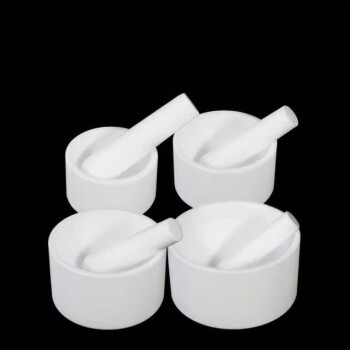
- Custom PTFE Teflon Parts Manufacturer Grinding Bowl
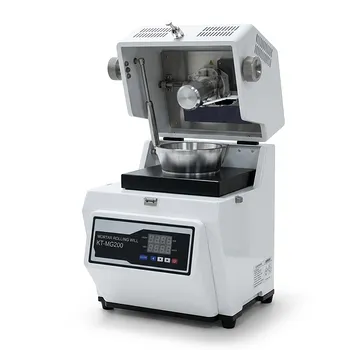
- Laboratory Grinding Mill Mortar Grinder for Sample Preparation
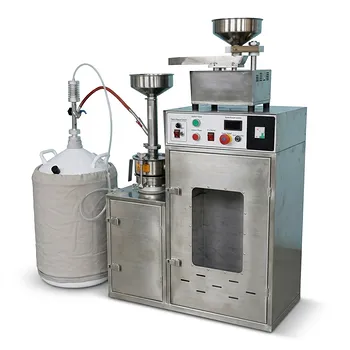
- Liquid Nitrogen Cryogenic Grinder Mill Cryomill with Screw Feeder
People Also Ask
- What is the purpose of using a grinding bowl? Achieve Perfect Electrode Slurry Homogeneity
- How is PTFE utilized for insulation in Alloy 22 corrosion setups? Ensure Signal Purity & Accuracy
- What are the specific applications of PTFE in micro-batch slug flow systems? Enhance Your Microfluidic Reaction Purity
- Is PTFE corrosion resistant? Discover the Ultimate Chemical Resistance for Your Lab
- What is the primary function of PTFE in Gas Diffusion Electrodes (GDE)? Ensure Peak Electrochemical Performance