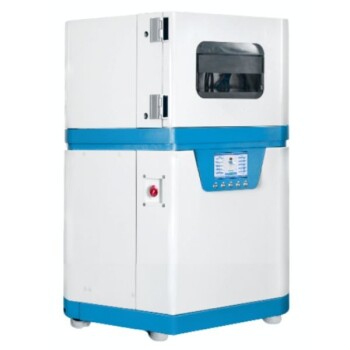
The primary function of a high-vacuum diffusion pump system in this process is to evacuate the interior of the powder capsule to an extremely low pressure—specifically around $1.0 \times 10^{-3}$ Pa—before it is sealed. This rigorous evacuation is critical for removing both ambient air and adsorbed gases clinging to the powder particles. By stripping away these contaminants, the system prevents the oxygen from reacting with alloying elements during the high temperatures of the Hot Isostatic Pressing (HIP) cycle.
The system acts as a critical safeguard against Prior Particle Boundary (PPB) oxide contamination, ensuring that residual oxygen does not compromise the bonding and structural integrity of the final sintered material.
The Mechanics of Contamination Prevention
Preventing Oxide Formation
The central challenge in powder metallurgy is maintaining the purity of the individual powder grains. When residual oxygen is present, it reacts with the alloy elements as the temperature rises.
This reaction creates oxide layers on the surface of the particles. These layers act as barriers, preventing the particles from fusing completely during the sintering process.
Eliminating the PPB Defect
These oxide barriers are technically known as Prior Particle Boundary (PPB) oxide contamination. PPBs are microscopic defects that outline the original shape of the powder particles within the solid metal.
If PPBs are allowed to form, they create distinct lines of weakness within the material. The high-vacuum diffusion pump prevents this specific defect by removing the reactants (oxygen) before heat is applied.
Achieving the Necessary Vacuum Level
Reaching High Vacuum Standards
Standard mechanical pumps are often insufficient for the cleanliness required in high-performance metallurgy. A diffusion pump is employed specifically to reach pressures as low as $1.0 \times 10^{-3}$ Pa.
This depth of vacuum is necessary to ensure the atmosphere inside the capsule is effectively void of reactive gases.
Removing Adsorbed Gases
Simply removing the air between particles is not enough. Gas molecules often physically adhere (adsorb) to the surface of the powder.
The high-vacuum environment induces these adsorbed gases to detach from the particle surfaces so they can be evacuated. This ensures the powder surfaces are chemically clean prior to sealing.
Critical Considerations for Process Control
The Cost of Insufficient Evacuation
Failing to achieve the specific pressure threshold ($1.0 \times 10^{-3}$ Pa) creates a false sense of security. A partial vacuum may remove bulk air but leave enough adsorbed oxygen to trigger PPB formation.
If PPBs form, the resulting component may pass visual inspection but fail under stress due to compromised internal bonding.
Impact on Material Performance
While the HIP process generally improves homogeneity and fatigue strength, these benefits are negated if the feedstock is contaminated.
The diffusion pump ensures that the HIP process can deliver on its promise of eliminating voids and enhancing fracture toughness without being undermined by internal oxide networks.
Optimizing Your HIP Strategy
To ensure maximum integrity in your powder metallurgy components, consider these priorities:
- If your primary focus is Structural Integrity: Ensure your pre-treatment reaches at least $1.0 \times 10^{-3}$ Pa to guarantee the elimination of Prior Particle Boundary (PPB) networks.
- If your primary focus is Material Homogeneity: Utilize high-vacuum evacuation to remove adsorbed gases that would otherwise create chemical inconsistencies at particle interfaces.
Precise atmosphere control during the encapsulation phase is the prerequisite for achieving the high-performance mechanical properties expected from Hot Isostatic Pressing.
Summary Table:
| Feature | Specification/Requirement | Impact on HIP Quality |
|---|---|---|
| Vacuum Level | 1.0 x 10⁻³ Pa | Removes bulk air and adsorbed gas molecules |
| Target Defect | Prior Particle Boundaries (PPBs) | Eliminates oxide layers that weaken material bonds |
| Mechanism | Diffusion Pumping | Ensures chemical cleanliness of powder surfaces |
| Material Benefit | Enhanced Homogeneity | Prevents fracture-prone internal oxide networks |
Elevate Your Material Purity with KINTEK Precision
Don't let Prior Particle Boundary (PPB) defects compromise your structural integrity. KINTEK specializes in advanced laboratory solutions designed for high-performance metallurgy. From our specialized high-vacuum diffusion pumps and hydraulic isostatic presses to our comprehensive range of high-temperature furnaces and reactors, we provide the tools you need to achieve absolute material homogeneity.
Ready to optimize your powder metallurgy workflow? Contact our technical experts today to discover how our high-precision equipment can enhance your lab's research and production outcomes.
Related Products
- Warm Isostatic Press for Solid State Battery Research
- Electric Split Lab Cold Isostatic Press CIP Machine for Cold Isostatic Pressing
- Manual Cold Isostatic Pressing Machine CIP Pellet Press
- Automatic High Temperature Heated Hydraulic Press Machine with Heated Plates for Lab
- Isostatic Molding Pressing Molds for Lab
People Also Ask
- What is the temperature of a warm isostatic press? Achieve Optimal Densification for Your Materials
- What is the function of a Warm Isostatic Press (WIP) in all-solid-state pouch cells? Optimize Battery Density
- Why are Warm Isostatic Presses (WIP) necessary for solid-state batteries? Achieve Atomic-Level Contact
- What advantages does a warm isostatic press offer over a traditional uniaxial press for Li6PS5Cl electrolyte sheets?
- How do warm isostatic presses improve dry electrode performance? Enhance ASSB Conductivity with Heat & Pressure