Knowledge What is the purpose of using an agate mortar for LDIP processing? Master Precision in Oil-Water Separation Membranes
Author avatar

Tech Team · Kintek Solution

Updated 2 days ago

What is the purpose of using an agate mortar for LDIP processing? Master Precision in Oil-Water Separation Membranes


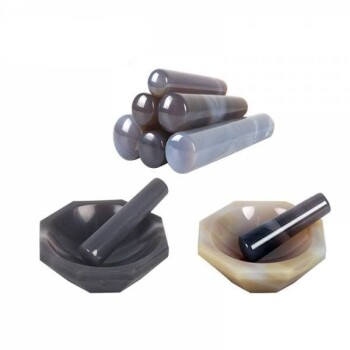
The primary purpose of using an agate mortar is to mechanically refine bulk low-density isotropic pyrolytic carbon (LDIP) into a fine powder without introducing contaminants. By leveraging the high hardness and chemical inertness of agate, you can effectively grind the material to increase its specific surface area. This step is a prerequisite for creating a uniform slurry that can be evenly coated onto substrates.

Effective oil-water separation relies on surface texture; the agate mortar provides the mechanical refinement necessary to transition LDIP from a raw bulk state to a dispersed coating capable of consistent micro-nano roughness.

The Mechanics of Material Refinement

Increasing Specific Surface Area

Processing starts with LDIP in a bulk state, which is unsuitable for membrane fabrication. The agate mortar is used to grind this bulk material down into a fine powder. This mechanical action drastically increases the specific surface area of the carbon.

Leveraging Material Properties

Agate is selected specifically for its high hardness and chemical inertness. This ensures that the grinding process is physically efficient while preventing chemical reactions or contamination that could alter the LDIP's properties.

Impact on Membrane Architecture

Facilitating Uniform Dispersion

A fine, high-surface-area powder is required to interact properly with solvents. The grinding process allows the LDIP to be uniformly dispersed to create a stable slurry. Without this refinement, the material would not mix evenly, leading to distinct processing failures.

Establishing Micro-Nano Roughness

The ultimate goal of the grinding process is to influence the surface topography of the final product. When the uniform slurry is coated onto a flexible substrate, such as filter paper, the fine particles create a specific texture. This consistent micro-nano roughness is the key physical trait that enables the membrane to effectively separate oil from water.

Critical Considerations and Trade-offs

The Requirement for Consistency

The effectiveness of the final membrane is directly tied to the uniformity of the powder. If the grinding is inconsistent, the dispersion in the solvent will be uneven. This leads to a membrane with irregular roughness, compromising its separation efficiency.

Mechanical Limitations

While an agate mortar is ideal for maintaining purity, it is a mechanical refinement tool. It requires thorough application to ensure the bulk material is completely converted to powder, as any remaining coarse particles will disrupt the coating process.

Making the Right Choice for Your Goal

To ensure your LDIP processing yields a functional membrane, consider your specific objectives:

  • If your primary focus is Coating Uniformity: Thoroughly grind the LDIP to a fine powder to ensure it disperses evenly throughout the solvent slurry.
  • If your primary focus is Separation Efficiency: Prioritize the reduction of particle size to maximize specific surface area, as this directly creates the micro-nano roughness required for separation.

The quality of your mechanical grinding is the single most important factor in establishing the surface architecture of your final membrane.

Summary Table:

Feature Benefit for LDIP Processing
High Hardness Efficiently grinds bulk LDIP into fine powder
Chemical Inertness Prevents contamination and preserves material purity
Increased Surface Area Ensures uniform dispersion in solvent slurries
Surface Topography Creates the micro-nano roughness needed for separation

Optimize Your Research with KINTEK Precision

Elevate your material processing with KINTEK’s premium laboratory equipment. Whether you need precise agate mortars, advanced crushing and milling systems, or sieving equipment, our solutions ensure the purity and consistency required for cutting-edge applications like oil-water separation membranes.

Beyond sample preparation, we offer a comprehensive range of high-temperature furnaces, isostatic hydraulic presses, and high-pressure reactors to support your entire experimental workflow. Contact us today to discover how KINTEK can enhance your lab's efficiency and help you achieve superior material refinement!

Related Products

People Also Ask

Related Products

Laboratory Single Horizontal Jar Mill

Laboratory Single Horizontal Jar Mill

KT-JM3000 is a mixing and grinding instrument for placing a ball milling tank with a volume of 3000ml or less. It adopts frequency conversion control to realize timing, constant speed, direction change, overload protection and other functions.

High Energy Planetary Ball Mill for Laboratory Horizontal Tank Type Milling Machine

High Energy Planetary Ball Mill for Laboratory Horizontal Tank Type Milling Machine

KT-P4000H uses the unique Y-axis planetary motion trajectory, and utilizes the collision, friction and gravity between the sample and the grinding ball to have a certain anti-sinking ability, which can obtain better grinding or mixing effects and further improve the sample output.

High Energy Planetary Ball Mill Milling Machine for Laboratory

High Energy Planetary Ball Mill Milling Machine for Laboratory

The biggest feature is that the high energy planetary ball mill can not only perform fast and effective grinding, but also has good crushing ability

High Energy Planetary Ball Mill Milling Machine for Laboratory

High Energy Planetary Ball Mill Milling Machine for Laboratory

Experience fast and effective sample processing with the F-P2000 high-energy planetary ball mill. This versatile equipment offers precise control and excellent grinding capabilities. Perfect for laboratories, it features multiple grinding bowls for simultaneous testing and high output. Achieve optimal results with its ergonomic design, compact structure, and advanced features. Ideal for a wide range of materials, it ensures consistent particle size reduction and low maintenance.

Twin Screw Extruder Plastic Granulation Machine

Twin Screw Extruder Plastic Granulation Machine

Twin screw extruder plastic granulation machine is designed for the mixing and processing experiments of engineering plastics, modified plastics, waste plastics and masterbatches.

Benchtop Laboratory Freeze Dryer for Lab Use

Benchtop Laboratory Freeze Dryer for Lab Use

Premium benchtop laboratory freeze dryer for lyophilization, preserving samples with ≤ -60°C cooling. Ideal for pharmaceuticals & research.

Small Vacuum Heat Treat and Tungsten Wire Sintering Furnace

Small Vacuum Heat Treat and Tungsten Wire Sintering Furnace

The small vacuum tungsten wire sintering furnace is a compact experimental vacuum furnace specially designed for universities and scientific research institutes. The furnace features a CNC welded shell and vacuum piping to ensure leak-free operation. Quick-connect electrical connections facilitate relocation and debugging, and the standard electrical control cabinet is safe and convenient to operate.

Custom PTFE Teflon Parts Manufacturer for PTFE Mesh F4 Sieve

Custom PTFE Teflon Parts Manufacturer for PTFE Mesh F4 Sieve

PTFE mesh sieve is a specialized test sieve designed for particle analysis in various industries, featuring a non-metallic mesh woven from PTFE filament. This synthetic mesh is ideal for applications where metal contamination is a concern . PTFE sieves are crucial for maintaining the integrity of samples in sensitive environments, ensuring accurate and reliable results in particle size distribution analysis.

Custom PTFE Wafer Holders for Lab and Semiconductor Processing

Custom PTFE Wafer Holders for Lab and Semiconductor Processing

This is a high-purity, custom-machined PTFE (Teflon) holder, expertly designed for the secure handling and processing of delicate substrates like conductive glass, wafers, and optical components.

Electric Rotary Kiln Continuous Working Small Rotary Furnace Heating Pyrolysis Plant

Electric Rotary Kiln Continuous Working Small Rotary Furnace Heating Pyrolysis Plant

Efficiently calcine and dry bulk powder and lump fluid materials with an electric heating rotary furnace. Ideal for processing lithium ion battery materials and more.

Precision Machined Zirconia Ceramic Ball for Engineering Advanced Fine Ceramics

Precision Machined Zirconia Ceramic Ball for Engineering Advanced Fine Ceramics

zirconia ceramic ball have the characteristics of high strength, high hardness, PPM wear level, high fracture toughness, good wear resistance, and high specific gravity.

CVD Diamond Cutting Tool Blanks for Precision Machining

CVD Diamond Cutting Tool Blanks for Precision Machining

CVD Diamond Cutting Tools: Superior Wear Resistance, Low Friction, High Thermal Conductivity for Non-Ferrous Materials, Ceramics, Composites Machining

Custom PTFE Teflon Parts Manufacturer Corrosion Resistant Cleaning Rack Flower Basket

Custom PTFE Teflon Parts Manufacturer Corrosion Resistant Cleaning Rack Flower Basket

The PTFE cleaning rack, also known as the PTFE flower basket cleaning flower basket, is a specialized laboratory tool designed for the efficient cleaning of PTFE materials. This cleaning rack ensures thorough and safe cleaning of PTFE items, maintaining their integrity and performance in laboratory settings.

Custom Machined and Molded PTFE Teflon Parts Manufacturer for Laboratory ITO FTO Conductive Glass Cleaning Flower Basket

Custom Machined and Molded PTFE Teflon Parts Manufacturer for Laboratory ITO FTO Conductive Glass Cleaning Flower Basket

PTFE cleaning racks are mainly made of tetrafluoroethylene. PTFE, known as the "King of Plastics", is a polymer compound made of tetrafluoroethylene.

Custom PTFE Teflon Parts Manufacturer for Centrifuge Tube Racks

Custom PTFE Teflon Parts Manufacturer for Centrifuge Tube Racks

The precision-made PTFE test tube racks are completely inert and, due to the high temperature properties of PTFE, these test tube racks can be sterilized (autoclaved) without any problems.

1200℃ Split Tube Furnace with Quartz Tube Laboratory Tubular Furnace

1200℃ Split Tube Furnace with Quartz Tube Laboratory Tubular Furnace

KT-TF12 split tube furnace: high-purity insulation, embedded heating wire coils, and max. 1200C. Widely used for new materials and chemical vapour deposition.


Leave Your Message