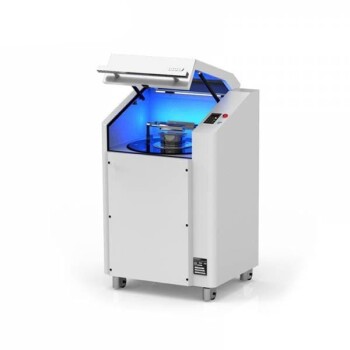
Knowledge What is the role of a planetary ball mill for W-50%Cu composites? Achieve Microscopic Homogeneity and Structural Integrity
Author avatar

Tech Team · Kintek Solution

Updated 2 days ago

What is the role of a planetary ball mill for W-50%Cu composites? Achieve Microscopic Homogeneity and Structural Integrity


The role of a planetary ball mill in W-50%Cu composite production is to act as a high-energy mechanical equalizer. By utilizing the centrifugal and frictional forces generated through mechanical rotation, the mill overcomes the significant density differences between tungsten (W) and copper (Cu) powders. This process breaks down powder agglomerates and forces a uniform distribution of both metals at a microscopic level, ensuring the mixture is homogenous before the sintering phase begins.

Core Takeaway The planetary ball mill is not merely a mixer; it is a structural homogenizer required to defeat density segregation. Its primary function is to eliminate powder clumps and mechanically lock tungsten and copper into a uniform distribution, creating the essential foundation for a defect-free composite during the subsequent sintering process.

Overcoming the Density Challenge

The Problem of Physical Separation

Tungsten and copper possess vastly different densities. In standard mixing scenarios, gravity and inertia cause these distinct powders to separate, or segregate.

The planetary ball mill solves this by applying forces that far exceed the influence of gravity.

Mechanical Forces at Work

The equipment utilizes high-speed mechanical rotation. This generates two specific types of forces:

  1. Centrifugal Force: pushes particles outward with high energy.
  2. Frictional Force: created by the grinding media moving against the powders.

These forces act simultaneously to keep the heavy tungsten and lighter copper in a constant state of energetic interaction.

Achieving Microscopic Homogeneity

Eliminating Powder Agglomeration

Raw metal powders, particularly fine ones, have a natural tendency to clump together, known as agglomeration.

If these clumps remain, the final material will have weak spots or regions of pure copper/tungsten. The planetary ball mill effectively pulverizes these agglomerates, ensuring every particle is discrete and available for mixing.

Establishing the Sintering Foundation

The ultimate goal of this stage is to prepare the "green body" (the pressed powder) for sintering.

Sintering requires a uniform starting point to be effective. By ensuring a homogenous distribution of metallic phases now, the ball mill prevents structural inconsistencies that cannot be fixed later in the manufacturing process.

Understanding the Process Dynamics

The Necessity of Shear and Impact

While simple stirring mixes fluids, solid powders require shear and impact forces.

Drawing from the physics of ball milling, the grinding media (balls) continuously collide with the powder. This action physically forces the tungsten and copper particles to intersperse, preventing the formation of localized clusters of a single metal.

Critical Considerations

The effectiveness of this process relies on the intensity of the force. If the rotation speed or duration is insufficient, the density difference between tungsten and copper will prevail, leading to segregation.

Conversely, the process creates a uniform "microscopic scale" mixture, which is distinct from a chemical alloy; the metals remain distinct phases but are intimately mixed.

Making the Right Choice for Your Goal

To ensure the highest quality W-50%Cu composite, apply the milling process based on your specific requirements:

  • If your primary focus is Structural Integrity: Prioritize the complete elimination of agglomeration to prevent weak spots in the final sintered product.
  • If your primary focus is Material Uniformity: Ensure sufficient rotational speed to generate the centrifugal force needed to counteract the density disparity between W and Cu.

The planetary ball mill is the non-negotiable step that transforms mismatched raw powders into a unified, sinter-ready composite material.

Summary Table:

Feature Role in W-50%Cu Mixing Key Benefit
Centrifugal Force Counteracts density disparity between W and Cu Prevents material segregation
High-Energy Impact Pulverizes powder agglomerates Eliminates weak spots in final product
Mechanical Rotation Provides intensive shear and friction Ensures microscopic phase distribution
Structural Homogenizer Creates a uniform "green body" foundation Leads to defect-free sintering results

Elevate Your Materials Research with KINTEK Precision

Achieving the perfect microscopic distribution in W-50%Cu composites requires more than just mixing—it requires high-energy mechanical precision. KINTEK specializes in advanced crushing and milling systems, including high-performance planetary ball mills designed to handle extreme density differences and eliminate powder agglomeration.

Whether you are developing advanced composites, conducting battery research, or exploring high-temperature metallurgy, our comprehensive portfolio—from high-temperature furnaces and hydraulic presses to PTFE consumables and ceramics—is engineered to meet the rigorous demands of your laboratory.

Ready to optimize your material uniformity? Contact our experts today to find the ideal milling and sintering solutions for your specific application.

Related Products

People Also Ask

Related Products

Laboratory Horizontal Planetary Ball Mill Milling Machine

Laboratory Horizontal Planetary Ball Mill Milling Machine

Improve sample uniformity with our Horizontal Planetary Ball Mills. KT-P400H reduces sample deposition and KT-P400E has multi-directional capabilities. Safe, convenient and efficient with overload protection.

Mini Planetary Ball Mill Machine for Laboratory Milling

Mini Planetary Ball Mill Machine for Laboratory Milling

Discover the KT-P400 desktop planetary ball mill, ideal for grinding and mixing small samples in the lab. Enjoy stable performance, long service life, and practicality. Functions include timing and overload protection.

High-Energy Omnidirectional Planetary Ball Mill Milling Machine for Laboratory

High-Energy Omnidirectional Planetary Ball Mill Milling Machine for Laboratory

The KT-P4000E is a new product derived from the vertical high-energy planetary ball mill with a 360° swivel function. Experience faster, uniform, and smaller sample output results with 4 ≤1000ml ball mill jars.

Laboratory Planetary Ball Mill Cabinet Planetary Ball Milling Machine

Laboratory Planetary Ball Mill Cabinet Planetary Ball Milling Machine

The vertical cabinet structure combined with ergonomic design enables users to obtain the best comfortable experience in standing operation. The maximum processing capacity is 2000ml, and the speed is 1200 revolutions per minute.

High Energy Planetary Ball Mill Machine for Laboratory Horizontal Tank Type

High Energy Planetary Ball Mill Machine for Laboratory Horizontal Tank Type

The KT-P2000H uses a unique Y-axis planetary trajectory, and utilizes the collision, friction and gravity between the sample and the grinding ball.

Laboratory Jar Ball Mill with Alumina Zirconia Grinding Jar and Balls

Laboratory Jar Ball Mill with Alumina Zirconia Grinding Jar and Balls

Grind to perfection with alumina/zirconia grinding jars and balls. Available in volume sizes from 50ml to 2500ml, compatible with various mills.

Laboratory Micro Tissue Grinding Mill Grinder

Laboratory Micro Tissue Grinding Mill Grinder

KT-MT10 is a miniature ball mill with a compact structure design. The width and depth are only 15X21 cm, and the total weight is only 8 kg. It can be used with a minimum 0.2ml centrifuge tube or a maximum 15ml ball mill jar.

Laboratory High Throughput Tissue Grinding Mill Grinder

Laboratory High Throughput Tissue Grinding Mill Grinder

KT-MT is a high-quality, small, and versatile tissue grinder used for crushing, grinding, mixing, and cell wall breaking in various fields, including food, medical, and environmental protection. It is equipped with 24 or 48 2ml adapters and ball grinding tanks and is widely employed for DNA, RNA, and protein extraction.

Laboratory Grinding Mill Mortar Grinder for Sample Preparation

Laboratory Grinding Mill Mortar Grinder for Sample Preparation

KT-MG200 mortar grinder can be used for mixing and homogenizing powder, suspension, paste and even viscous samples. It can help users realize the ideal operation of sample preparation with more regularization and higher repeatability.

Laboratory Disc Cup Vibratory Mill for Sample Grinding

Laboratory Disc Cup Vibratory Mill for Sample Grinding

The vibrating disc mill is suitable for non-destructive crushing and fine grinding of samples with large particle sizes, and can quickly prepare samples with analytical fineness and purity.

Small Cryogenic Grinder Cryomill Cryogrinder with Liquid Nitrogen for Laboratory Use

Small Cryogenic Grinder Cryomill Cryogrinder with Liquid Nitrogen for Laboratory Use

Our KINTEK Cryomilling is perfect for small runs and R&D trials. With a versatile cryogenic system, it can handle a variety of materials, including plastics, rubber, pharmaceuticals, and food grades. Plus, our specialized hydraulic laboratory crushers ensure accurate results through multiple passes, making it suitable for XRF analysis. Get finely-powdered samples with ease!

Liquid Nitrogen Cryogenic Grinder Mill Cryomill Airflow Ultrafine Pulverizer

Liquid Nitrogen Cryogenic Grinder Mill Cryomill Airflow Ultrafine Pulverizer

Discover the Liquid Nitrogen Cryogenic Grinding Machine, perfect for lab use, ultra-fine pulverization, and preserving material properties. Ideal for pharmaceuticals, cosmetics, and more.

Battery Lab Equipment Battery Capacity and Comprehensive Tester

Battery Lab Equipment Battery Capacity and Comprehensive Tester

The scope of application of the battery comprehensive tester can be tested: 18650 and other cylindrical, square lithium batteries, polymer batteries, nickel-cadmium batteries, nickel-metal hydride batteries, lead-acid batteries, etc.

Custom PTFE Teflon Parts Manufacturer F4 Conical Flask Triangular Flask 50 100 250ml

Custom PTFE Teflon Parts Manufacturer F4 Conical Flask Triangular Flask 50 100 250ml

The PTFE triangular flask, also known as a Teflon reagent bottle, is a robust, chemical-resistant alternative to traditional glass bottles, suitable for handling both acids and alkalis. These bottles are unbreakable, lightweight, and feature a leak-proof screw cap, making them ideal for laboratory use.

Small Vacuum Heat Treat and Tungsten Wire Sintering Furnace

Small Vacuum Heat Treat and Tungsten Wire Sintering Furnace

The small vacuum tungsten wire sintering furnace is a compact experimental vacuum furnace specially designed for universities and scientific research institutes. The furnace features a CNC welded shell and vacuum piping to ensure leak-free operation. Quick-connect electrical connections facilitate relocation and debugging, and the standard electrical control cabinet is safe and convenient to operate.

Vacuum Sealed Continuous Working Rotary Tube Furnace Rotating Tube Furnace

Vacuum Sealed Continuous Working Rotary Tube Furnace Rotating Tube Furnace

Experience efficient material processing with our vacuum-sealed rotary tube furnace. Perfect for experiments or industrial production, equipped with optional features for controlled feeding and optimized results. Order now.

Desktop Fast Laboratory Autoclave Sterilizer 35L 50L 90L for Lab Use

Desktop Fast Laboratory Autoclave Sterilizer 35L 50L 90L for Lab Use

The desktop fast steam sterilizer is a compact and reliable device used for rapid sterilization of medical, pharmaceutical, and research items. It efficiently sterilizes surgical instruments, glassware, medicines, and resistant materials, making it suitable for various applications.

Benchtop Laboratory Freeze Dryer for Lab Use

Benchtop Laboratory Freeze Dryer for Lab Use

Premium benchtop laboratory freeze dryer for lyophilization, preserving samples with ≤ -60°C cooling. Ideal for pharmaceuticals & research.

Custom PTFE Teflon Parts Manufacturer for PTFE Mesh F4 Sieve

Custom PTFE Teflon Parts Manufacturer for PTFE Mesh F4 Sieve

PTFE mesh sieve is a specialized test sieve designed for particle analysis in various industries, featuring a non-metallic mesh woven from PTFE filament. This synthetic mesh is ideal for applications where metal contamination is a concern . PTFE sieves are crucial for maintaining the integrity of samples in sensitive environments, ensuring accurate and reliable results in particle size distribution analysis.

Custom PTFE Teflon Parts Manufacturer for Acid and Alkali Resistant Chemical Powder Material Scoops

Custom PTFE Teflon Parts Manufacturer for Acid and Alkali Resistant Chemical Powder Material Scoops

Known for its excellent thermal stability, chemical resistance and electrical insulating properties, PTFE is a versatile thermoplastic material.


Leave Your Message