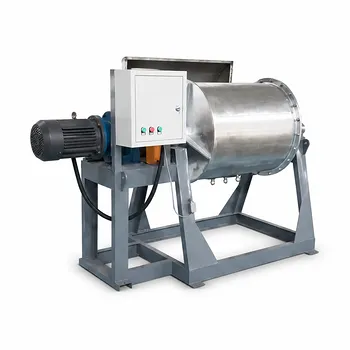
The primary role of a planetary ball mill in this process is to ensure the atomic-level mixing and mechanical activation of the raw materials required to synthesize carbon-coated lithium manganese silicate (Li2MnSiO4).
By subjecting lithium, manganese, and silicon sources—along with Polyethylene Glycol (PEG)—to intense centrifugal and frictional forces within an ethanol medium, the mill creates a chemically uniform, highly reactive slurry. This mechanical step is not merely about mixing; it is a critical prerequisite that defines the quality of the subsequent solid-state reaction.
Core Insight: The planetary ball mill acts as a mechanical catalyst. By breaking down particles and enforcing stoichiometric uniformity at a microscopic scale, it lowers the energy barrier for the solid-state reaction, ensuring the final material is pure, homogeneous, and effectively coated with carbon.
The Mechanics of Precursor Synthesis
Generating High-Energy Forces
The planetary ball mill operates by rotating jars around a central axis while the jars themselves spin in the opposite direction.
At high rotational speeds (e.g., 450 rpm), this motion generates immense centrifugal and frictional forces.
These forces are far superior to standard stirring, allowing for the breakdown of agglomerates that simple mixing cannot resolve.
The Wet Mixing Environment
The process is typically conducted as a "wet mixing" stage using a solvent like ethanol.
The ethanol acts as a carrier, preventing dry powder agglomeration and dissipating heat generated by the high-energy impact.
It facilitates the uniform dispersion of the carbon source (PEG) among the metal precursors, which is vital for the eventual carbon coating.
Achieving Chemical and Physical Homogeneity
Ensuring Stoichiometric Uniformity
For complex materials like Li2MnSiO4, the ratio of Lithium, Manganese, and Silicon must be exact throughout the entire mixture.
The planetary ball mill forces these distinct components into intimate contact.
This ensures that every microscopic region of the slurry contains the correct "recipe" (stoichiometry) required to form the desired crystal structure.
Particle Refinement and Slurry Stability
The mechanical force physically fractures the raw material particles, significantly reducing their size.
This refinement increases the specific surface area of the reactants.
The result is a stable, homogeneous slurry that resists settling, ensuring consistency when the mixture is dried and fired.
Why This Matters for Solid-State Reactions
Increasing Reactivity
Solid-state reactions are inherently sluggish because solids do not mix easily at the atomic level.
By refining particle size, the ball mill maximizes the contact area between reactants.
This "mechanical activation" allows the chemical reaction to proceed more completely and often at lower temperatures during the heating phase.
Facilitating Effective Carbon Coating
The inclusion of PEG (or similar organic sources like glucose) in the milling jar is strategic.
The milling process disperses this polymer uniformly over the surface of the ceramic particles.
Upon heating, the PEG decomposes into a conductive carbon layer, which is essential for the electrical performance of the final battery cathode.
Understanding the Trade-offs
The Risk of Over-Milling
While high energy is beneficial, excessive milling time or speed can introduce impurities.
Debris from the grinding media (balls) or the jar lining can contaminate the precursor, potentially degrading the electrochemical performance of the final material.
Optimization of Parameters
The speed (e.g., 450 rpm vs. 550 rpm) and duration must be carefully tuned.
Insufficient energy leads to incomplete reactions (impure phase), while excessive energy wastes power and risks contamination.
Making the Right Choice for Your Goal
To maximize the effectiveness of planetary ball milling for Li2MnSiO4 precursors, align your process parameters with your specific objectives:
- If your primary focus is Phase Purity: Ensure the rotational speed is sufficient (e.g., 450 rpm) to achieve complete stoichiometric uniformity, preventing the formation of secondary impurity phases.
- If your primary focus is Particle Size/Reactivity: Prioritize the duration of the milling to refine particles sufficiently, maximizing surface area for the solid-state reaction without over-milling.
- If your primary focus is Conductivity: Verify that the carbon source (PEG) is introduced at the start of the milling process to ensure it is thoroughly intermixed and coating the metal oxide particles.
The planetary ball mill is the bridge between raw chemical powders and a high-performance, electrochemically active battery material.
Summary Table:
| Feature | Role in Precursor Synthesis | Impact on Final Material |
|---|---|---|
| High-Energy Impact | Breaks down agglomerates via centrifugal forces | Enhances stoichiometric uniformity |
| Wet Mixing (Ethanol) | Facilitates uniform dispersion of PEG/reactants | Ensures consistent carbon coating |
| Particle Refinement | Increases specific surface area of raw materials | Lowers energy barrier for reactions |
| Mechanical Activation | Atomic-level contact between Li, Mn, and Si | Improves phase purity & conductivity |
Elevate Your Battery Research with KINTEK Precision
Maximize the performance of your Li2MnSiO4 and other advanced cathode materials with KINTEK’s industry-leading preparation tools. Our high-performance planetary ball mills, crushing and milling systems, and specialized grinding media are designed to deliver the exact stoichiometric uniformity and particle refinement your research demands.
From high-energy mechanical activation to the final thermal processing in our vacuum and atmosphere furnaces, KINTEK provides a comprehensive range of laboratory equipment including hydraulic presses, electrolytic cells, and high-temperature reactors.
Ready to achieve superior chemical homogeneity? Contact our laboratory specialists today to find the perfect equipment solution for your battery research and material science applications!
Related Products
- High Energy Planetary Ball Mill for Laboratory Horizontal Tank Type Milling Machine
- High-Energy Omnidirectional Planetary Ball Mill Milling Machine for Laboratory
- Laboratory Planetary Ball Mill Rotating Ball Milling Machine
- High Energy Planetary Ball Mill Milling Machine for Laboratory
- High Energy Planetary Ball Mill Machine for Laboratory Horizontal Tank Type
People Also Ask
- What is the role of a planetary ball mill in sulfide-based solid-state batteries? Engineer High-Performance Cathodes
- What are the parameters of a planetary ball mill? Master Speed, Time, and Media for Perfect Grinding
- What is the function of a planetary ball mill for nanostructured eutectic steel? Essential Prep for High-Strength Alloys
- What role does a planetary ball mill play in the preparation of NASICON-type solid electrolytes like LATP and LAGP?
- What is the function of a planetary ball mill in solid-state electrolyte prep? Milling vs. SDS Methods Explained