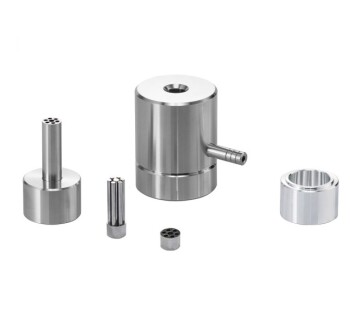
The stainless steel high-pressure reactor is the foundational hardware for solvothermal synthesis, providing the sealed environment necessary to reach supercritical or near-critical conditions. By containing the reaction at temperatures typically around 200 °C, the reactor generates internal pressure that drives the decomposition of precursor salts and the subsequent assembly of $Fe_3O_4$ crystals within an ethylene glycol solvent. This specific high-energy environment is essential for producing nanospheres with high crystallinity and a uniform particle size distribution.
The reactor functions as a controlled "pressure cooker" that enables chemical reactions to occur far above the atmospheric boiling point of the solvent. This ensures the thorough reduction of reactants and the precise self-assembly of magnetic nanostructures that would be impossible in an open-system environment.
The Mechanics of High-Pressure Synthesis
Overcoming Boiling Point Limitations
In standard laboratory glassware, the reaction temperature is limited by the boiling point of the solvent. A stainless steel high-pressure reactor bypasses this limit by creating a sealed system where the pressure increases as the temperature rises.
This allows the ethylene glycol solvent to remain in a liquid state well above its normal boiling point. These elevated conditions provide the thermal energy required to trigger the decomposition and nucleation of iron precursor salts.
Driving Chemical Transformation and Assembly
The internal pressure generated within the reactor acts as a catalyst for the self-assembly of nanoparticles. Under these conditions, the precursors undergo a thorough reduction and crystallization process.
The high-pressure environment forces the iron ions and organic ligands to interact more frequently and energetically. This results in the formation of well-defined core-shell structures or solid nanospheres with specific magnetic properties.
Impact on Nanosphere Morphology
Achieving High Crystallinity
The high-temperature environment maintained by the reactor is critical for the development of a well-defined crystal structure. Without the sustained heat and pressure, the resulting $Fe_3O_4$ would often be amorphous or poorly crystallized.
High crystallinity is not just an aesthetic requirement; it directly determines the magnetic performance of the nanospheres. The reactor ensures that the atoms are arranged in a precise lattice, maximizing the material's functional utility.
Ensuring Size Uniformity
A sealed reactor provides a homogeneous thermal environment, meaning the temperature is consistent throughout the reaction volume. This consistency is vital for ensuring that all nanospheres grow at the same rate.
The result is a uniform particle size distribution, which is essential for applications such as boron adsorption or targeted drug delivery. Consistent sizing ensures that the particles behave predictably in magnetic fields.
The Essential Role of the PTFE Liner
Preventing Chemical Corrosion
Solvothermal reactions often involve strong electrolytes and organic solvents that become highly corrosive at 200 °C. The reactor utilizes a PTFE (polytetrafluoroethylene) liner to act as a chemical shield for the stainless steel body.
This liner protects the structural integrity of the steel exterior from being degraded by the reaction fluid. Without it, the reactor would quickly succumb to pitting and stress corrosion, leading to equipment failure.
Maintaining Product Purity
The PTFE liner also prevents metal ion contamination from the reactor walls from leaching into the $Fe_3O_4$ product. Maintaining high purity is critical for the accuracy of experimental results and the performance of the magnetic cores.
By isolating the reaction, the liner ensures that the only iron present in the final nanospheres comes from the intended precursor salts. This creates a "clean room" environment inside the high-pressure chamber.
Understanding the Trade-offs and Potential Risks
Thermal Lag and Pressure Monitoring
One significant trade-off is the thermal inertia of the heavy stainless steel walls. The internal temperature may lag behind the oven or heating mantle's set point, requiring precise calibration to ensure the reaction actually reaches the intended 200 °C.
Furthermore, exceeding the reactor's maximum pressure rating can lead to catastrophic failure. Users must carefully calculate the solvent filling degree to ensure there is enough "headspace" for gas expansion.
Maintenance and Seal Integrity
The effectiveness of the reactor depends entirely on the integrity of the seal. High-temperature cycles can cause the PTFE liner to deform over time, leading to leaks that drop the internal pressure and ruin the synthesis.
Regular inspection of the gaskets and locking mechanisms is mandatory. A minor leak not only compromises the particle size distribution but also poses a significant safety hazard in the laboratory.
Applying This to Your Synthesis Project
Making the Right Choice for Your Goal
To achieve the best results in your $Fe_3O_4$ synthesis, consider your primary objective when configuring your reactor setup:
- If your primary focus is high magnetic susceptibility: Ensure the reactor is maintained at 200 °C or higher for a sufficient duration to maximize the crystallinity of the $Fe_3O_4$ cores.
- If your primary focus is particle size monodispersity: Use a reactor with a high-quality PTFE liner and ensure the filling degree is consistent across different batches to maintain reproducible pressure levels.
- If your primary focus is laboratory safety and equipment longevity: Never exceed a 70-80% solvent filling ratio and regularly inspect the reactor's stainless steel threads and liner for signs of wear or deformation.
The stainless steel reactor is the silent engine of solvothermal synthesis, providing the extreme conditions necessary to transform simple iron salts into sophisticated, high-performance nanospheres.
Summary Table:
| Component/Feature | Role in Synthesis | Key Benefit |
|---|---|---|
| High-Pressure Chamber | Creates a sealed environment for supercritical conditions | Drives precursor decomposition and assembly |
| PTFE Liner | Provides a chemical shield against corrosive precursors | Prevents metal contamination and equipment wear |
| Sealed System | Raises solvent boiling point (e.g., Ethylene Glycol) | Facilitates high crystallinity and magnetic susceptibility |
| Homogeneous Heating | Maintains consistent thermal environment | Ensures uniform particle size distribution |
Elevate your solvothermal research with KINTEK’s precision-engineered laboratory solutions. Whether you are synthesizing magnetic nanostructures or exploring advanced material chemistry, our robust high-temperature high-pressure reactors and autoclaves provide the reliable sealed environment necessary for uniform $Fe_3O_4$ nanosphere growth.
We also offer high-quality PTFE products, ceramics, and crucibles to ensure your reactions remain pure and your equipment stays protected. Beyond reactors, KINTEK specializes in a comprehensive range of lab tools including high-temperature furnaces, crushing systems, and hydraulic presses to support your entire material synthesis workflow.
Contact us today to find the perfect high-performance reactor for your laboratory!
References
- Congcong Lu, Maiyong Zhu. Construction of Fe3O4@Fe2P Heterostructures as Electrode Materials for Supercapacitors. DOI: 10.3390/batteries9060326
This article is also based on technical information from Kintek Solution Knowledge Base .
Related Products
- Stainless High Pressure Autoclave Reactor Laboratory Pressure Reactor
- Mini SS High Pressure Autoclave Reactor for Laboratory Use
- Customizable High Pressure Reactors for Advanced Scientific and Industrial Applications
- Customizable Laboratory High Temperature High Pressure Reactors for Diverse Scientific Applications
- High Pressure Laboratory Autoclave Reactor for Hydrothermal Synthesis
People Also Ask
- Why is a laboratory high-pressure reactor necessary for synthesizing fly ash-based zeolite? Achieve Pure Crystallization
- Why is a laboratory high-pressure reactor used in the hydrothermal synthesis of hydroxyapatite catalysts?
- What role does a laboratory high-pressure reactor play in the leaching process of spent cathode materials? Optimize Recovery
- What conditions do laboratory high-pressure reactors provide for HTC? Optimize Your Biochar Production Processes
- How are high-pressure reactors used to prepare metaphosphate electrocatalysts? Master In-Situ Precursor Growth