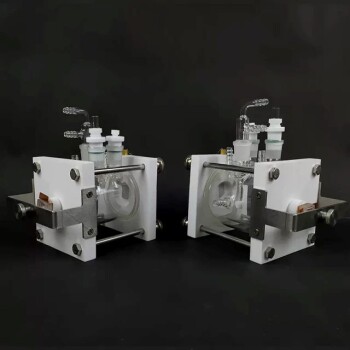
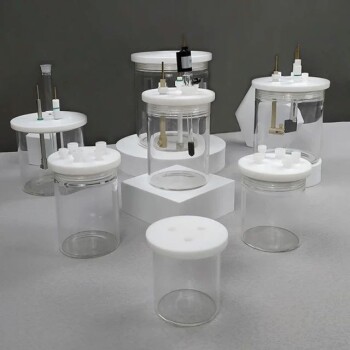
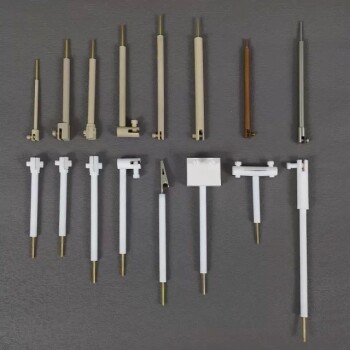
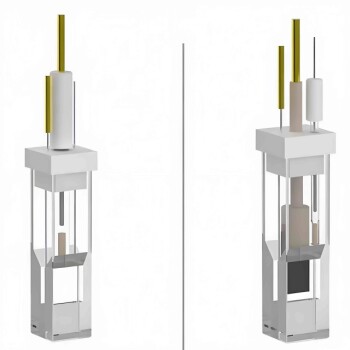
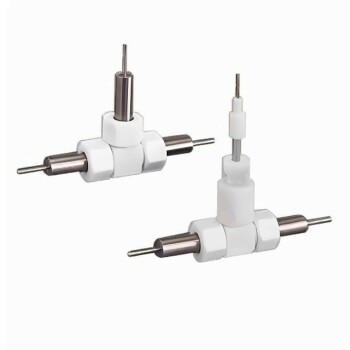
A three-electrode electrochemical corrosion cell system serves as a precision verification tool used to quantify the anti-corrosion performance of chromium coatings through potentiodynamic polarization testing. By isolating the chromium-coated sample as the working electrode, this setup measures the material’s pitting potential in corrosive environments, such as 3.5 wt% NaCl solution, to predict long-term durability.
Core Takeaway The three-electrode system decouples potential control from current measurement, eliminating electrical noise and resistance errors. This allows for an accurate determination of exactly when and how a chromium coating will fail (pitting potential) when subjected to specific processing conditions.
The Anatomy of the System
To understand how this system verifies performance, you must first understand the specific function of each component defined in the testing standard.
The Working Electrode (The Sample)
The chromium-coated sample serves as the working electrode. This is the material being tested.
The entire focus of the experiment is to monitor the reaction at the interface of this specific coating.
The Reference Electrode (The Baseline)
A saturated calomel electrode (SCE) is typically used as the reference.
Its sole role is to provide a stable, unchanging potential baseline against which the working electrode is measured. It does not conduct the main test current, ensuring its reading remains accurate and uninfluenced by the reaction.
The Counter Electrode (The Conductor)
A platinum wire acts as the counter (or auxiliary) electrode.
This component completes the electrical circuit, allowing current to flow through the solution without interfering with the voltage measurement occurring at the reference electrode.
The Mechanics of Verification
Decoupling Control and Measurement
The primary advantage of using three electrodes instead of two is the decoupling of potential control and current measurement.
In a two-electrode system, the current flow can distort voltage readings due to solution resistance. The three-electrode setup isolates the voltage measurement (Reference) from the current path (Counter), enabling high-precision control by the electrochemical workstation.
Potentiodynamic Polarization Testing
This system is primarily used to conduct potentiodynamic polarization tests.
The workstation systematically alters the voltage and measures the resulting current response. This "stress test" forces the coating to reveal its electrochemical characteristics under accelerated conditions.
Simulating Corrosive Environments
The test is conducted in a controlled corrosive medium, commonly a 3.5 wt% NaCl solution.
This specifically simulates saline or marine environments, providing a realistic backdrop for evaluating how the chromium coating will behave when exposed to aggressive chloride ions.
Critical Data Outputs
Determining Pitting Potential
The most vital data point derived from this test is the pitting potential.
This value represents the voltage threshold at which the passive chromium layer breaks down and localized corrosion (pits) begins to form. A higher pitting potential indicates a more robust, protective coating.
Evaluating Process Conditions
This system provides the scientific basis for comparing different manufacturing process conditions.
By running this test on samples created with different parameters, engineers can objectively determine which process yields the highest corrosion resistance based on the breakdown potential and polarization resistance.
Understanding the Trade-offs
Idealized vs. Real-World Conditions
While this system provides precise quantitative data, it represents an idealized, accelerated environment.
A 3.5 wt% NaCl solution is a standard proxy for seawater, but it lacks the biological organisms and complex chemical mixtures found in real-world service environments.
The Speed of Failure
Potentiodynamic testing forces corrosion to happen in minutes or hours.
Real-world corrosion is a slow, kinetic process. While the ranking of materials (Material A is better than Material B) is generally accurate, the absolute "lifespan" cannot be calculated solely from this test.
Making the Right Choice for Your Goal
When employing a three-electrode system for chromium coatings, tailor your analysis to your specific objective.
- If your primary focus is process optimization: Prioritize the pitting potential; the process recipe that yields the highest voltage before breakdown offers the best theoretical protection.
- If your primary focus is fundamental research: Analyze the polarization resistance to understand the kinetics of the corrosion reaction and the stability of the passive film.
The three-electrode cell transforms corrosion from a guessing game into a measurable, controllable science.
Summary Table:
| Component | Role in Verification | Material/Standard |
|---|---|---|
| Working Electrode | The sample under test | Chromium-coated material |
| Reference Electrode | Stable potential baseline | Saturated Calomel Electrode (SCE) |
| Counter Electrode | Completes electrical circuit | Platinum Wire |
| Electrolyte | Simulates corrosive environment | 3.5 wt% NaCl solution |
| Key Output | Determines breakdown threshold | Pitting Potential |
Optimize Your Coating Performance with KINTEK Precision
Precision in electrochemical testing is the foundation of material durability. KINTEK provides a comprehensive suite of laboratory solutions designed for rigorous research and quality control. From advanced electrolytic cells and electrodes specifically engineered for three-electrode systems to high-performance high-temperature furnaces (CVD/PECVD/Vacuum) for coating application and cooling solutions for process control, we empower your lab to achieve scientific excellence.
Ready to elevate your material testing? Contact KINTEK today to discover how our high-precision equipment and consumables can refine your manufacturing process and guarantee superior anti-corrosion performance.
References
- Bright O. Okonkwo, Ali Davoodi. Development and optimization of trivalent chromium electrodeposit on 304L stainless steel to improve corrosion resistance in chloride-containing environment. DOI: 10.1016/j.heliyon.2023.e22538
This article is also based on technical information from Kintek Solution Knowledge Base .
Related Products
- PTFE Electrolytic Cell Electrochemical Cell Corrosion-Resistant Sealed and Non-Sealed
- H Type Electrolytic Cell Triple Electrochemical Cell
- Flat Corrosion Electrolytic Electrochemical Cell
- Electrolytic Electrochemical Cell for Coating Evaluation
- Customizable PEM Electrolysis Cells for Diverse Research Applications
People Also Ask
- What is the necessity of selecting a PTFE electrolytic cell? Ensure Precise Graphene Corrosion Testing Accuracy
- What is the proper method for cleaning the surface of an all-PTFE electrolytic cell? Ensure Accurate Results with a Pristine Surface
- How should an all-PTFE electrolytic cell be stored after use? Expert Maintenance Tips for Long-Lasting Performance
- What is the proper cleaning method for an all-PTFE electrolytic cell? Essential Tips for Surface Integrity
- What are the standard opening specifications for all-PTFE electrolytic cells? A Guide to Sealed vs. Non-Sealed Ports