In two-step thermochemical cycle reactors, Reticulated Porous Ceramic (RPC) foam serves as a critical structural component designed to maximize energy capture and chemical reactivity. It functions either as an inert carrier that supports active reactants or is constructed directly from the reactant material itself. By replacing traditional solid structures, RPC foam enables solar or thermal radiation to penetrate deep into the reactor, fundamentally changing how heat is absorbed and distributed.
By leveraging a unique porous architecture, RPC foam shifts the heating process from surface-level interaction to volumetric radiation absorption, solving the low heat exchange efficiency inherent in traditional packed bed reactors.
The Structural Role of RPC Foam
Versatility in Material Composition
RPC foam provides a flexible foundation for reactor engineering.
It can be utilized as a passive carrier, providing a robust skeleton to hold active reactant materials in place.
Alternatively, the foam can be manufactured directly from the reactants, ensuring that the entire structure contributes to the thermochemical process.
Enabling Volumetric Absorption
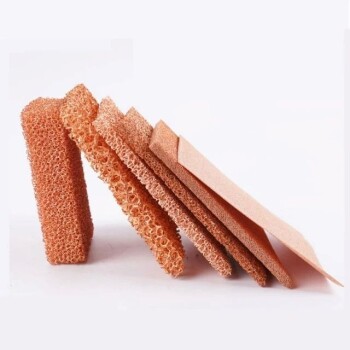
The most distinct advantage of RPC foam is its open, cellular architecture.
This porous design allows concentrated radiation to pass through the outer layers and penetrate deep into the material's volume.
This phenomenon, known as volumetric radiation absorption, ensures that heat is generated uniformly throughout the reactor rather than accumulating solely on the exposed surface.
Enhancing Reactor Performance
Optimizing Heat and Mass Transfer
The physical characteristics of the foam are not arbitrary; they are tunable variables.
By optimizing the pore size and the material loading, engineers can significantly enhance the efficiency of heat and mass transfer within the system.
This optimization ensures that reactants are heated evenly and that gaseous products can move freely through the structure.
Increasing Reaction Rates
Superior heat and mass transfer directly correlate to reactor output.
The improved thermal environment provided by the RPC foam leads to noticeably increased reaction rates.
This allows the reactor to process materials more quickly and effectively than designs limited by surface-heating constraints.
Solving the Packed Bed Limitation
Overcoming Low Heat Exchange Efficiency
Traditional reactor designs frequently utilize packed beds (granules or pellets packed together).
These legacy systems are often plagued by low heat exchange efficiency, as heat struggles to penetrate the packed material.
RPC foam specifically addresses this bottleneck, offering a conductive, open pathway that outperforms the thermal limitations of packed beds.
Critical Design Considerations
The Necessity of Optimization
While RPC foam offers superior theoretical performance, its implementation requires precision.
The benefits of volumetric absorption are only realized if the pore size and loading are correctly matched to the reactor's radiation source.
Improper configuration may reduce the effectiveness of the heat transfer, negating the advantages over packed beds.
Making the Right Choice for Your Goal
When integrating RPC foam into your thermochemical reactor design, success relies on aligning the foam's physical parameters with your specific performance metrics.
- If your primary focus is thermal uniformity: Prioritize an RPC architecture that promotes deep volumetric radiation absorption to eliminate cold spots and surface overheating.
- If your primary focus is throughput: Concentrate on optimizing pore size and loading to maximize mass transfer efficiency and accelerate reaction rates.
By moving away from packed beds to optimized RPC foam, you unlock the potential for a reactor that absorbs energy volumetrically and reacts with superior efficiency.
Summary Table:
| Feature | Traditional Packed Bed | RPC Foam Structure |
|---|---|---|
| Heating Mechanism | Surface-level interaction | Volumetric radiation absorption |
| Heat Exchange Efficiency | Low / Limited penetration | High / Deep penetration |
| Mass Transfer | Restricted by dense packing | High due to open cellular architecture |
| Reaction Rates | Slower due to thermal gradients | Increased through uniform heating |
| Structural Versatility | Limited to granules/pellets | Can be a carrier or the reactant itself |
Elevate Your Reactor Efficiency with KINTEK Solutions
Are you looking to overcome the thermal limitations of traditional packed bed reactors? KINTEK specializes in advanced laboratory equipment and high-performance materials designed for the most demanding research environments. Our expertise in high-temperature furnaces, CVD systems, and advanced ceramic components allows us to provide the precise tools needed for optimized thermochemical cycles.
Whether you require custom ceramic crucibles, high-temperature high-pressure reactors, or specialized consumables like PTFE and ceramic foam support, KINTEK delivers the durability and precision your mission-critical experiments demand.
Ready to optimize your volumetric absorption and reaction rates? Contact our technical specialists today to discover how our comprehensive range of laboratory solutions can accelerate your breakthroughs.
References
- Chen Chen, Hongguang Jin. Challenges and perspectives for solar fuel production from water/carbon dioxide with thermochemical cycles. DOI: 10.1007/s43979-023-00048-6
This article is also based on technical information from Kintek Solution Knowledge Base .
Related Products
- Copper Foam
- Nickel Foam for Industrial and Laboratory Applications
- Copper Nickel Foam Metal Sheet
- Silicon Carbide (SIC) Ceramic Sheet Wear-Resistant Engineering Advanced Fine Ceramics
- Vacuum Dental Porcelain Sintering Furnace
People Also Ask
- What is copper foam used for? A Guide to Its High-Performance Thermal and Energy Applications
- How do you make copper foam? A Step-by-Step Guide to Creating Porous Metal Structures
- What are the available sizes and thicknesses for copper foam? Optimize Your Thermal and Filtration Performance
- What are the characteristics of copper foam? Unlock High-Performance Thermal and Electrical Solutions
- Is copper foam safe? Discover the facts about its antimicrobial and cooling benefits