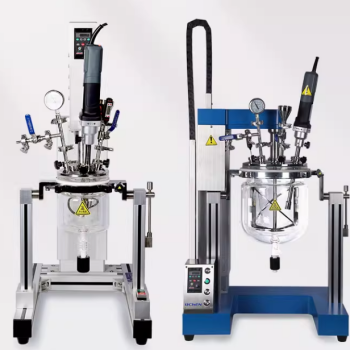
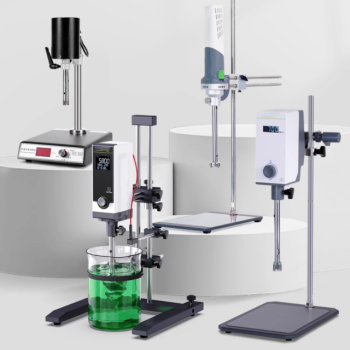
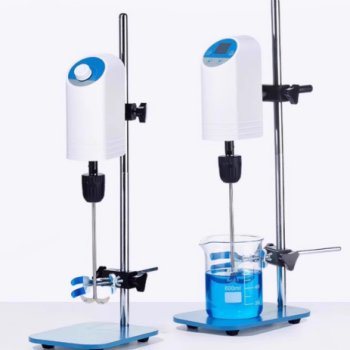
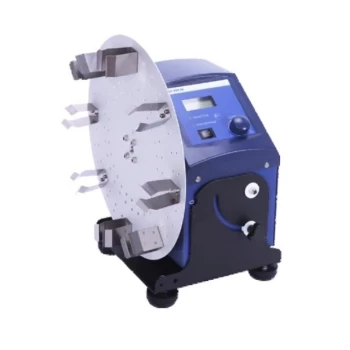
The high-power probe-type ultrasonic homogenizer serves as the primary mechanism for de-agglomeration. It functions by generating intense acoustic cavitation within the organic solvent. This physical force overcomes the strong Van der Waals forces that naturally hold Multi-Walled Carbon Nanotubes (MWCNT) together, ensuring a uniform dispersion prior to chemical reaction.
Core Takeaway The homogenizer is not merely a mixing tool; it is a surface-area multiplier. By breaking nanotube bundles into individual strands through cavitation, it exposes the maximum possible surface area for the subsequent in-situ oxidative polymerization of pyrrole.
The Mechanics of Dispersion
Overcoming Van der Waals Forces
Multi-Walled Carbon Nanotubes (MWCNT) possess a strong natural tendency to clump together due to Van der Waals forces. Standard mechanical stirring is often insufficient to break these molecular attractions.
The probe-type homogenizer introduces high-intensity energy directly into the fluid. This energy is required to physically overpower the attractive forces holding the nanotube bundles together.
The Power of Acoustic Cavitation
The specific mechanism at work is acoustic cavitation. The probe creates rapid pressure fluctuations in the liquid, causing microscopic bubbles to form and collapse violently.
This collapse generates intense shear forces. These forces act like microscopic wedges, prying the nanotubes apart and distributing them evenly throughout the organic solvent.
Facilitating In-Situ Polymerization
Maximizing Surface Area
The ultimate goal of using the homogenizer is to prepare the nanotubes for the chemical coating process. When MWCNTs are bundled, the inner tubes are hidden from the chemical reactants.
By fully dispersing the nanotubes, the homogenizer drastically increases the effective surface area. Every individual nanotube becomes accessible to the surrounding solution.
Ensuring Uniform Coating
Once the nanotubes are dispersed, the in-situ oxidative polymerization of pyrrole monomers begins.
Because the nanotubes are separated, the polypyrrole (PPy) can coat the surface of each individual nanotube. This prevents the formation of polymer "clumps" and ensures the composite material has a consistent structure.
Critical Considerations and Trade-offs
The Necessity of Intensity
The primary reference highlights that "intense" cavitation effects are required. Low-power ultrasonic baths or simple mechanical mixers often fail to generate the shear force needed to break the specific Van der Waals bonds of MWCNTs.
Consequences of Incomplete Dispersion
If the homogenization step is shortened or under-powered, the nanotubes will remain in aggregates.
This results in the polypyrrole coating the outside of a bundle rather than the individual tubes. This lack of uniformity compromises the structural integrity and performance of the final MWCNT/PPy composite.
Application for Material Synthesis
To ensure the highest quality MWCNT/PPy composites, align your process with these objectives:
- If your primary focus is Structural Homogeneity: Ensure the ultrasonic intensity is sufficient to fully overcome Van der Waals forces, eliminating visible bundles in the solvent.
- If your primary focus is Reaction Efficiency: Maximize the duration of dispersion to expose the largest possible surface area before introducing pyrrole monomers.
The success of the composite relies not just on the chemistry, but on the physical separation of the nanomaterials before the reaction ever begins.
Summary Table:
| Feature | Role in MWCNT/PPy Synthesis | Benefit |
|---|---|---|
| Acoustic Cavitation | Generates intense shear forces through bubble collapse | Overcomes strong Van der Waals forces |
| De-agglomeration | Breaks bundles into individual nanotube strands | Multiplies effective surface area |
| Pre-reaction Prep | Ensures uniform dispersion in organic solvents | Facilitates even in-situ polymerization |
| In-situ Coating | Exposes nanotubes to pyrrole monomers | Prevents polymer clumping & ensures homogeneity |
Elevate Your Nanomaterial Synthesis with KINTEK
Precision in material science begins with effective dispersion. At KINTEK, we specialize in high-performance homogenizers and shakers designed to deliver the intense acoustic cavitation required for MWCNT/PPy composite excellence. Beyond dispersion, our comprehensive laboratory range includes high-temperature furnaces, high-pressure reactors, and specialized battery research tools to support your entire R&D workflow.
Ready to optimize your composite performance? Contact our technical experts today to find the perfect equipment solution for your laboratory's unique requirements.
References
- Banan Hudaib, Abed Alqader Ibrahim. Fabrication of a Novel (PVDF/MWCNT/Polypyrrole) Antifouling High Flux Ultrafiltration Membrane for Crude Oil Wastewater Treatment. DOI: 10.3390/membranes12080751
This article is also based on technical information from Kintek Solution Knowledge Base .
Related Products
- High Performance Lab Homogenizer for Pharma Cosmetics and Food R&D
- High Shear Homogenizer for Pharmaceutical and Cosmetic Applications
- Lab Sterile Slapping Type Homogenizer for Tissue Mashing and Dispersing
- Laboratory High Throughput Tissue Grinding Mill Grinder
- High Performance Laboratory Stirrers for Diverse Applications
People Also Ask
- Why is a high-performance homogenizer essential for Fe3O4@C9 anode slurries? Boost Battery Performance & Stability.
- What is the primary function of high-performance homogenizers for SAPO-34 MMMs? Ensure Superior Gas Separation Efficiency
- How do lab stirrers & homogenizers ensure uniform distribution? Optimize Your Complex Multiphase Chemical Mixing
- What role does a laboratory homogenizer play in radioactive cesium detection? Ensure Accuracy in Wildlife Sampling
- How does a laboratory automatic masticator or homogenizer facilitate the processing of biofilm samples? Optimize Accuracy