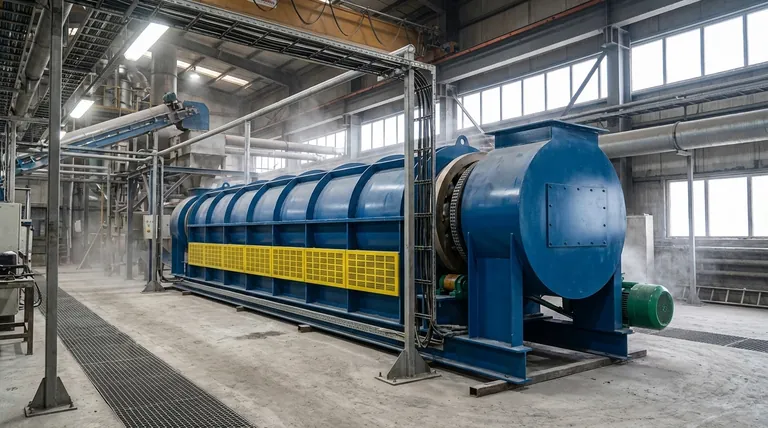
In most industrial applications, a rotary kiln rotates at a very slow and deliberate speed. The typical operational range is between 1 to 3 revolutions per minute (RPM), though in some specific cases, speeds can reach up to 5 RPM.
The specific RPM of a rotary kiln is not about speed but about control. It is one of the most critical variables an operator manages to dictate how long material is exposed to heat, ensuring a complete and uniform chemical or physical transformation.
Why Rotation Speed is a Critical Process Variable
The slow, constant turning of a rotary kiln is fundamental to its function. Operators do not set the RPM arbitrarily; it is a calculated decision that directly influences the quality of the final product and the efficiency of the entire system.
Controlling Retention Time
The primary purpose of adjusting RPM is to control retention time—the duration the material spends inside the kiln. A slower rotation means the material tumbles and travels toward the discharge end more slowly, increasing its exposure to the high-temperature environment.
Ensuring Uniform Heat Transfer
Rotation continuously mixes and tumbles the solid material. This action, known as cascading, ensures every particle is evenly exposed to the heat source, which is critical for achieving a consistent and homogenous final product.
Facilitating Material Transport
Rotary kilns are installed at a slight incline. The combination of this angle and the slow rotation is what gently conveys material from the feed end to the discharge end, acting as a continuous processing system.
Factors That Influence the Ideal RPM
The optimal rotation speed is not a single value but is dependent on several interconnected factors. A stable process requires balancing the RPM against other operational parameters.
The Material Being Processed
Different materials have unique thermal properties. Some require a long, slow heating process to drive a chemical reaction, while others may only need a quick pass for simple drying. The ideal RPM is tailored to these specific material requirements.
The Desired Transformation
The goal of the process—be it drying, calcination, or incineration—dictates the necessary retention time and temperature profile. A complex chemical reaction will almost always require a slower RPM than a simple moisture-removal process.
Kiln Dimensions and Design
The length and diameter of the kiln play a significant role. A longer kiln may be able to run at a slightly higher RPM and achieve the same retention time as a shorter kiln running more slowly.
Understanding the Trade-offs of RPM Control
Adjusting the kiln's speed is a balancing act. Misjudging the optimal RPM can lead to significant operational problems and poor product quality, highlighting the need for skilled central control operators.
The Risk of Rotating Too Slowly
An RPM that is too low can lead to over-processing or even melting of the material. It can also cause inefficient "clumping" or "balling" and reduces the overall throughput of the system, making the process less economical.
The Risk of Rotating Too Fast
Conversely, an RPM that is too high is a common cause of poor quality. The material passes through the kiln too quickly to be heated properly, resulting in an incomplete reaction. This also increases dust generation and can cause raw material to be scattered.
The Need for Thermodynamic Stability
The RPM is just one part of a complex thermodynamic system that includes temperature, fuel input, and airflow. A change in rotation speed must be carefully managed, as it will impact the entire heat balance within the kiln. Stabilizing this system is the primary goal of the kiln operator.
Setting the Right Speed for Your Process
The correct RPM is always relative to the desired outcome. By understanding your primary goal, you can determine the right approach to setting this critical parameter.
- If your primary focus is a complete chemical reaction (e.g., calcination): You will likely favor a slower RPM to maximize retention time and ensure every particle is fully processed.
- If your primary focus is high throughput for a simple drying task: A slightly faster RPM may be acceptable, provided the material achieves the required moisture content before discharge.
- If your primary focus is overall system efficiency and stability: The ideal RPM is the one that perfectly balances retention time with fuel consumption and creates a stable, predictable thermodynamic environment.
Ultimately, mastering a rotary kiln's speed is about using it as a precise tool to control the transformation of material.
Summary Table:
| Key Aspect | Typical Range / Details |
|---|---|
| Operational RPM | 1 to 3 RPM |
| Maximum RPM | Up to 5 RPM (in specific cases) |
| Primary Goal of RPM Control | Manage material retention time |
| Risk of Low RPM | Over-processing, clumping, reduced throughput |
| Risk of High RPM | Incomplete reaction, poor quality, increased dust |
Optimize Your Thermal Processing with KINTEK
Mastering the precise control of variables like RPM is essential for efficient and high-quality results in your lab or production facility. Whether you are calcining, drying, or incinerating materials, the right equipment is the foundation of success.
At KINTEK, we specialize in providing robust and reliable lab equipment, including rotary kilns and furnaces, designed to deliver the precise control your processes demand. Our solutions help you achieve uniform heat transfer, consistent product quality, and maximum throughput.
Ready to enhance your thermal processing capabilities? Contact our experts today to discuss your specific application needs and discover how KINTEK's equipment can drive your success.
Visual Guide

Related Products
- Electric Rotary Kiln Small Rotary Furnace Biomass Pyrolysis Plant
- Electric Rotary Kiln Continuous Working Small Rotary Furnace Heating Pyrolysis Plant
- Electric Rotary Kiln Small Rotary Furnace for Activated Carbon Regeneration
- Electric Rotary Kiln Pyrolysis Furnace Plant Machine Calciner Small Rotary Kiln Rotating Furnace
- Vacuum Sealed Continuous Working Rotary Tube Furnace Rotating Tube Furnace
People Also Ask
- What are the reactions involved in pyrolysis of biomass? Unlock the Chemistry for Tailored Bio-Products
- What is the temperature of a rotating kiln? It Depends on Your Material and Process Goal
- What are the characteristics of the slipping, slumping, and rolling modes of bed motion? Optimize Your Rotary Process
- What are the reactors for fast pyrolysis? Choosing the Right System for Maximum Bio-Oil Yield
- How are rotary kilns heated? Direct vs. Indirect Heating Methods Explained