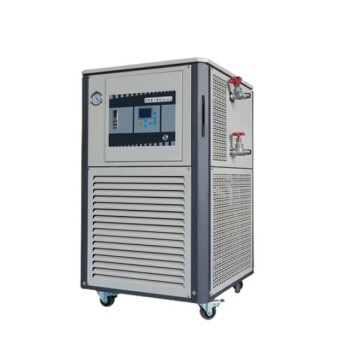
A high-pressure hot water (HTW) reactor establishes a specialized hydrothermal environment by maintaining temperatures between 200–300 °C and pressures ranging from 1–4 MPa. These conditions transition water into a subcritical or supercritical state, dramatically altering its chemical properties to facilitate the breakdown of Polyethylene Terephthalate (PET) backsheets.
Core Takeaway By elevating temperature and pressure, the HTW reactor transforms water into a dual-purpose agent—acting as both the solvent and the catalyst. This enables "neutral" hydrolysis without strong acids or bases, significantly reducing equipment corrosion and wastewater treatment complexity.
The Physics of the HTW Environment
Achieving the Subcritical State
The HTW reactor targets a specific thermodynamic window defined by temperatures of 200–300 °C.
In this range, water possesses high kinetic energy, essential for breaking the chemical bonds within the PET polymer chain.
The Role of Pressure
To prevent the water from boiling off into steam at these high temperatures, the system maintains a pressure of 1–4 MPa.
This pressure keeps the water in a liquid-like density while allowing it to exhibit gas-like transport properties, optimizing it for chemical recycling.
The Chemical Mechanism
Increasing the Ion Product
Under these specific processing conditions, the ion product of water increases.
This physical change means water naturally dissociates into hydrogen (H+) and hydroxide (OH-) ions more readily than it does at standard conditions.
Water as a Catalyst
Because of this increased ionization, the water itself acts as the catalyst for the reaction.
It directs the hydrolysis of PET, efficiently breaking it down into its constituent monomers: terephthalic acid and ethylene glycol.
Operational Advantages
Eliminating Corrosive Reagents
The defining feature of this process is neutral hydrolysis.
Because the water acts as the catalyst, the process avoids the need for strong acids or alkalis typically required in chemical recycling.
Reducing Infrastructure Strain
The absence of harsh chemicals lowers the requirements for corrosion resistance in the reactor materials.
Furthermore, it significantly lowers the pressure on downstream wastewater treatment systems, as there are no acidic or basic streams to neutralize.
Understanding the Trade-offs
Process Conditions vs. Energy Input
While this method saves on chemical costs, maintaining temperatures of 200–300 °C requires significant thermal energy input.
Pressure Safety Requirements
Although 1–4 MPa is moderate compared to some industrial processes, it still classifies as a pressure vessel operation.
Operators must ensure robust safety protocols are in place for high-temperature pressurized systems, distinct from standard atmospheric tanks.
Making the Right Choice for Your Goal
When evaluating the HTW reactor for PET recovery, consider your strategic priorities:
- If your primary focus is environmental sustainability: Adopt this method to eliminate the use of hazardous acids and bases, simplifying your chemical waste profile.
- If your primary focus is reducing capital maintenance: Leverage the neutral hydrolysis process to extend equipment lifespan and reduce the need for exotic, corrosion-resistant alloys.
The HTW reactor effectively replaces chemical aggression with thermal energy, offering a cleaner, self-catalyzing path to PET depolymerization.
Summary Table:
| Parameter | Specification | Functional Role in PET Hydrolysis |
|---|---|---|
| Temperature | 200–300 °C | Provides kinetic energy to break PET polymer bonds. |
| Pressure | 1–4 MPa | Maintains water in a liquid-like state; enables subcritical properties. |
| Medium | Subcritical Water | Acts as both a solvent and a self-generating catalyst. |
| Ion Product | Increased H+/OH- | Facilitates dissociation for acid-base free chemical breakdown. |
| Reaction Type | Neutral Hydrolysis | Eliminates corrosive reagents and reduces wastewater complexity. |
Revolutionize Your Chemical Recycling with KINTEK
Transition to cleaner, more sustainable material recovery with KINTEK’s high-temperature high-pressure reactors and autoclaves. Our precision-engineered systems are designed to withstand the rigorous demands of subcritical water processing, allowing you to achieve neutral hydrolysis of PET and other polymers without the need for corrosive acids or bases.
Why choose KINTEK for your laboratory and pilot-scale operations?
- Advanced Reactor Technology: Specifically built for safe and efficient high-pressure hydrothermal environments.
- Comprehensive Laboratory Solutions: From high-temperature furnaces and hydraulic presses to specialized cooling solutions and essential ceramics.
- Sustainability & Durability: Reduce equipment corrosion and environmental impact with our neutral-catalysis compatible systems.
Ready to enhance your lab's efficiency and equipment lifespan? Contact us today to discuss your reactor specifications!
References
- Pradeep Padhamnath. Recent Progress in the Recovery and Recycling of Polymers from End-of-Life Silicon PV Modules. DOI: 10.3390/su17104583
This article is also based on technical information from Kintek Solution Knowledge Base .
Related Products
- Customizable High Pressure Reactors for Advanced Scientific and Industrial Applications
- Customizable Laboratory High Temperature High Pressure Reactors for Diverse Scientific Applications
- Stainless High Pressure Autoclave Reactor Laboratory Pressure Reactor
- Mini SS High Pressure Autoclave Reactor for Laboratory Use
- High Pressure Laboratory Autoclave Reactor for Hydrothermal Synthesis
People Also Ask
- What is the function of high-pressure reactors in the synthesis of MFI-type zeolites? Master Dry Gel Conversion.
- Graphene Fiber Synthesis: Key High-Pressure Reactor Processing Conditions Explained
- What reactor is used for high pressure reactions? Select the Right Autoclave for Your Lab
- What is the primary function of a high-pressure reactor in NiMoO4 preparation? Optimize Hydrothermal Catalyst Synthesis
- What are the hazards of high pressure reactors? A Guide to Managing Explosive Risks