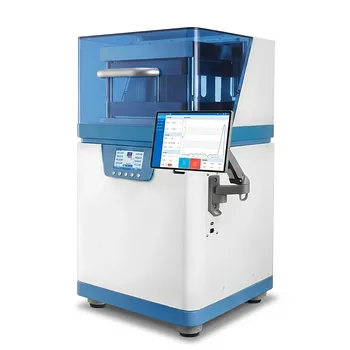
The high-pressure reactor creates a controlled solvothermal environment essential for nanomaterial integration. This equipment provides a sealed, high-temperature (typically 120 °C), and high-pressure setting that facilitates the solvothermal synthesis of cobalt hydroxide nanosheets. Within this environment, cobalt sources and urea in a methanol solution undergo controlled hydrolysis, allowing the nanosheets to grow uniformly and densely in situ on the internal micro-channels of carbonized wood.
Core Takeaway: The high-pressure reactor functions as a precision engineering chamber, using autogenous pressure and elevated temperatures to drive deep solvent penetration and ensure a robust chemical bond between the cobalt hydroxide catalyst and the carbonized wood substrate.
The Mechanics of the Solvothermal Environment
Achieving Subcritical Liquid Conditions
The primary function of the autoclave is to maintain a sealed environment where the solvent can be heated beyond its atmospheric boiling point. In this specific application, the methanol solution generates autogenous pressure, creating a subcritical environment that alters the solvent's physical properties.
These conditions significantly enhance the solubility of reactants, such as cobalt sources and urea. This allows for a more homogenous distribution of precursors throughout the reaction medium compared to standard atmospheric heating.
Enhancing Penetration into Wood Micro-channels
Carbonized wood is a complex, porous structure with intricate 3D micro-channels. High pressure is critical because it forces the reactant-rich methanol solution deep into these low-surface-energy layers.
Without this pressure-assisted penetration, the loading of cobalt hydroxide would be limited to the surface. The autoclave ensures that the catalyst precursors reach the deep inner walls of the wood scaffold, maximizing the active surface area of the electrode.
Driving Chemical Precision and Adhesion
Facilitating Controlled Hydrolysis and Growth
The constant temperature of 120 °C provided by the reactor is the thermal trigger for the controlled hydrolysis of urea. As urea decomposes, it slowly releases hydroxyl ions, which react with cobalt ions to form the nanosheet structures.
Because the environment is sealed and stable, the growth rate remains uniform across the entire wood template. This results in densely packed nanosheet arrays rather than disorganized clusters or large, bulk particles.
Strengthening the Precursor-to-Carrier Bond
One of the most critical roles of the high-pressure environment is ensuring a strong interfacial bond. The energetic conditions within the reactor facilitate a more intimate contact between the growing cobalt hydroxide and the carbonized wood carrier.
This in situ growth process creates a catalyst-carrier interface that is much more durable than simple mechanical coating. The result is a high-performance electrode where the catalyst is less likely to detach during electrochemical cycling.
Understanding the Trade-offs and Limitations
The Risks of Parameter Deviation
While 120 °C is the standard for this process, exceeding optimal temperatures can lead to morphology collapse. If the temperature or pressure is too high, the nanosheets may aggregate into dense spheres, drastically reducing the effective surface area and electrode performance.
Scalability and Safety Concerns
High-pressure reactors are inherently limited by their batch-processing nature. Transitioning from a laboratory-scale autoclave to industrial production requires significant capital investment in pressure vessels that can safely manage flammable solvents like methanol at high temperatures.
Substrate Vulnerability
The extreme conditions required for synthesis can sometimes stress the structural integrity of the carbonized wood. If the wood is not properly carbonized or if the pressure ramp-up is too aggressive, the delicate micro-channels may fracture, compromising the electrode's conductivity.
Optimizing the Synthesis for Your Project Goals
Applying These Principles to Electrode Development
To achieve the best results when loading nanosheets onto wood-based templates, the reactor settings must be tailored to your specific material requirements.
- If your primary focus is maximum catalyst density: Maintain the 120 °C threshold for a longer duration to allow for the complete hydrolysis of urea and maximum "in-filling" of the wood pores.
- If your primary focus is structural integrity of the wood: Use a slower heating and cooling ramp within the autoclave to prevent thermal shock and mechanical stress on the carbonized micro-channels.
- If your primary focus is nanosheet morphology precision: Ensure the methanol-to-precursor ratio is strictly controlled, as the autogenous pressure is highly sensitive to the volume of solvent in the sealed vessel.
By mastering the high-pressure environment of the autoclave, you can transform simple carbonized wood into a high-performance, nanostructured electrode with superior chemical stability.
Summary Table:
| Process Condition | Role in Synthesis | Impact on Electrode Performance |
|---|---|---|
| Temperature (120 °C) | Triggers controlled urea hydrolysis | Ensures uniform, densely packed nanosheet arrays. |
| Autogenous Pressure | Drives solvent into wood micro-channels | Maximizes active surface area and catalyst loading. |
| Sealed Environment | Creates subcritical liquid conditions | Enhances precursor solubility and distribution. |
| In Situ Growth | Facilitates strong interfacial bonding | Improves durability during electrochemical cycling. |
| Methanol Solvent | Acts as a high-penetration reaction medium | Enables deep chemical precision within the wood scaffold. |
Elevate Your Material Synthesis with KINTEK Precision
Are you looking to master the complexities of solvothermal synthesis or nanostructured electrode development? KINTEK specializes in providing high-performance laboratory equipment designed for the most demanding research environments.
Whether you need high-pressure reactors and autoclaves for precise catalyst growth, or advanced high-temperature furnaces (CVD, vacuum, or muffle) for carbonization, our portfolio is built to ensure reliability and repeatability. We also offer a comprehensive range of hydraulic presses, electrolytic cells, and battery research tools to support your workflow from precursor preparation to final testing.
Ready to optimize your lab’s efficiency and achieve superior material performance? Contact our technical experts today to find the perfect solution for your project!
References
- Linfeng Yu, Xiaoming Sun. Bio‐Derived Wood‐Based Gas Diffusion Electrode for High‐Performance Aluminum–Air Batteries: Insights into Pore Structure. DOI: 10.1002/admi.202300355
This article is also based on technical information from Kintek Solution Knowledge Base .
Related Products
- Customizable Laboratory High Temperature High Pressure Reactors for Diverse Scientific Applications
- Customizable High Pressure Reactors for Advanced Scientific and Industrial Applications
- Stainless High Pressure Autoclave Reactor Laboratory Pressure Reactor
- Mini SS High Pressure Autoclave Reactor for Laboratory Use
- High Pressure Laboratory Autoclave Reactor for Hydrothermal Synthesis
People Also Ask
- How do high-pressure and high-temperature reactors ensure the effective treatment of lignocellulosic wastewater in WAO?
- What equipment is required for high-pressure high-temperature reactions? Master Extreme Chemistry Safely
- How do you control high pressure in a reactor? A Guide to Safe & Stable Operation
- Why is argon better than nitrogen for inert atmosphere? Ensure Absolute Reactivity & Stability
- How does initial oxygen pressure affect the wet oxidation of pharmaceutical sludge? Master Your Oxidation Depth