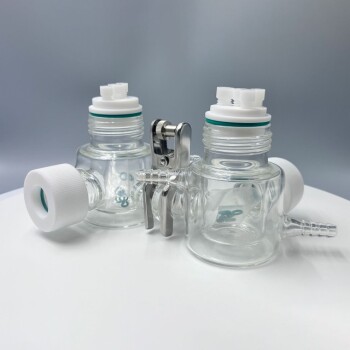
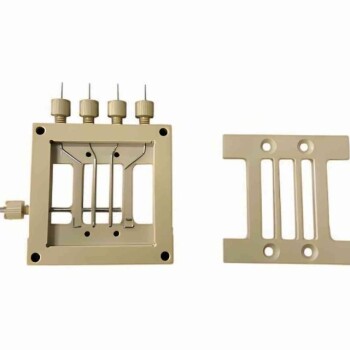
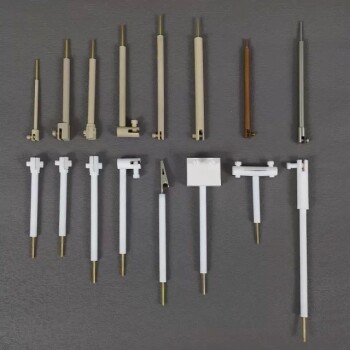
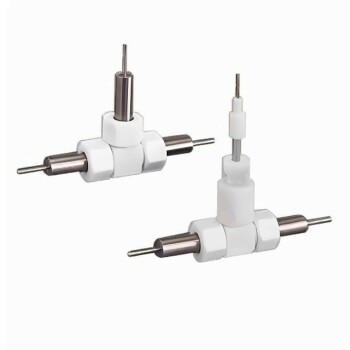
The electrolytic cell and three-electrode system provide the controlled electrochemical environment necessary to isolate and measure the intrinsic catalytic performance of 2H-NbS2. This specialized setup enables the precise application of potential and measurement of current, allowing researchers to derive critical kinetic parameters like overpotential and Tafel slopes while eliminating interference from the counter electrode.
The three-electrode electrolytic cell is the fundamental tool for quantifying HER activity, as it separates potential control from the current-carrying circuit. For 2H-NbS2 catalysts, this ensures that measured data reflects the material's actual electronic and chemical properties rather than system-wide resistance.
The Architecture of the Three-Electrode System
The Working Electrode (WE) as the Catalyst Host
In HER testing, the 2H-NbS2 catalyst is typically applied as a thin film onto a conductive substrate, such as Carbon Cloth or a Carbon Nanotube (CNT) composite.
This electrode serves as the primary site for the hydrogen evolution reaction. Its design ensures maximum surface area exposure and efficient electron transfer from the substrate to the catalyst active sites.
The Reference Electrode (RE) for Potential Stability
The reference electrode, such as Ag/AgCl or a Saturated Calomel Electrode (SCE), provides a stable, known electrochemical potential.
By using an RE, the system can monitor the potential of the working electrode without being affected by the current flowing through the cell. This is critical for maintaining the accuracy of onset potential measurements.
The Counter Electrode (CE) for Circuit Completion
The counter electrode, often a graphite rod or platinum wire, completes the electrical circuit by facilitating the balancing half-reaction.
Because the three-electrode setup measures the potential difference between the WE and RE, any polarization or resistance at the counter electrode does not interfere with the data collected from the 2H-NbS2 catalyst.
Quantifying Catalyst Performance Metrics
Polarization Curves and Overpotential
The electrolytic cell allows for the generation of linear sweep voltammetry (LSV) curves. These curves are used to determine the overpotential—the extra energy required to initiate the hydrogen evolution reaction on the 2H-NbS2 surface.
Precise control within the cell ensures that these measurements remain consistent across different pH levels, such as in 0.5 M H2SO4 (acidic) or 1 M KOH (alkaline) environments.
Kinetic Analysis via Tafel Slopes
By analyzing the relationship between overpotential and the logarithm of current density, researchers calculate the Tafel slope.
This value reveals the specific reaction mechanism occurring on the 2H-NbS2 surface. It helps determine the rate-determining step of the HER process, such as the Volmer, Heyrovsky, or Tafel pathways.
Electrochemical Impedance Spectroscopy (EIS)
The cell environment supports EIS testing, which is used to measure the charge transfer resistance (Rct).
Lower resistance values indicate more efficient electron movement at the interface between the 2H-NbS2 catalyst and the electrolyte. This data is essential for evaluating the catalytic efficiency and the quality of the catalyst-electrode bond.
Physical Environment and Ion Transport
Fluid Dynamics and Mass Transport
The electrolytic cell acts as a reaction vessel that maintains stable ion transport paths.
The physical design of the cell ensures that protons (in acid) or water molecules (in base) can freely reach the catalyst surface. Effective fluid dynamics prevent the local depletion of reactants, which could otherwise lead to inaccurate performance data.
Gas Collection and Separation
As 2H-NbS2 facilitates the reduction of protons, hydrogen gas bubbles form on the electrode surface.
The cell's structure must manage the collection and separation of these gases. This prevents hydrogen bubbles from masking active sites or interfering with the ion conduction between the electrodes.
Understanding the Trade-offs
Electrolyte Compatibility and Corrosion
While 2H-NbS2 is versatile, the choice of electrolyte in the cell can lead to material degradation.
Testing in highly acidic or basic environments requires cell components (like gaskets and O-rings) that are chemically inert. Failure to ensure compatibility can introduce impurities into the system, poisoning the catalyst and skewing results.
Ohmic Drop (iR Compensation)
Even with a three-electrode system, the resistance of the electrolyte between the WE and RE can cause a voltage error known as the iR drop.
If the cell is not designed to minimize the distance between these electrodes, or if software-based iR compensation is not applied, the measured overpotential will appear higher than the catalyst's true performance.
Applying This to Your HER Research
Recommendations for Experimental Setup
- If your primary focus is intrinsic activity: Use a three-electrode cell with a Luggin capillary to place the reference electrode as close to the 2H-NbS2 as possible, minimizing iR drop.
- If your primary focus is catalyst durability: Conduct long-term chronopotentiometry within a cell that allows for continuous electrolyte circulation to maintain stable pH and ion levels.
- If your primary focus is light-driven HER: Utilize a specialized photoelectrochemical cell equipped with a quartz window to allow unobstructed light penetration to the catalyst surface.
By meticulously configuring the electrolytic cell and electrode system, you ensure that the recorded performance of 2H-NbS2 is a true reflection of its electrochemical potential.
Summary Table:
| Component | Role in HER Testing | Key Metrics / Benefits |
|---|---|---|
| Working Electrode | Hosts 2H-NbS2 catalyst | Overpotential, current density, LSV curves |
| Reference Electrode | Ensures potential stability | Accurate onset potential measurement |
| Counter Electrode | Completes electrical circuit | Eliminates interference from counter-reactions |
| Electrolytic Cell | Provides controlled environment | Facilitates Tafel analysis and EIS testing |
Maximize Your Catalytic Research Accuracy with KINTEK
Precision is paramount when evaluating the intrinsic activity of 2H-NbS2 catalysts. KINTEK provides researchers with high-performance electrolytic cells and electrodes designed for rigorous HER testing. Our expertise extends beyond electrochemistry to include a comprehensive suite of laboratory solutions, such as high-temperature high-pressure reactors and autoclaves, CVD/PECVD systems, and precision crushing/milling equipment.
Whether you are conducting kinetic analysis via Tafel slopes or performing long-term durability tests, KINTEK’s equipment ensures stable ion transport and reliable data. Empower your laboratory with tools designed for high-end material science.
Contact our experts today to find the perfect setup for your research!
References
- Peng You, Yanfeng Zhang. Highly Stable Vertically Oriented 2H‐NbS<sub>2</sub> Nanosheets on Carbon Nanotube Films toward Superior Electrocatalytic Activity. DOI: 10.1002/aenm.202302510
This article is also based on technical information from Kintek Solution Knowledge Base .
Related Products
- H Type Electrolytic Cell Triple Electrochemical Cell
- Electrolytic Electrochemical Cell for Coating Evaluation
- Electrolytic Electrochemical Cell Gas Diffusion Liquid Flow Reaction Cell
- Electrolytic Electrochemical Cell with Five-Port
- Flat Corrosion Electrolytic Electrochemical Cell
People Also Ask
- What is a H type cell? A Guide to Divided Electrochemical Cells for Accurate Experiments
- How should the electrolyte be prepared and added to the H-type electrolytic cell? Best Practices for Purity and Safety
- What is the technical necessity of using an H-type electrolytic cell for NO3RR tests? Protect Your Ammonia Yields
- How does the design of an H-type electrolytic cell benefit the neutral water electrolysis process for metal recovery?
- What is the primary function of an H-type electrolytic cell in NitRR? Ensure Accurate Product Yields