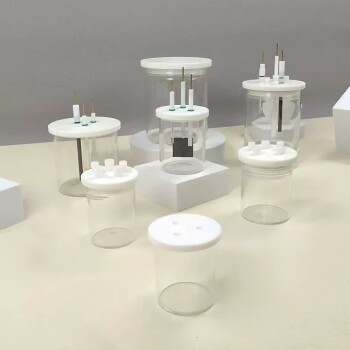
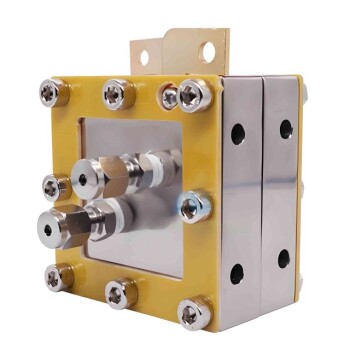
Molten salt electrolyzers act as the central energy driver in the lithium-mediated ammonia synthesis cycle. Their primary function is to electrochemically reduce lithium ions into reactive metallic lithium using a liquid ionic medium, such as LiOH, at high temperatures ranging from 400°C to 450°C.
The core challenge in making ammonia is breaking the incredibly strong chemical bonds of nitrogen molecules. The molten salt electrolyzer solves this by generating metallic lithium—a highly reactive intermediate capable of fixing nitrogen—effectively serving as the primary energy input for the entire cycle.
The Operational Mechanics
To understand the electrolyzer's role, we must look at the specific conditions it creates to facilitate chemical change.
The High-Temperature Environment
The electrolyzer does not operate at room temperature; it requires a specific thermal window.
It typically functions between 400°C and 450°C. This high heat is necessary to maintain the salt (often Lithium Hydroxide, LiOH) in a molten, liquid state.
The Ionic Medium
Unlike aqueous solutions used in standard electrolysis, this system utilizes a liquid ionic medium.
The molten LiOH salt acts as the electrolyte. This medium allows for the free movement of ions, which is critical for the electrochemical reactions to occur efficiently.
Electrochemical Reduction
The defining action of the electrolyzer is the reduction of lithium ions.
Through the application of electrical energy, lithium ions within the molten salt are converted into metallic lithium. This metallic lithium is the essential fuel required for the subsequent steps of ammonia production.
Role in the Broader Synthesis Cycle
The electrolyzer is not an isolated component; it initiates the chain reaction that leads to ammonia formation.
Enabling Nitrogen Fixation
Once the electrolyzer produces metallic lithium, that lithium reacts with nitrogen gas.
This reaction forms lithium nitride. The high reactivity of the metallic lithium is what allows the system to overcome the inert nature of nitrogen and break its strong bonds.
Completion via Hydrolysis
The cycle concludes when the lithium nitride is processed further.
Through a process called hydrolysis, the lithium nitride reacts to finally produce ammonia. The electrolyzer is the prerequisite for this step, as it provides the raw lithium starting material.
Primary Energy Source
The electrolyzer represents the primary energy input stage for the entire synthesis loop.
While the subsequent chemical reactions (nitridation and hydrolysis) follow chemically, the energy required to drive the cycle is predominantly consumed here to create the metallic lithium.
Understanding the Critical Requirements
While this method offers a pathway to ammonia synthesis, the reliance on molten salt electrolyzers introduces specific operational demands.
Thermal Management Necessity
Maintaining a consistent temperature between 400°C and 450°C is non-negotiable.
Fluctuations outside this range could lead to the solidification of the salt or degradation of the cell components. The system requires robust thermal insulation and control to remain efficient.
Material Compatibility
The operating environment is chemically aggressive.
Dealing with molten salts like LiOH at high temperatures requires specialized materials to prevent corrosion and ensure the longevity of the electrolyzer unit.
Making the Right Choice for Your Goal
When evaluating the implementation of molten salt electrolyzers for ammonia synthesis, consider your primary engineering objectives.
- If your primary focus is process initiation: Ensure your power supply and thermal management systems are sized to handle the 400–450°C operating window, as this is the primary energy consumption point.
- If your primary focus is chemical yield: Prioritize the efficiency of the Li+ to Metallic Lithium reduction step, as this dictates how much reactant is available for nitrogen fixation.
The molten salt electrolyzer is the foundational engine that transforms electrical energy into the chemical potential needed to unlock nitrogen.
Summary Table:
| Feature | Specification/Role |
|---|---|
| Primary Function | Electrochemical reduction of Li+ to metallic Lithium |
| Operating Temperature | 400°C to 450°C |
| Electrolyte Medium | Molten Lithium Hydroxide (LiOH) |
| Key Output | Metallic Lithium (Intermediate for Nitrogen Fixation) |
| Cycle Importance | Primary energy input stage for the entire synthesis loop |
Advance Your Ammonia Synthesis Research with KINTEK
Unlock the full potential of your lithium-mediated chemical cycles with precision-engineered laboratory solutions. At KINTEK, we specialize in providing the high-performance tools necessary for aggressive chemical environments and high-temperature research.
Our comprehensive portfolio includes:
- High-Temperature Furnaces & Reactors: Perfect for maintaining stable 400°C–450°C windows.
- Advanced Electrolytic Cells & Electrodes: Designed for durability in molten salt environments.
- High-Pressure Autoclaves & Reactors: For downstream nitridation and hydrolysis studies.
- Specialized Consumables: Ceramic crucibles and PTFE products that resist corrosion.
Whether you are focusing on electrochemical reduction efficiency or scaling nitrogen fixation, our experts are ready to equip your lab with the best-in-class tools to ensure reliable results.
Contact KINTEK today to discuss your project requirements!
References
- Justin S. J. Hargreaves, Harold H. Kung. Minimizing energy demand and environmental impact for sustainable NH3 and H2O2 production—A perspective on contributions from thermal, electro-, and photo-catalysis. DOI: 10.1016/j.apcata.2020.117419
This article is also based on technical information from Kintek Solution Knowledge Base .
Related Products
- Quartz Electrolytic Electrochemical Cell for Electrochemical Experiments
- Customizable PEM Electrolysis Cells for Diverse Research Applications
People Also Ask
- Why is a quartz electrolytic cell used for acrylic acid wastewater? Ensure Chemical Stability & Data Integrity
- How does the design of an electrochemical electrolytic cell influence the coating uniformity? Optimize Your Catalysts
- What are the key features of quartz that make it suitable for electrolytic cells? Discover the 4 Pillars of Superior Performance
- What is the correct shutdown and disassembly procedure after an experiment? Ensure Safety and Protect Your Equipment
- How do the electrochemical cell and three-electrode testing system collaborate? Optimize Zinc Anode Deposition Control