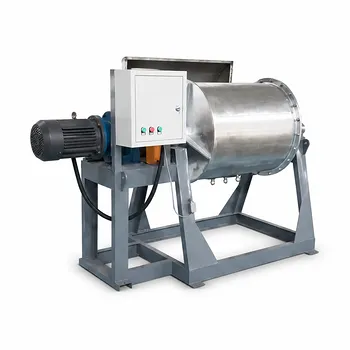
High-energy planetary ball milling serves as the decisive physical refinement step in the production of Ni-SmDC catalyst powders. It transforms calcined bulk solids into a highly reactive, fine powder through the application of intense impact and shear forces generated by high-speed rotation.
The planetary ball mill does more than simply grind material; it fundamentally alters the physical state of the catalyst. By pulverizing bulk solids into fine particles, the process maximizes specific surface area and reactivity, creating a necessary foundation for high-quality coating slurries.
The Mechanics of Refinement
Utilizing Kinetic Energy
The planetary ball mill operates by subjecting the material to high-speed rotation. This motion generates powerful impact and shear forces within the grinding jars.
Pulverizing Bulk Solids
The primary raw materials for Ni-SmDC are often calcined bulk solids. The ball mill acts as a mechanical pulverizer, breaking these larger agglomerates down.
Achieving Particle Reduction
Through continuous high-energy collisions, the mill effectively reduces the particle size of the catalyst. This transforms coarse, calcined chunks into a consistent, fine powder.
Enhancing Material Properties
Increasing Specific Surface Area
The most critical outcome of the particle size reduction is a significant increase in the specific surface area. By exposing more surface per unit of mass, the material becomes physically primed for interaction.
Boosting Reactivity
A larger surface area directly correlates to enhanced reactivity. The milling process ensures that the Ni-SmDC powder is not just smaller, but chemically more active and ready for subsequent reactions.
Preparation for Downstream Processing
Optimizing for Coating Slurries
The ultimate goal of this refinement is to produce a high-performance raw material for coating slurry preparation.
Ensuring Uniformity
A finely milled powder allows for a more stable and uniform suspension. This ensures that when the catalyst is eventually applied as a coating, the distribution of Ni-SmDC is homogeneous.
Understanding the Trade-offs
Managing Energy Input
The "high-energy" nature of the process is a double-edged sword. While necessary for pulverization, excessive energy input can lead to unwanted heat generation or structural degradation if not monitored.
Media Contamination Risks
Because the process relies on the impact of grinding balls, there is an inherent risk of the grinding media wearing down. This can introduce trace contaminants into the catalyst powder if compatible materials are not selected carefully.
Making the Right Choice for Your Goal
To maximize the effectiveness of your Ni-SmDC preparation, consider your specific processing targets:
- If your primary focus is Catalytic Activity: Prioritize the milling duration and speed to maximize specific surface area, as this directly drives the reactivity of the powder.
- If your primary focus is Slurry Stability: Focus on achieving a narrow and consistent particle size distribution to ensure the powder remains suspended uniformly during the coating process.
Precision in the milling stage is the difference between a raw powder and a high-performance functional material.
Summary Table:
| Process Variable | Role in Ni-SmDC Preparation | Key Benefit |
|---|---|---|
| High-Speed Rotation | Generates intense impact and shear forces | Rapid pulverization of bulk solids |
| Particle Size Reduction | Transforms calcined chunks into fine powder | Increased specific surface area |
| Mechanical Activation | Increases physical and chemical activity | Enhanced catalytic reactivity |
| Homogenization | Ensures consistent particle distribution | Stable, high-quality coating slurries |
Elevate Your Material Research with KINTEK
Precision milling is the foundation of high-performance catalyst development. At KINTEK, we specialize in providing cutting-edge laboratory solutions, including high-energy planetary ball mills and comprehensive crushing and milling systems designed to achieve the exact particle size and reactivity your Ni-SmDC powders require.
Whether you are focusing on maximizing catalytic activity or ensuring coating slurry stability, our equipment—from planetary mills to high-temperature furnaces and pellet presses—is engineered to meet the rigorous demands of material science. Partner with KINTEK to access expert support and a diverse portfolio of consumables, including PTFE products, ceramics, and crucibles.
Ready to optimize your catalyst refinement process? Contact our technical experts today and let us help you achieve superior material performance!
References
- Mariarita Santoro, Elisabetta Di Bartolomeo. Nickel-Based Structured Catalysts for Indirect Internal Reforming of Methane. DOI: 10.3390/app10093083
This article is also based on technical information from Kintek Solution Knowledge Base .
Related Products
- High Energy Planetary Ball Mill for Laboratory Horizontal Tank Type Milling Machine
- High Energy Planetary Ball Mill Milling Machine for Laboratory
- High Energy Planetary Ball Mill Milling Machine for Laboratory
- High Energy Planetary Ball Mill Machine for Laboratory Horizontal Tank Type
- High-Energy Omnidirectional Planetary Ball Mill Milling Machine for Laboratory
People Also Ask
- What is the role of a planetary ball mill in sulfide-based solid-state batteries? Engineer High-Performance Cathodes
- What are the parameters of a planetary ball mill? Master Speed, Time, and Media for Perfect Grinding
- What is the function of a planetary ball mill for nanostructured eutectic steel? Essential Prep for High-Strength Alloys
- What role does a planetary ball mill play in the preparation of NASICON-type solid electrolytes like LATP and LAGP?
- What is the function of a planetary ball mill in solid-state electrolyte prep? Milling vs. SDS Methods Explained