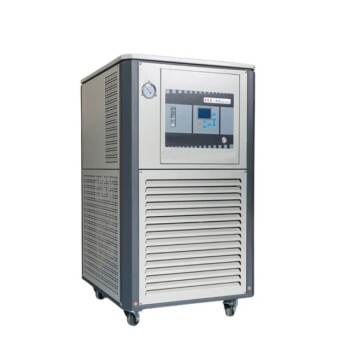
A high-pressure hydrothermal reactor serves as the critical vessel for creating a subcritical water environment, enabling the synthesis of advanced materials like mesoporous hydroxyapatite and biomass-derived hydrochar. By sealing reactants in a closed system at elevated temperatures and pressures, the reactor facilitates physicochemical transformations that are impossible under standard atmospheric conditions.
The core value of a high-pressure hydrothermal reactor lies in its ability to maintain a subcritical water state, which dramatically increases reactant solubility and reactivity. This allows for precise engineering of pore structures, surface functional groups, and crystallinity, directly translating to superior adsorption and catalytic performance in the final material.
The Mechanism of Transformation
Creating a Subcritical Environment
The fundamental role of the reactor is to push water beyond its atmospheric boiling point without allowing it to evaporate.
By maintaining a sealed, high-pressure environment, the reactor keeps water in a liquid subcritical state. In this state, the solvent properties of water change, significantly enhancing the solubility and activity of the raw materials involved in the synthesis.
Driving Liquid-Phase Reactions
The reactor fosters an environment where complex liquid-phase reactions can occur efficiently.
This "closed-system" approach ensures that reactants do not escape, allowing for a dissolution-recrystallization mechanism to take hold. This mechanism is essential for the uniform growth of materials and the integration of doping elements into the crystal lattice.
Generating Autogenous Pressure
Unlike open systems, these reactors utilize the pressure generated by the solvent itself (autogenous pressure) as temperature rises.
This internal pressure is a key variable in controlling the reaction kinetics. It forces the reactants to interact more intimately, promoting high crystallinity and ensuring phase purity in materials like hydroxyapatite.
Engineering Material Properties
Controlling Pore Structure and Surface Area
The most significant impact of the reactor is its ability to tune the physical architecture of the material.
By manipulating the temperature and pressure distribution, you can drive the formation of mesoporous structures. This directly results in a massive increase in specific surface area, which is the primary requirement for effective adsorbents and heterogeneous catalysts.
Enhancing Surface Chemistry
Beyond structure, the reactor influences the chemical landscape of the material's surface.
The hydrothermal environment facilitates the abundant formation of surface functional groups. For biomass-derived hydrochar, this surface modification is critical for capturing pollutants, such as heavy metals, from aqueous solutions.
Ensuring Reproducibility and Uniformity
The sealed nature of the reactor removes external variables, creating a highly consistent processing environment.
This allows for the precise regulation of phase composition and particle morphology. Whether producing nanostructured powders or specific crystal shapes, the reactor ensures the output is uniform and reproducible across batches.
Understanding the Trade-offs
Sensitivity to Process Parameters
While the reactor offers precision, it also demands it. Small deviations in the temperature or pressure distribution within the vessel can lead to significant changes in particle size or phase composition. Achieving the specific "mesoporous" structure requires rigorous control protocols, as the line between forming a porous structure and collapsing it can be thin.
Operational Complexity
The requirement for high-pressure conditions introduces safety and operational complexities not present in atmospheric synthesis. The process is typically performed in batches, which can limit throughput compared to continuous flow methods. Furthermore, the energy required to maintain high temperatures and pressures makes this a more resource-intensive process than simple precipitation methods.
Making the Right Choice for Your Goal
To maximize the utility of a high-pressure hydrothermal reactor, align your synthesis parameters with your specific performance targets:
- If your primary focus is Environmental Adsorption: Prioritize the development of surface functional groups and pore volume to maximize contaminant uptake (e.g., increasing cadmium adsorption).
- If your primary focus is Catalytic Activity: Focus on optimizing the pressure to ensure high crystallinity and phase purity, which are essential for stable and active catalytic sites.
The high-pressure hydrothermal reactor is not just a heating vessel; it is a tuning instrument for defining the microscopic architecture of your material.
Summary Table:
| Key Role of Reactor | Impact on Material Synthesis | Target Applications |
|---|---|---|
| Subcritical Solvent Creation | Increases solubility & reactivity of precursors | Mesoporous Hydroxyapatite |
| Autogenous Pressure | Drives phase purity & high crystallinity | Catalytic Support Systems |
| Closed-System Control | Precise tuning of pore size & surface area | Environmental Adsorbents |
| Surface Functionalization | Enhances development of functional groups | Biomass-derived Hydrochar |
Elevate Your Material Research with KINTEK Precision
Unlock the full potential of subcritical water synthesis with KINTEK’s high-pressure hydrothermal reactors and autoclaves. Our equipment is engineered to provide the rigorous temperature and pressure control necessary for creating advanced mesoporous structures and high-purity nanostructured materials.
Whether you are developing biomass-derived hydrochar for environmental adsorption or hydroxyapatite for biomedical applications, KINTEK offers a comprehensive range of laboratory solutions, including:
- High-Temperature & High-Pressure Reactors
- Crushing, Milling, and Sieving Systems
- Advanced Battery Research Tools
- Specialized Ceramics and PTFE Consumables
Ready to achieve superior phase purity and particle uniformity? Contact KINTEK today to find the perfect reactor for your laboratory’s unique requirements.
References
- Aigul Sarkeeva, R. R. Mulyukov. Multilayer laminate manufactured from near-alpha titanium alloy. DOI: 10.21175/rad.abstr.book.2023.19.10
This article is also based on technical information from Kintek Solution Knowledge Base .
Related Products
- Customizable Laboratory High Temperature High Pressure Reactors for Diverse Scientific Applications
- High Pressure Laboratory Autoclave Reactor for Hydrothermal Synthesis
- Customizable High Pressure Reactors for Advanced Scientific and Industrial Applications
- Stainless High Pressure Autoclave Reactor Laboratory Pressure Reactor
- Mini SS High Pressure Autoclave Reactor for Laboratory Use
People Also Ask
- How do high-pressure and high-temperature reactors ensure the effective treatment of lignocellulosic wastewater in WAO?
- What equipment is required for high-pressure high-temperature reactions? Master Extreme Chemistry Safely
- How do you control high pressure in a reactor? A Guide to Safe & Stable Operation
- How does initial oxygen pressure affect the wet oxidation of pharmaceutical sludge? Master Your Oxidation Depth
- Why is argon better than nitrogen for inert atmosphere? Ensure Absolute Reactivity & Stability