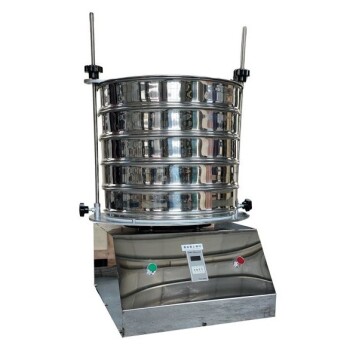
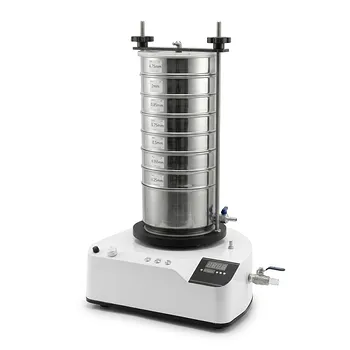
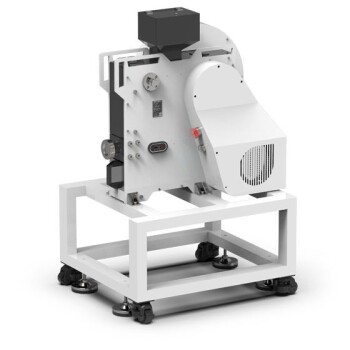
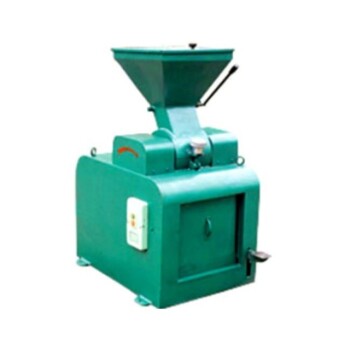
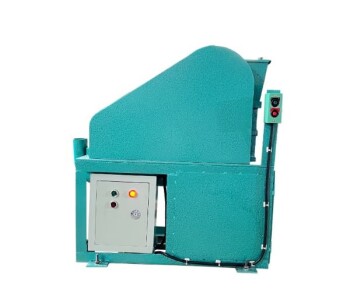
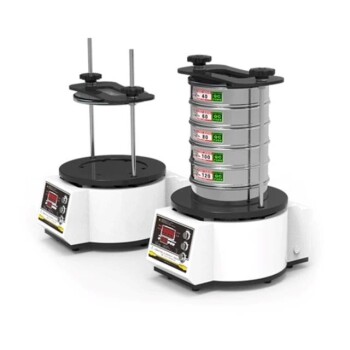
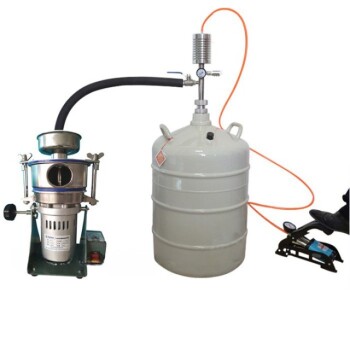
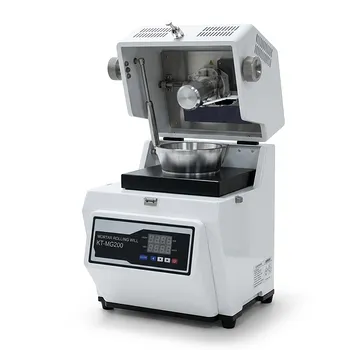
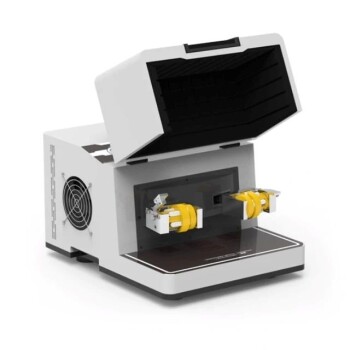
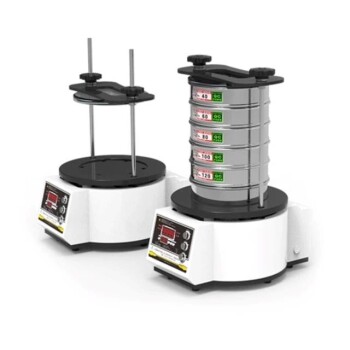
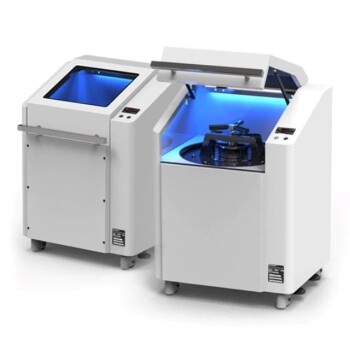
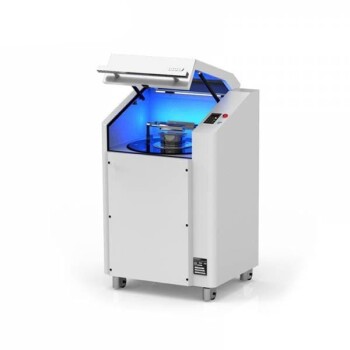
The laboratory crushing and sieving system serves as the precise mechanical gatekeeper for the physical geometry of CoCeBa catalysts. Its primary function is to process dried catalyst precursors into a strictly defined particle diameter range of 0.20–0.63 mm, preparing the material for testing in high-pressure laboratory tube reactors.
The Core Insight By standardizing particle size, this system eliminates physical barriers that could skew experimental data. It ensures that the performance measured in the lab reflects the catalyst's true chemical potential, uncorrupted by flow irregularities or diffusion limitations.
The Mechanics of Catalyst Shaping
Processing Dried Precursors
The shaping stage begins after the catalyst precursors have been dried. At this point, the material is likely in an irregular or bulk state that is unsuitable for consistent testing.
The crushing mechanism breaks this material down mechanically. It transforms the bulk solid into smaller, manageable fragments without altering the chemical composition of the precursor.
Achieving Target Dimensions
Once crushed, the material must be classified. The sieving component acts as a filter to isolate a specific fraction of particles.
For CoCeBa catalysts in a laboratory setting, the target range is 0.20–0.63 mm. Any particles larger than this are re-processed or discarded, and any particles smaller (fines) are removed to prevent reactor clogging.
Why Precision Sizing Matters
Eliminating Internal Diffusion Limitations
The most critical role of this system is ensuring that the catalyst particles are small enough to prevent internal diffusion limitations.
If particles are too large, reactant gases cannot penetrate to the center of the particle efficiently. This means the reaction only occurs on the outer shell, hiding the true performance of the catalyst's internal structure.
Ensuring Uniform Gas Flow
In a high-pressure tube reactor, how the gas moves through the catalyst bed is vital. Irregular or overly large particles can create channels where gas bypasses the catalyst entirely.
By strictly sieving the particles to the 0.20–0.63 mm range, the system creates a packed bed with consistent void spaces. This promotes uniform flow of reaction gases, ensuring every part of the bed contributes to the process.
Full Utilization of Active Sites
The ultimate goal of shaping is to expose the reactants to the catalyst's active sites.
Proper sizing ensures that reactants can diffuse into the mesoporous structure. This allows researchers to utilize the full capacity of active sites, providing an accurate assessment of the catalyst's intrinsic kinetic performance.
Understanding the Trade-offs
The Balance of Particle Size
While smaller particles reduce diffusion limitations, there is a lower limit to what is acceptable.
The system targets 0.20–0.63 mm specifically to balance diffusion efficiency with reactor hydrodynamics. Particles smaller than this range could cause excessive pressure drops or blockages in the reactor tube.
Laboratory vs. Industrial Standards
It is important to note the distinction in sizing goals between scales.
While the laboratory system targets 0.20–0.63 mm to prioritize kinetic data accuracy, industrial systems often target slightly different ranges (e.g., 0.15–0.25 mm) depending on the specific application. The laboratory crushing system must therefore be tuned specifically for data validity, not necessarily to mimic mass production dimensions perfectly.
Making the Right Choice for Your Goal
To maximize the reliability of your CoCeBa catalyst research, consider the following regarding the shaping stage:
- If your primary focus is intrinsic kinetic data: Ensure your sieving protocols strictly enforce the 0.20–0.63 mm range to guarantee you are measuring chemical activity, not diffusion limits.
- If your primary focus is reactor stability: Prioritize the removal of "fines" (particles <0.20 mm) during the sieving process to maintain uniform gas flow and prevent pressure buildup.
Precision in the crushing and sieving stage is the only way to ensure that your laboratory results accurately predict real-world catalyst potential.
Summary Table:
| Process Stage | Action Taken | Targeted Outcome |
|---|---|---|
| Crushing | Mechanical breakdown of dried precursors | Uniform material fragments |
| Sieving | Classification to 0.20–0.63 mm range | Removal of fines & oversized particles |
| Flow Control | Packing the reactor tube bed | Uniform gas flow & void space |
| Kinetic Testing | Maximizing active site exposure | Reliable, diffusion-free data |
Elevate Your Catalyst Research with KINTEK Precision
Ensure the integrity of your experimental data with KINTEK’s industry-leading laboratory solutions. From advanced crushing and milling systems to precision sieving equipment, we provide the tools necessary to achieve the exact particle geometry required for CoCeBa catalysts and beyond.
Why choose KINTEK?
- Unmatched Precision: Eliminate internal diffusion limitations and ensure uniform gas flow in your reactors.
- Comprehensive Range: We specialize in high-temperature furnaces, high-pressure reactors, and specialized consumables like PTFE and ceramics to support your entire workflow.
- Tailored Solutions: Our equipment is designed for researchers who demand data validity and reactor stability.
Don't let physical irregularities skew your chemical insights. Contact KINTEK today to find the perfect mechanical gatekeeper for your laboratory.
References
- Magdalena Zybert, Wioletta Raróg‐Pilecka. Stability Studies of Highly Active Cobalt Catalyst for the Ammonia Synthesis Process. DOI: 10.3390/en16237787
This article is also based on technical information from Kintek Solution Knowledge Base .
Related Products
- Laboratory Test Sieves and Sieving Machines
- Laboratory Vibratory Sieve Shaker Machine for Dry and Wet Three-Dimensional Sieving
- Laboratory Jaw Crusher
- Laboratory Sealed Hammer Crusher for Efficient Sample Preparation
- Sealed Jaw Crusher High Efficiency Environmental Protection Safe and Reliable
People Also Ask
- What are laboratory test sieves used for? A Guide to Particle Size Analysis
- How do you calculate the sieve test? Master Particle Size Distribution for Quality Control
- How does a lab test sieve contribute to biomass charcoal powder preparation? Achieve Uniform Particle Size
- What are the specifications for test sieves? A Guide to ASTM & ISO Standards for Accurate Particle Analysis
- What materials are required for sieving? Achieve Accurate Particle Size Analysis