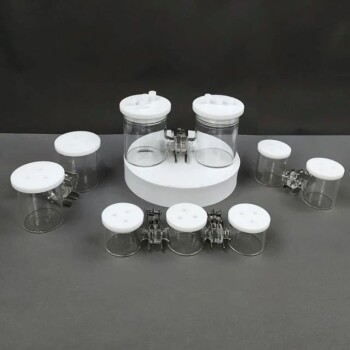
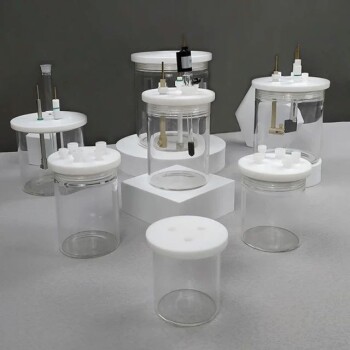
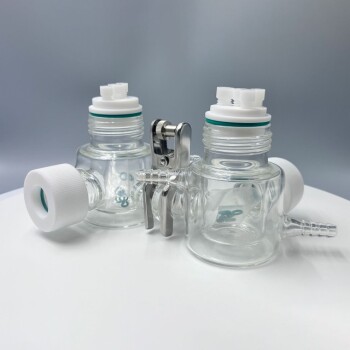
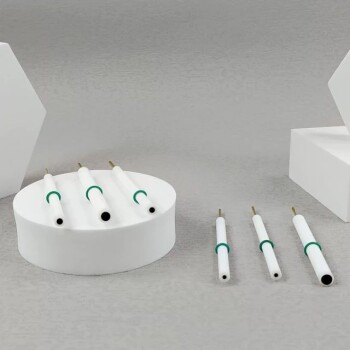
The three-electrode glass electrolytic cell serves as a precision filter for identifying the most effective catalyst formulations. In the context of IrSn/MMT catalysts, this setup creates a standardized aqueous environment that isolates the performance of active sites, allowing researchers to rapidly determine the optimal ratio of metal loading by measuring Oxygen Evolution Reaction (OER) activity without auxiliary interference.
Core Takeaway The three-electrode system is essential for the preliminary screening of IrSn/MMT catalysts because it eliminates external electrical interference. This isolation allows for the precise detection of OER performance at defined voltages, facilitating the rapid identification of the most efficient metal loading ratios.
The Architecture of the Testing Environment
Establishing Standardization
To accurately screen IrSn/MMT catalysts, consistency is paramount. The three-electrode glass electrolytic cell provides a standardized aqueous electrochemical testing environment.
The Three-Electrode Configuration
This specific configuration enables precise measurements by assigning distinct roles to each component. The setup utilizes the catalyst-coated electrode as the working electrode, ensuring the focus remains strictly on the material being tested.
Supporting Components
To complete the circuit and maintain reference potential, the system employs a platinum wire as the counter electrode and a silver/silver chloride (Ag/AgCl) electrode as the reference.
Isolating Catalyst Performance
Eliminating Auxiliary Interference
A primary challenge in electrochemical testing is noise or interference from the testing equipment itself. The three-electrode configuration specifically addresses this by eliminating auxiliary interference.
Focusing on Active Sites
By removing interference, the cell allows researchers to see the true behavior of the catalyst's active sites. This clarity is critical when evaluating the subtle performance differences between various catalyst formulations.
Driving the Screening Process
Detecting OER Performance
The primary metric for these catalysts is their ability to facilitate the Oxygen Evolution Reaction (OER). This cell setup enables the detection of OER performance at specifically defined voltages.
Identifying Optimal Loading Ratios
The ultimate goal of this preliminary screening is optimization. By testing the catalyst under these controlled conditions, researchers can rapidly identify the optimal metal loading ratios for the IrSn/MMT composite.
Critical Considerations for Accuracy
Dependency on Electrode Integrity
While the system eliminates interference, it relies heavily on the specific electrode types mentioned. The accuracy of the screening is contingent upon the platinum wire and Ag/AgCl reference functioning correctly to maintain the standardized environment.
Scope of Screening
It is important to note that this setup is designed for preliminary performance screening. It isolates active sites for rapid comparison but is specifically tailored for detecting OER performance in an aqueous setting.
Making the Right Choice for Your Goal
To maximize the utility of the three-electrode glass electrolytic cell in your research, consider your specific optimization targets.
- If your primary focus is Rapid Formulation: Use the defined voltage settings to quickly compare different metal loading ratios and identify the most active composition.
- If your primary focus is Mechanism Analysis: Leverage the interference-free environment to isolate the specific OER activity of the catalyst's active sites without signal noise.
By strictly adhering to this standardized configuration, you ensure that your catalyst screening is both rapid and data-driven.
Summary Table:
| Feature | Role in IrSn/MMT Catalyst Screening |
|---|---|
| Working Electrode | Houses the catalyst-coated material for direct performance measurement. |
| Counter Electrode | Platinum wire that completes the circuit for stable electrochemical flux. |
| Reference Electrode | Ag/AgCl electrode ensuring precise potential control during OER testing. |
| Environment | Standardized aqueous setup providing interference-free performance data. |
| Core Goal | Rapid identification of optimal metal loading ratios via OER activity. |
Accelerate Your Catalyst Research with KINTEK Precision
Maximize the accuracy of your electrochemical screening with KINTEK’s high-performance laboratory solutions. Whether you are optimizing IrSn/MMT catalysts or exploring advanced energy materials, KINTEK specializes in high-quality electrolytic cells and electrodes designed to eliminate interference and deliver reproducible results.
Beyond electrochemistry, our comprehensive portfolio supports your entire lab workflow:
- High-Temperature Processing: Muffle, tube, and vacuum furnaces for material synthesis.
- Sample Preparation: Precision crushing, milling systems, and hydraulic presses.
- Advanced Reactors: High-temperature high-pressure reactors and autoclaves for complex reactions.
- Thermal Management: ULT freezers, cold traps, and freeze dryers for sensitive samples.
Ready to upgrade your research capabilities? Contact us today to discover how KINTEK’s specialized equipment and consumables can enhance your lab's efficiency and data precision.
References
- Iveta Boshnakova, Evelina Slavcheva. Bimetallic Ir-Sn Non-Carbon Supported Anode Catalysts for PEM Water Electrolysis. DOI: 10.3390/inorganics13070210
This article is also based on technical information from Kintek Solution Knowledge Base .
Related Products
- H Type Electrolytic Cell Triple Electrochemical Cell
- PTFE Electrolytic Cell Electrochemical Cell Corrosion-Resistant Sealed and Non-Sealed
- Side Window Optical Electrolytic Electrochemical Cell
- Electrolytic Electrochemical Cell Gas Diffusion Liquid Flow Reaction Cell
- Electrolytic Electrochemical Cell with Five-Port
People Also Ask
- What is a H type cell? A Guide to Divided Electrochemical Cells for Accurate Experiments
- How should the electrolyte be prepared and added to the H-type electrolytic cell? Best Practices for Purity and Safety
- What is the technical necessity of using an H-type electrolytic cell for NO3RR tests? Protect Your Ammonia Yields
- How does the design of an H-type electrolytic cell benefit the neutral water electrolysis process for metal recovery?
- What is the primary function of an H-type electrolytic cell in NitRR? Ensure Accurate Product Yields