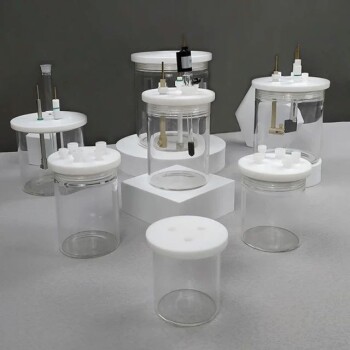
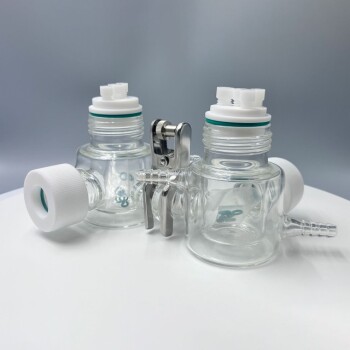
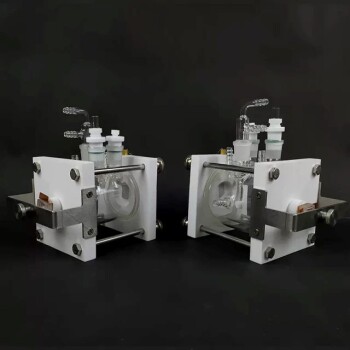
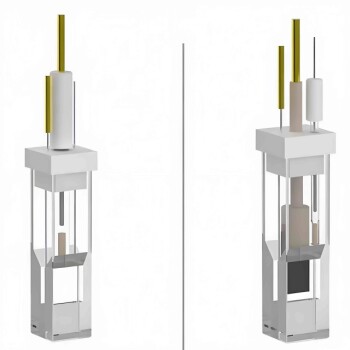
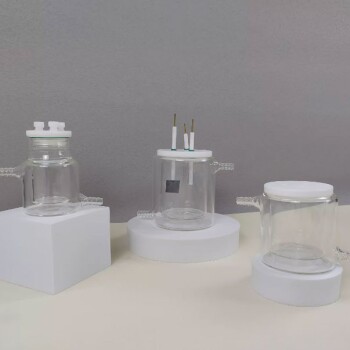
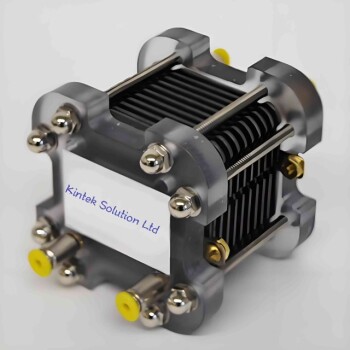
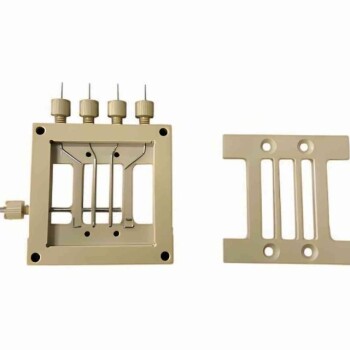
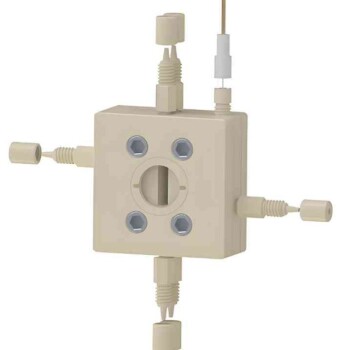
The role of a three-electrode system in simulated corrosion testing is to isolate the electrochemical behavior of a specific material without interference from the measurement circuit itself. By utilizing a working electrode (the sample), a reference electrode, and an auxiliary electrode, the system decouples voltage measurement from current flow. This ensures that the data collected—specifically polarization current and potential—reflects only the corrosion properties of the coated specimen.
By separating the current-carrying path from the potential-sensing path, the three-electrode system eliminates polarization interference. This provides the high-precision environment required to accurately determine coating protection efficiency and charge transfer resistance.
The Anatomy of the Configuration
The Working Electrode (WE)
The working electrode is the specific coated specimen or material sample undergoing testing (e.g., 8620 steel or AISI 420). This is the interface where the corrosion reaction occurs and is the sole focus of the analysis.
The Reference Electrode (RE)
This component, often a saturated calomel electrode (SCE) or silver/silver chloride electrode, establishes a stable, unchanging potential baseline. Its purpose is strictly to provide a reference point for voltage measurement; it does not carry significant current.
The Auxiliary (Counter) Electrode (CE)
Also known as the counter electrode, this is typically made of inert, conductive materials like graphite, platinum wire, or platinum-titanium mesh. Its role is to complete the closed-loop circuit, facilitating the flow of current through the electrolyte without participating in the reaction at the working electrode.
How the System Ensures Accuracy
Decoupling Potential and Current
The primary technical advantage of this system is the decoupling of potential control and current measurement. The instrumentation forces current to flow between the working electrode and the auxiliary electrode, while potential is measured between the working electrode and the reference electrode.
Eliminating Polarization Interference
In simpler systems, the electrode measuring voltage also carries current, leading to polarization errors. The three-electrode setup ensures that polarization interference occurs only at the auxiliary electrode, which is ignored during analysis.
Ensuring Signal Purity
This configuration guarantees that the measured electrochemical signals originate solely from the interface between the test coating and the electrolyte. This isolation is critical for obtaining authentic corrosion kinetic data.
Advanced Testing Capabilities
Determining Critical Parameters
This setup allows high-precision electrochemical workstations to calculate vital metrics. Researchers can accurately determine corrosion potential, breakdown potential, and polarization resistance.
Real-Time In-Situ Monitoring
Because the system is stable, it enables real-time monitoring of a coating’s anti-corrosion state, even under high-temperature and high-pressure conditions. This allows for the collection of continuous kinetic data without needing to depressurize the system or remove the sample.
Common Pitfalls to Avoid
Counter Electrode Instability
While the auxiliary electrode is intended to be inert, using materials with poor conductivity or chemical stability can disrupt the circuit. It is essential to use high-purity graphite or platinum to ensure uniform current flow.
Reference Potential Drift
The accuracy of the entire system hinges on the stability of the reference electrode. If the reference electrode (e.g., Ag/AgCl) degrades or drifts, the potential baseline shifts, rendering the evaluation of corrosion behavior invalid.
Making the Right Choice for Your Goal
To maximize the value of your corrosion testing, align your experimental setup with your specific analytical needs:
- If your primary focus is determining coating lifespan: Prioritize the precise measurement of polarization resistance and charge transfer resistance to quantify protection efficiency.
- If your primary focus is process monitoring: Utilize the system’s ability to perform in-situ monitoring to track corrosion kinetics continuously under operating pressures and temperatures.
The three-electrode system is not just a testing apparatus; it is the fundamental standard for ensuring that your corrosion data is physically representative and chemically accurate.
Summary Table:
| Component | Material Example | Primary Function |
|---|---|---|
| Working Electrode (WE) | Coated Steel (8620/AISI 420) | Interface where corrosion reaction occurs (Test Sample). |
| Reference Electrode (RE) | Saturated Calomel (SCE) / Ag/AgCl | Provides a stable potential baseline for voltage sensing. |
| Auxiliary Electrode (CE) | Graphite / Platinum / Pt-Ti Mesh | Completes the circuit to facilitate current flow. |
Elevate Your Corrosion Research with KINTEK
Precision in electrochemical testing starts with the right equipment. KINTEK specializes in advanced laboratory solutions, offering high-performance electrolytic cells and electrodes specifically designed for high-temperature and high-pressure simulated environments.
Whether you are analyzing coating lifespan with our specialized high-pressure reactors or conducting in-situ monitoring of corrosion kinetics, our comprehensive range of high-purity graphite and platinum consumables ensures signal purity and data accuracy.
Ready to optimize your lab's efficiency? Contact us today to discover how KINTEK's expertise in crushing, milling, and electrochemical tools can support your research goals.
References
- Cheng‐fu Chen. Polystyrene Coating on APTES-Primed Hydroxylated AA2024-T3: Characterization and Failure Mechanism of Corrosion. DOI: 10.3390/solids4030016
This article is also based on technical information from Kintek Solution Knowledge Base .
Related Products
- H Type Electrolytic Cell Triple Electrochemical Cell
- PTFE Electrolytic Cell Electrochemical Cell Corrosion-Resistant Sealed and Non-Sealed
- Customizable PEM Electrolysis Cells for Diverse Research Applications
- Electrolytic Electrochemical Cell Gas Diffusion Liquid Flow Reaction Cell
- Electrolytic Electrochemical Cell with Five-Port
People Also Ask
- What is a H type cell? A Guide to Divided Electrochemical Cells for Accurate Experiments
- How should the electrolyte be prepared and added to the H-type electrolytic cell? Best Practices for Purity and Safety
- What is the technical necessity of using an H-type electrolytic cell for NO3RR tests? Protect Your Ammonia Yields
- How does the design of an H-type electrolytic cell benefit the neutral water electrolysis process for metal recovery?
- What is the primary function of an H-type electrolytic cell in NitRR? Ensure Accurate Product Yields